

When the Machine Is More Than a Machine. What the First Day of AFTER HEIDEGGER Revealed
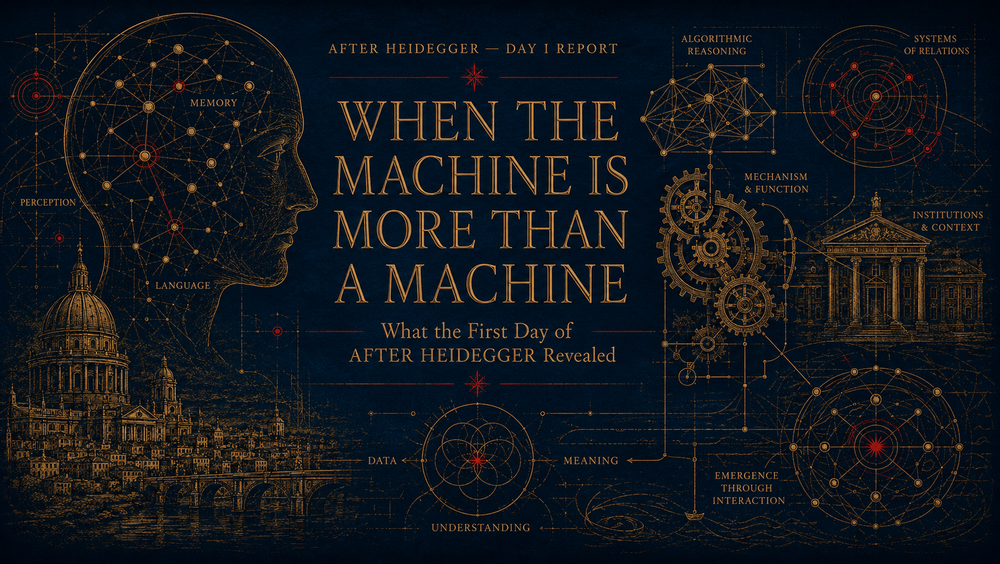
When the Machine Is More Than a Machine
What the First Day of AFTER HEIDEGGER Revealed
On 26 August, the international online conference AFTER HEIDEGGER: From Technology to the Architecture of the World, organised by the European Academy of Sciences of Ukraine, opened with a deceptively simple question:
What, exactly, are we talking about when we talk about a machine?
At first sight, the answer seems obvious. A machine is a technical object. It has components, performs operations, consumes energy, produces a result. We can take it apart, describe it, measure it and perhaps improve it.
However, the first day of the conference was devoted to showing why this apparently obvious answer is no longer enough.
The discussion commenced with Heidegger and his understanding of technology, but it did not remain there. The participants moved from technology as an object to technology as a way of revealing the world; from machines to algorithms, artificial intelligence and data; from technology to human perception; and finally to a more fundamental question:
If a machine cannot be understood by looking at the machine alone, then where does its architecture actually begin?
That question shaped the internal logic of the very first day.
The old machine and the new world
The first discussion, Beyond Gestell: What Discloses the World Today?, returned to one of Heidegger's most consequential ideas: technology is not simply a collection of tools.
For Heidegger, the essence of technology is not itself technological. The important question is what technology does to the way the world becomes visible to us. Through Gestell, or Enframing, nature, things and eventually human beings can come to appear primarily as resources — something available for use, extraction, calculation and control.
This idea acquired a new urgency during the discussion because the technological environment has changed dramatically since Heidegger's time.
Today, the world is increasingly encountered through algorithms, digital networks, artificial intelligence, databases, surveillance systems, simulations and streams of data. The question is therefore no longer only whether technology changes what we do. It is whether it changes what we are able to see in the first place.
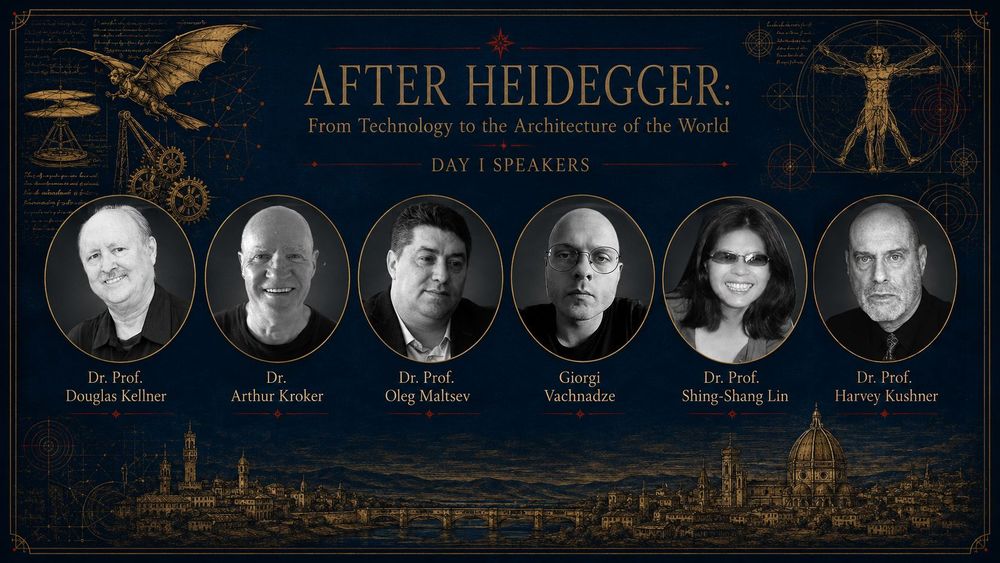
Professor Douglas Kellner approached the problem through Heidegger's distinction between technology and the essence of technology. The danger, as he presented it, lies not in technology being inherently good or evil, but in a technological worldview that reduces beings to objects of use.
His discussion of Gelassenheit pointed towards another possible relation to the world — one in which things are encountered not merely according to their usefulness.
Professor Arthur Kroker pushed the question further. Rather than living in a world that had simply moved «after Heidegger», he suggested that we might still be living through the historical process Heidegger described. Artificial intelligence, humanoid robots, genetics, drone warfare and large language models are accelerating technological transformation, while at the same time the social and cultural environment itself appears increasingly unstable and difficult to define.
The result is a peculiar tension. Technology is becoming more powerful and more deeply embedded in human existence at precisely the moment when the reality it is supposed to organise appears increasingly uncertain.
Giorgi Vachnadze returned to Heidegger's distinction between older forms of technology and modern technological revealing. Earlier forms could be understood through poiesis — a bringing-forth that worked with nature. Modern technology, by contrast, challenges nature to provide energy that can be extracted, stored and distributed. The concern is not merely that machines consume resources, but that the same logic can eventually be applied to human beings.
Professor Shing-Shang Lin emphasised another side of the problem: every form of revealing also conceals something. Technology may disclose the world in a particular way while making other possibilities of disclosure less visible. The danger, therefore, lies not simply in technological development, but in forgetting what has been concealed by the technological mode of revealing.
Professor Harvey Kushner approached the question from a different direction, comparing Heidegger's concerns with Marshall McLuhan's understanding of media. His proposal was that art can create a certain distance from technological immersion. A smartphone, for example, is normally something we use. Place it in a glass case in a gallery, however, and the object changes status. We stop using it and begin looking at it.
The machine has not changed. Our relationship to it has.
That unique shift contains an important insight: sometimes we can see a technological environment only when we are given enough distance from it to notice what it is doing to us.
But where does the machine ‘begin’?
At this point, the discussion had already moved well beyond the question of whether technology is beneficial or dangerous. A more difficult problem had appeared.
If technology participates in the way the world is disclosed, if digital systems organise information and if artificial intelligence increasingly interacts with human perception and action, then perhaps the machine should not be treated as an isolated object at all.
This was the central question of the second discussion:
Where does the architecture of the machine begin?
Douglas Kellner offered a direct answer: in the interaction between the human mind, technoculture and machines. The contemporary technological environment includes digital databases, algorithms, planetary networks, artificial intelligence, simulations, satellites, drones and smart infrastructure. These systems do not merely represent reality; increasingly, they participate in determining how reality is perceived and understood.
Arthur Kroker approached the same problem from the opposite direction. For him, the contemporary technological environment does not have an obvious beginning or end. It is a constantly shifting system of algorithms, coded procedures, communication networks and value systems that increasingly determine what — and who — will be selected, processed and «harvested».
The machine, in this view, is no longer simply something standing outside us. It has become part of the environment in which we think, communicate and understand ourselves. And yet this still leaves a question unanswered.
If the machine is part of a system, perhaps we should stop asking where the machine is and begin asking what system makes the machine necessary.
This is where Professor Oleg Maltsev's contribution became a crucial turning point in the discussion.
The machine does not start with the machine
Professor Oleg Maltsev proposed that the architecture of the machine cannot be understood in isolation. Before attempting to describe the machine, one must first establish the model of the system in which the machine exists.
This sounds like a small change in perspective. It is not. It changes the object of research.
Instead of looking at a machine and asking what it consists of, we first ask what elements are interacting around it, what function has to be organised, and why a machine is required at all.
Referring to Academician Popov, Maltsev described a six-element model involving individual memory and individual consciousness, civilisational memory and civilisational consciousness, and group memory and group consciousness. These elements should not be imagined as isolated compartments. They constantly interact with one another.
And this is precisely where the question of the machine becomes interesting.
If there is only one element, there may be no need for a machine. But when several elements begin interacting, a new problem appears: the interaction itself has to be organised.
This is the point at which, in Maltsev's formulation, the machine becomes necessary. The machine is therefore not the starting point. Interaction is the starting point.
The machine emerges as an answer to the need to organise that interaction.
This also explains why the same machine can have completely different meanings in different systems. A tool standing by the roadside tells us very little. We need to know who uses it, what task it performs, what system it belongs to, what other elements interact with it and what function it is designed to maintain. Only then does its architecture become visible.
The implication is especially important when we turn to contemporary systems such as artificial intelligence. It is tempting to begin with the technology itself: its architecture, its algorithms, its computational power or its capabilities. Maltsev's approach suggests beginning one step earlier.
What system requires this machine?
And: what interactions make the machine necessary?
From the object to the architecture
This shift may be the most important result of the first day.
- A machine viewed as an object is something we can describe.
- A machine viewed as an element of a system is something we can begin to understand.
The difference matters because contemporary technology increasingly operates through systems rather than isolated devices. Digital networks, algorithms, databases, artificial intelligence, surveillance systems and smart infrastructure are interconnected. Their functions emerge through interaction.
The same is true of the human side of the system. Individual consciousness does not exist in complete isolation from group structures, collective memory or broader civilisational processes. These levels interact, influence one another and create demands for new forms of organisation.
The machine, then, should not be reduced to the thing we can point at. Its architecture begins in the relations that make its function necessary.
This does not make the machine less concrete. It makes the object of research larger.
Why does this matter?
It matters because the usual question — What can this technology do? — is becoming increasingly insufficient.
A technology can perform a particular operation, but its significance depends upon the system in which that operation takes place. The same technical capability can serve research, medicine, communication, surveillance, economic extraction or warfare. Understanding the machine therefore requires understanding the environment of interactions that gives its capabilities a particular function.
This was one of the underlying concerns running through the first day's discussions.
Kellner raised the question of who controls increasingly autonomous digital systems. Kroker examined the growing integration of human life with systems of data extraction and algorithmic selection. Lin returned to the problem of what technological revealing makes visible and what it conceals. Kushner asked whether art can create enough distance for us to see technological immersion itself.
Maltsev's contribution connected these concerns at another level.
Before asking what the machine does to the world, we must ask what world of interactions produces the machine in the first place. That is why the question of architecture matters.
The first step towards the Architecture of the World
The first day of AFTER HEIDEGGER therefore did not attempt to produce a final definition of the machine. Instead, it changed the position from which the machine should be studied.
The machine cannot be adequately understood as an isolated technical object. Nor can it be understood solely through its components. Its architecture becomes visible when we examine the system in which it emerges, the elements that interact within that system, and the function that has to be organised.
This leads to a simple progression:
OBJECT → SYSTEM → INTERACTION → FUNCTION → MACHINE
The machine appears at the end of this sequence, not at the beginning.
And this may be why the first day matters beyond the particular discussions that took place on 26 August.
If we start with the machine, we see a technical object. If we start with the system, we start to perceive why the machine exists. And once we realise that, we ought to raise a more significant question:
What kind of world produces the machines through which it understands and organises itself?
That question leads directly to the next stage of the conference. The four-day programme moves from the Architecture of the Machine to the Architecture of Action, then to the Architecture of Memory, and finally to the Architecture of the World.
The first day has therefore done something quite precise. It has ‘pushed’ the machine from the centre of the picture to its proper place within a larger architecture. And once that architecture becomes visible, the machine is no longer simply something humanity builds.
It becomes part of the system through which humanity builds its world.