
Twenty-four thinking skills: An Anatomy of a Critical Thinking Textbook for Adults and Children
Twenty-four thinking skills: An Anatomy of a Critical Thinking Textbook for Adults and Children
Prof. Dr. Oleg Maltsev
European Academy of Sciences of Ukraine
This essay roots in my first meeting with Professor Paul Frijters (Academia Libera Mentis), a remarkable scholar whose work has immediately revealed a strong intellectual affinity with the mission of the European Academy of Sciences of Ukraine. Our conversation led to the idea of a shared intellectual experiment: to approach one of the questions that stands at the centre of both our institutions — what critical thinking actually is, how it develops, and how it can be preserved under conditions in which independent thought is increasingly under pressure.
From this meeting emerged the proposal that Paul and I should each write a ten-page paper on the same subject during the summer of 2026, approaching the problem from our respective academic environments in Belgium and Ukraine. What commenced as an exchange between two scholars thus became a broader inquiry into the nature of critical thinking, the conditions required for its development in young minds, and the growing institutional and cultural challenges it faces in contemporary societies.
Abstract
This article presents a conceptual map of the critical thinking textbook ‘Think for Yourself’, designed for two target audiences: adults and children. It examines twenty-four skills, grouped into parallel courses, each covering twelve topics. The pedagogical logic of the structure is analysed: from working with facts and sources to independent judgement. The use of caricature as an independent teaching tool is justified. The core of the textbook and a system of eight key concepts are formulated.
Keywords: critical thinking, pedagogy, textbook, verification skills, media literacy, logical fallacies, manipulation, independent judgement.
Statement of the problem
Today, an adult receives more information in a single day than a resident of a medieval town received in a whole year. This is no exaggeration — it is a structural characteristic of the environment in which both adults and children live. The problem has long since ceased to be one of access to information. The problem has become its processing.
A person who is unable to verify information does not simply make mistakes. They become a resource for those who know how to manipulate attention. Advertising, political rhetoric, social media, rumours, peer pressure – all these systems operate more effectively when the audience does not ask questions. In this context, critical thinking is a practical defence mechanism, rather than an academic discipline.
Meanwhile, the very phrase ‘critical thinking’ has become distorted in popular usage. It is confused with nit-picking — the habit of attacking any assertion; with suspicion — the fear of trusting anyone; and with nihilism — the rejection of all authority. None of these three has anything to do with what is meant by critical thinking in the pedagogical tradition.
Critical thinking is the examination of the basis of a thought. It is the ability to pause before drawing a conclusion and ask: ‘What is this based on?’ The textbook Think for Yourself is structured around this axis and breaks it down into twenty-four specific skills — twelve for adults, twelve for children. This article presents a conceptual map of these skills and explains the rationale behind their selection.
The textbook’s central axis and system of key concepts
A textbook constructed without a central axis breaks down into a collection of topics. The reader learns individual rules but does not acquire a tool that is applicable beyond the specific situation described in the text. A critical thinking textbook is particularly vulnerable to this pitfall: listing twenty logical fallacies is not difficult, but without an understanding of why, the reader will have forgotten the list within a week.
The central theme of this textbook is encapsulated in a single phrase: ideas must be tested, especially one’s own. Everything else stems from this. It contains two assertions. The first: testing an idea is an action to be taken, not a position to be adopted. Second: it is easier to test other people’s thoughts than one’s own, because by definition, one is biased towards one’s own.
Around this core, a constellation of eight concepts is formed, each of which is developed in the handbook as a skill rather than a definition.
A fact is something that can be independently verified, regardless of the speaker’s identity. A fact does not cease to be a fact simply because it is inconvenient, nor does it become a fact merely because it is stated by an authority figure.
An opinion is an assessment or interpretation. An opinion is no worse than a fact; it is simply different in nature. The mistake lies not in holding an opinion, but in mistaking it for a fact or failing to justify it.
An argument is a structure comprising three elements: a thesis, a premise, and evidence. An argument without evidence is a claim. A claim without a premise is pressure.
A source is the origin of information. An assessment is based on three questions: is the source competent on this specific issue; does it have access to the relevant facts; and does it have a personal interest in the information being perceived in a particular way?
Manipulation is an influence that bypasses rational judgement through emotional reactions. Fear, urgency, shame, guilt, false dilemmas, and appeals to the majority all share one common feature: they rush the decision.
Emotion is a signal about a person’s state of mind, not information about reality. Anger indicates that something has upset you. It does not tell you who is right. Fear signals a perceived threat, but not whether it is real.
A logical fallacy is a line of reasoning that appears correct but contains a hidden flaw. The three most common types are: confusing temporal sequence with cause and effect; generalising from a single instance; and shifting from criticising a person to criticising their argument.
Self-reflection is the ability to recognise one’s own biases, desires and fears as factors that distort one’s conclusions. It is the most difficult skill to master, because people tend to see themselves as the least likely source of error.
The reader does not simply memorise what manipulation is; they learn to pause when they feel pressure. This is the difference between knowing the definition and mastering the skill.
Adult course: twelve skills
The adult course covers the full spectrum of concepts. It is designed for people who work with information in professional and social contexts. The skills progress from basic information handling to managing one’s own reactions and forming an independent position.
1. Working with information (skills 1–4)
The first skill is distinguishing between facts, opinions, interpretations and conclusions. This is the starting point of the course. Anyone who cannot distinguish between ‘sales have fallen by twelve per cent’ and ‘the sales department is performing poorly’ cannot move forward. Both statements may be true, but they operate at different levels: the first describes something measured, the second something interpreted. Between them lies the question of causes, and causes require separate verification.
The second skill is the probing question. ‘How do you know that?’ establishes the status of the information without being either aggressive or distrustful. Rumour, hearsay, personal observation, an official document, and scientific research are different categories. Treating them all the same amounts to a systematic error.
The third skill is evaluating the source. Fame does not equal competence. An actor who speaks publicly about medicine remains an actor. A journalist writing about quantum physics without a relevant degree does not become a physicist. The three criteria—competence, access to facts, and the absence of personal interest — apply to any source, regardless of its popularity.
The fourth skill is distinguishing between an argument and a statement. ‘I’m sure’, ‘everyone does it’, ‘it’s obvious’ — these are not arguments. An argument requires a thesis, a basis and evidence. The absence of any one of these three turns a statement into pressure.
2. Dealing with fallacies and pressure (skills 5–8)
The fifth skill is recognising logical fallacies. Priority is given to three types that occur more frequently than others. False cause: event A precedes event B, therefore A caused B. False dichotomy: you are either with us or against us. Overgeneralisation: a single case is used to describe the whole group. This skill does not require knowledge of Latin terms. It requires the ability to pause and ask: ‘Has the connection been proven, or is it merely assumed?’
The sixth skill is recognising manipulation. The main indicator is a strong emotional reaction combined with a sense of urgency. The strategy for countering this is: strong emotion, a pause, a question, verification, and only then a decision. The pause here acts as a resistance to the pressure tactic.
The seventh skill is distinguishing between emotion and decision. A decision made whilst in a state of intense emotion often turns out to be something one later regrets. Emotion serves a specific moment, whilst a decision has consequences beyond it. The process: name the emotion, identify its source, return to the facts, and make a decision.
The eighth skill is information hygiene. ‘I just forwarded it’ — this amounts to participating in the dissemination of unverified information. A person who forwards unverified information becomes a link in the rumour chain, even if they are not the author. The rule is: if I don’t know, I don’t forward it; if I’m in doubt, I check it; if I haven’t checked it, I keep quiet.
3. Dealing with uncertainty and oneself (skills 9–12)
The ninth skill is dealing with uncertainty. The culture of quick opinions exerts pressure: you have to make up your mind immediately. This pressure often forces people to replace the unknown with fiction. ‘I don’t know yet’ is an intellectually honest stance, and it requires more courage than an immediate opinion: in an environment where everyone is rushing to have their say, restraint looks like weakness. In reality, it is precision.
The tenth skill is self-examination. People are deceived not only by the words of others, but also by their own desire to believe what is convenient. The textbook suggests four questions: what do I want to believe is true in this situation; what am I afraid of; whom do I excuse in advance; and whom accusing before I’ve even considered the facts? They reveal the gap between desire and reality — and it is precisely there that honest scrutiny is possible.
The eleventh skill is civilised debate. A personal attack (‘you’re wrong because you’re a bad person’) is a logical fallacy and, at the same time, a sign that one has run out of arguments. The structure: thesis, argument, question to the opponent, counter-argument, conclusion. A personal attack does not fit into any of these steps.
The twelfth skill is independent judgement. Formulating your own position with justification and acknowledging its limitations. ‘I think this because…’ is the first step. ‘I’m not sure about…’ is honesty. ‘My opinion will change if…’ — intellectual flexibility. These three elements together distinguish an opinion from a position.
Children’s course: the same skills, a different starting point
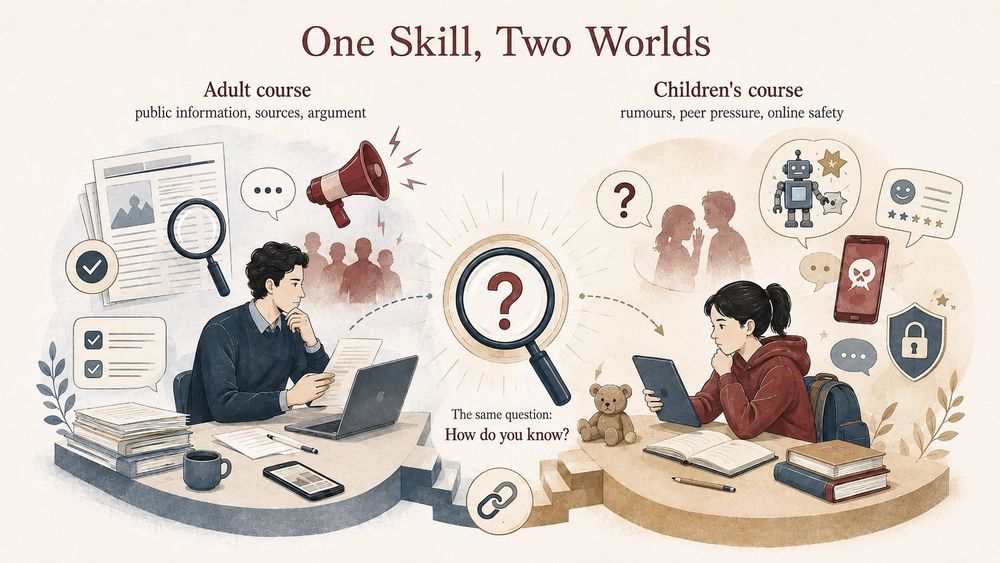
The children’s course mirrors the adult course in structure: twelve chapters, the same eight concepts, the same framework. The difference lies in the entry point. Children do not deal with business negotiations or political news. They deal with rumours in the classroom, peer pressure, toy adverts, a suspicious message on their phone, or a row with a friend.
This is not a simplified version of the adult course. Verifying a source in a children’s context takes the form of asking ‘who said it first and how do they know?’ — rather than an academic analysis of methodology. The process is the same, but the situation is different.
1. Basic differences (skills 1–4)
The first skill in the children’s course is distinguishing between ‘I know’, ‘I think’ and ‘I think so’. Children tend to confuse these three states, especially when their feelings are strong. ‘I think Petya did it on purpose’ and ‘Petya did it on purpose’ are fundamentally different statements, and children often fail to notice the difference between them.
The second skill is distinguishing between a fact and an evaluation. ‘Petya was late’ is a fact. ‘Petya is irresponsible’ is a conclusion that requires further information: is he always late, was there a reason, and was it his choice or due to circumstances? The ability not to jump from an event to a label is one of the fundamental skills for treating people fairly.
The third skill is asking ‘why?’. In children’s experiences, this question is often perceived by adults as a sign of disrespect. The textbook addresses this conflict directly: ‘Why?’ is a request to understand the reasoning behind something, not a challenge. Asking it calmly and accepting the answer is a skill that fosters the habit of seeking reasons rather than mechanically following instructions.
The fourth skill is working with what one hears. ‘The whole class says so’ is not proof. The number of people repeating information does not make it more reliable. Four questions: who saw it themselves; who said it first; can we check with an adult; is there any evidence?
2. Pressure and safety (skills 5–8)
The fifth skill is peer pressure. ‘You’re not up to it’, ‘everyone does it’, ‘be like us’ — are standard phrases used to exert peer pressure. The textbook suggests four questions to check: am I being persuaded or pressured; is it safe; do I want to do this myself; can I refuse? It is important that peer pressure is viewed not as malicious intent, but as a mechanism that operates automatically in any group.
The sixth skill is the ability to say ‘no’. Refusal requires not only a decision, but also the words to express it. A child who disagrees internally but cannot voice their refusal remains vulnerable. The handbook offers phrases that require neither aggression nor explanation: ‘no’, ‘I don’t want to’, ‘I’ll ask first’, ‘that’s not right for me’.
The seventh skill is understanding advertising. Advertising sells not only a product, but also an image of who you will become by buying it. This is no secret conspiracy — it is simply how advertising works. Four questions: what am I being shown; what are they promising; what are they hiding; do I need this or do I simply want it? The distinction between a want and a need, which is introduced here, will subsequently arise every time in adult life when making any financial decision.
The eighth skill is online safety. The children’s equivalent of digital hygiene. A ‘you’ve won’ message on your phone requires the same verification as a rumour in the classroom: who sent it, how do they know, and do you need to provide your details? The steps: don’t click straight away; don’t send any details; show an adult; check the source.
3. Thinking and independence (skills 9–12)
The ninth skill is emotions and thoughts. ‘I got angry — so he must be to blame’ is a childish way of confusing emotion with a conclusion. The process: what am I feeling; why; what actually happened; what is the best thing to do after taking a moment’s pause. Following this sequence does not suppress the emotion — it places it in its proper place within the decision-making process.
The tenth skill — the consequences of one’s actions. Thinking several steps ahead is a skill that has not yet become second nature to children. Four questions: what will happen in a minute; what will happen this evening; who will be upset; can it be put right?
The eleventh skill is honest debate. Calling your opponent names is not a victory. It’s a sign that you’ve run out of arguments. The framework: ‘I think this because…’; ‘Why do you think that?’; ‘Let’s check’; ‘Perhaps I was wrong’. The last phrase is the hardest, because it requires acceptance: being wrong is not a disgrace.
The twelfth skill is drawing one’s own conclusion. ‘I think this because…’ is the first step. ‘I’m not sure about…’ is honesty. ‘I need to check…’ is the next step. A child who can say these three phrases has mastered a tool that isn’t tied to any specific situation.
Cartoons as a teaching tool
Each chapter of the textbook is accompanied by a cartoon. This is a distinct method of conveying content, not merely a decorative feature. The cartoon and the text appeal to different channels of perception.
A headteacher who stamps ‘Guilty’ on an employee without reading the facts conveys the content of the first chapter in a fraction of a second. A shop assistant with a clock without hands and a sign ‘Today only’ — this captures the essence of the sixth chapter on manipulation. The visual image does not compete with the text — it reinforces what the text describes.
The textbook features three visual languages. The ‘Crocodile’ style — a Soviet tradition of social satire — is used for bureaucratic and manipulative situations: large figures, grotesque imagery, a clear moral, and a minimum of detail. French caricature — for intellectual errors: fine lines, irony, an absurd situation whilst the characters appear normal on the surface. Italian theatrical caricature — for emotional and group situations: masks, open spaces, movement, theatrical composition.
Each caricature ends with a one-line caption that acts as a mnemonic anchor. ‘The manipulator is always in a hurry to think for you.’ ‘Coincidence has donned the costume of cause.’ ‘The rarest form of courage is not to pretend you know.’ The caption is memorised separately from the image and may come to mind the moment the skill is applied.
In the children’s version, the same three languages are used, but on an adapted scale: the characters are more recognisable, and the grotesque elements are softer. A child must be able to see themselves or their surroundings in the cartoon — without this, it does not work didactically.
The pedagogical logic of the sequence
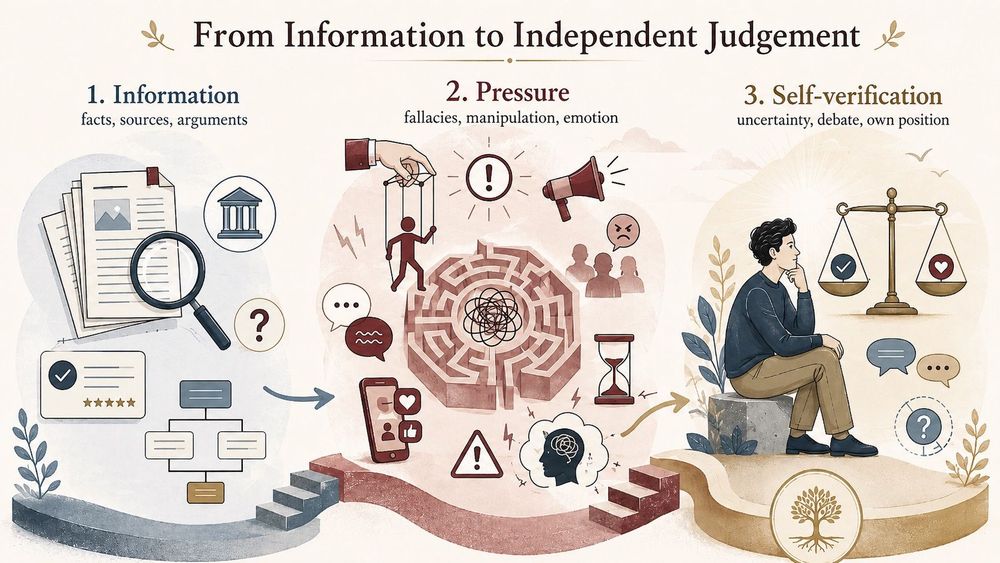
The order of the twelve skills in each course is not arbitrary. It moves from the external to the internal.
The first four skills involve processing information received from outside: fact, verification question, source, argument. This forms the foundation without which all subsequent steps are impossible.
Skills five to eight involve operations under pressure: logical fallacies, manipulation, emotion, and information hygiene. Here, the external environment actively attempts to circumvent rational scrutiny. Without the first four skills, a person will not recognise the pressure in time.
Skills nine to twelve are inward-looking: uncertainty, self-verification, debate, and one’s own position. They are the most complex because they require applying verification to oneself. A person who is unable to verify external information lacks the tools to verify their own biases as well.
This three-tiered structure—information, pressure, self-verification—forms the hidden backbone of the textbook. The reader need not be aware of it, but it is precisely this structure that ensures the cumulative effect: each subsequent skill builds upon the previous one.
Dual targeting as a pedagogical challenge
A textbook aimed at both adults and children faces an obvious difficulty: the two audiences have different experiences, different vocabularies and different contexts of use. It is difficult to bring them together in a single text without compromising either.
The solution adopted in this textbook is that the two courses exist as two separate books within a single volume. They are parallel in structure but independent in content. Adults read their own course, and children read theirs. At the same time, this parallel structure creates an opportunity for shared reading: a parent and child, studying the same topic in different versions, acquire a common vocabulary for conversation.
Here, the textbook’s main pedagogical idea is probably one that is not explicitly stated, but is built into its structure. Adults tell children: ‘Think for yourself.’ But if an adult and a child have worked through different chapters on the same skill, they have the opportunity to test each other. A child who understands manipulation might ask an awkward question. An adult who understands peer pressure can talk to the child in their own terms — not in a lecturing manner, but as equals.
Cartoons also serve as a connecting element here. An image requires no translation between courses. The same image of a shop assistant with a clock without hands works for both a seven-year-old and a forty-year-old — the situations in which the skill is applied may differ, but the image remains the same.
Conclusion
The twenty-four skills discussed in this article do not cover everything related to critical thinking. They have been selected on the basis of a single criterion: practical applicability without the need for specialised training. A person who has mastered them does not become a logician or a philosopher. They become someone who knows how to pause before drawing a conclusion.
Such a person is less susceptible to manipulation. They are less likely to make decisions whilst in an emotional state. They realise that a rumour remains just a rumour, no matter how many people repeat it. And they are capable of changing their mind if there are grounds for doing so — which is not a sign of weakness, but of sound thinking.
The ‘Think for Yourself’ textbook is based on the premise that critical thinking is a skill, not a talent. A skill is developed through practice, and practice requires a specific tool. There is just one tool here: the question ‘What is the basis for this?’, which a person has learnt to ask themselves before voicing a conclusion aloud.
Bibliography
Maltsev, O. V. How to Write Stunning Textbooks: The 8-Act Methodology. Odessa: EANU, 2024.
Shatalov, V. F. The Experiment Continues. Moscow: Pedagogika, 1989.
Lerner, I. Ya. The Didactic Foundations of Teaching Methods. Moscow: Pedagogika, 1981.
Granik, G. G., Bondarenko, S. M., and Kontseva, L. A. When a Book Teaches. Moscow: Pedagogika, 1988.
Gigerenzer, G. Understanding Risk: How to Make the Right Decisions. Moscow: Kar’era Press, 2015.
Paul R., Elder L. Critical Thinking: Tools for Taking Charge of Your Professional and Personal Life. Pearson, 2014.
Kahneman, D. Thinking, Fast and Slow. Farrar, Straus and Giroux, 2011.