

The Architecture of Scientific Activity by Dr. Prof. Oleg Maltsev
THE ARCHITECTURE OF SCIENTIFIC ACTIVITY
Why a scientific discovery does not yet mean a scientific result capable of changing reality
Programmatic scientific-analytical article | Author’s research conception
Abstract
Contemporary science possesses a developed system of research institutions, methods, publications, and mechanisms of expert evaluation. The question of the criteria of effectiveness of scientific activity, however, remains open. Scientific novelty, methodological correctness, publication activity, and practical significance are often treated as interrelated yet independent characteristics of scientific work.
The article proposes a new research programme, “The Architecture of Scientific Activity,” based on three fundamental criteria: the applied realization of a scientific result; the explicability and testability of research activity; and the creation of an independent scientific product that ensures the transmission and further use of the knowledge obtained.
The central hypothesis is that the effectiveness of science cannot be exhaustively assessed by the number of publications, by formal novelty, or by adherence to research procedures. For application-oriented scientific activity, decisive importance belongs to the capacity of well-founded knowledge to be transformed into operating technologies, methods, educational systems, and other forms of practical activity.
A distinction is proposed between the obtaining of a scientific result, its formalization in a scientific product, and confirmed applied use. A conceptual model for assessing the completeness of the scientific-applied cycle is developed, together with a programme for the interdisciplinary testing of its propositions.
Keywords: architecture of science, scientific activity, applied realization, scientific product, research methodology, scientific discovery, reproducibility, scientific construction, knowledge transfer, effectiveness of science.
The fundamental contradiction of contemporary science
Science is traditionally defined through the production of new knowledge. A researcher discovers an unknown regularity, establishes a previously unidentified dependence, creates a theory, develops a method, or offers a new explanation of an existing phenomenon.
Yet a question arises that far more rarely becomes a central subject of methodological inquiry.
What happens to a scientific discovery after it has been made?
The obtaining of new knowledge does not in itself guarantee its transformation into an instrument of human activity.
One may discover a regularity and yet not create a way of using it.
One may develop a method and yet not establish the conditions under which it actually works.
One may publish a study, gain the recognition of the scientific community, and still fail to provide for the practical application of its results.
In such cases we are dealing with different states of scientific activity, which cannot be regarded as identical.
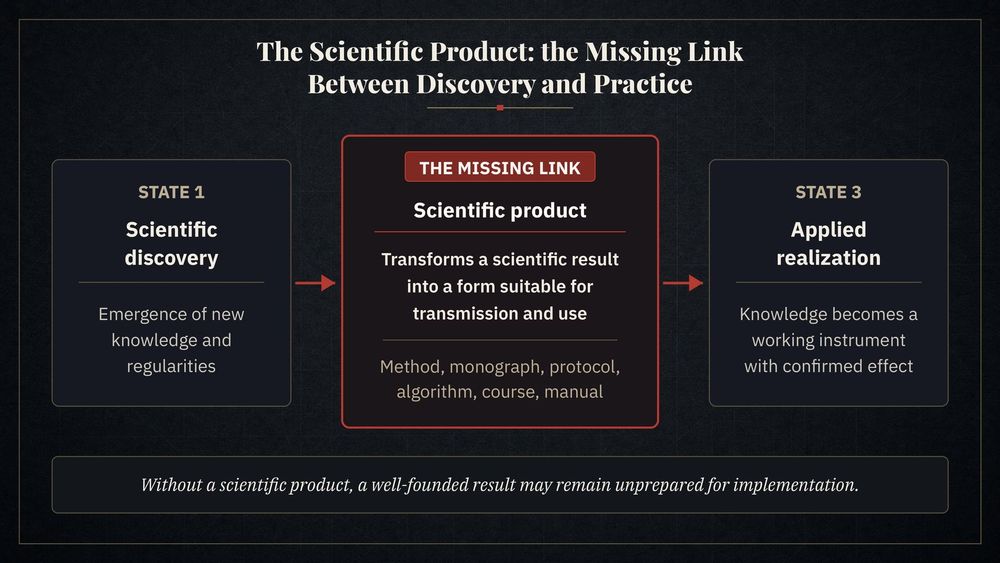
A scientific discovery characterizes the emergence of new knowledge.
A scientific product ensures its formulation, justification, and transmission.
Applied realization attests that knowledge has become a basis for performing certain actions and solving problems.
Consequently, the production of knowledge and the transformation of knowledge into a working instrument are related but not identical processes.
It is precisely this distinction that is proposed as the foundation of a new architecture of scientific activity.
Why the scientific community has no single operational model of its own activity
Science unites disciplines that differ substantially in their object of inquiry, methods, modes of proof, and the character of their results.
A mathematician establishes relations among formal objects.
A physicist investigates the regularities of the material world.
A historian reconstructs events and processes of the past.
A psychologist studies mental processes and behaviour.
The engineering sciences develop and test technical solutions.
At the same time, each discipline has its own requirements for the justification of results.
Differences in conceptions of scientific activity are also confirmed by empirical research. A study by Marina Dubova and Qiawen E. Liu, published in Royal Society Open Science in 2026, showed the heterogeneity of researchers’ conceptions of the nature of science.
It does not follow from these data, however, that scientific activity has no common foundations. The study’s sample is limited, and an examination of scientists’ conceptions is not identical with an analysis of the operations they perform.
A more substantial problem arises.
It may be that researchers define science differently because they are describing different sides of one complex activity.
Some attend to methods.
Others attend to proofs.
Still others attend to creativity, chance, and the unpredictability of discoveries.
A fourth group attends to the practical significance of the results obtained.
But the characteristics listed may relate to different functions of scientific activity.
Therefore, in order to construct a general architecture, it is necessary not to choose a single definition of science, but to investigate the relations among the production of knowledge, its justification, its formulation, and its application.
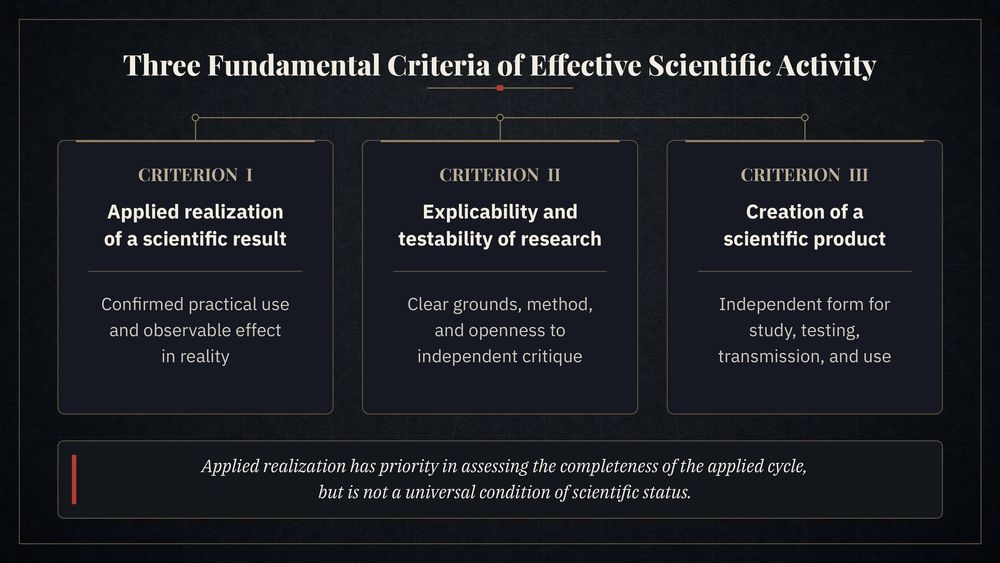
Three fundamental criteria of effective scientific activity
The proposed conception proceeds from three criteria, each of which characterizes an independent aspect of scientific work.
The first criterion. Applied realization of a scientific result
The most significant indicator of the effectiveness of application-oriented science is the confirmed use of the knowledge obtained.
The principal question here is not how many publications have been prepared or how originally a hypothesis has been formulated.
It is necessary to establish:
What has changed in practical activity as a result of the scientific result obtained?
Has a new technology appeared?
Has a more effective way of solving a problem been created?
Has a method arisen that makes it possible to obtain a previously inaccessible result?
Have the capacities of a person, an organization, or a technical system changed?
Practical application must be confirmed not by the author’s declaration, but by observable results of use.
It is necessary, however, to preserve a principal distinction between scientific value and applied effectiveness.
A fundamental study may possess high scientific significance even if its practical application is not yet known.
Therefore the first criterion has the highest priority in assessing the completeness of the scientific-applied cycle, but is not a universal condition for recognizing knowledge as scientific.
The second criterion. Explicability and testability of research
Scientific activity must be conducted in accordance with definite requirements for the investigation, justification, and testing of results.
These requirements may differ substantially among disciplines.
The researcher is nevertheless obliged to explain what exactly was done, why the chosen methods were used, how the results were obtained, and on what grounds the conclusions were formulated.
Scientific work cannot rest solely on the author’s assertion of his or her own correctness.
The possibility of independent critical examination must exist.
At the same time, testability does not necessarily mean the literal repetition of all research operations.
In mathematics it may consist in the checking of a proof.
In experimental science, in an independent investigation of an observed effect.
In history, in a critical analysis of sources and argumentation.
In engineering, in the testing of a technical solution.
Consequently, what is universal is not a particular method of testing, but the requirement that the result be well founded and open to professional criticism.
The third criterion. Creation of a scientific product
Scientific knowledge must be presented in a form that makes possible its study, testing, transmission, and use.
That form is the scientific product.
A scientific product should not be identified exclusively with a journal article.
It may be a monograph, a textbook, a method, a research protocol, an algorithm, a model, technical documentation, an educational course, or another form accepted in the relevant field of science.
The principal requirement is that the product should preserve the essential properties of the knowledge obtained and enable other specialists to work with it.
In the proposed normative model of organized scientific implementation, the creation of such a product precedes wide practical application.
Historically, however, application sometimes arises before the final publication or formalization of a method. The matter is therefore one of a standard of responsible scientific implementation, not of an immutable law of the history of science.
The scientific product as the missing link between discovery and practice
A special place in the proposed architecture is occupied by the third criterion.
In contemporary scientific practice, publication is often regarded as the final result of research work.
The researcher completes an experiment, processes the data, formulates conclusions, prepares an article, and submits it to a journal.
After publication the work is frequently considered finished.
But a publication and a scientific product intended for use do not always coincide.
A scientific article may convincingly demonstrate the existence of a certain regularity and yet contain no technology for its practical application.
A method, by contrast, may include the necessary procedures, requirements for the practitioner, conditions of application, limitations, and ways of monitoring the result.
Consequently, between knowledge and application there exists an independent task — the transformation of a scientific result into a product suitable for transmission and use.
This transformation cannot be regarded as merely technical formatting.
It requires answers to additional questions.
Who will use the result? What knowledge and skills are necessary for this? Under what conditions does the method work? What errors are possible? How can the correctness of application be checked? What limitations must be known to the user?
If these questions remain unanswered, a scientific result may be well founded and yet not yet prepared for implementation.
A typology of scientific products
| Form of product | Principal purpose |
|---|---|
| Scientific article | Presentation and justification of a result |
| Monograph | Systematic exposition of a theory or research system |
| Method | Description of a way of solving a definite problem |
| Textbook | Organized transmission of a system of knowledge |
| Educational course | Formation of knowledge and competencies |
| Algorithm | Formalized procedure for processing information or performing a task |
| Research protocol | Provision for the controlled conduct and testing of a study |
| Technological documentation | Preparation of a result for practical use |
At the same time, form itself does not guarantee scientific quality.
A book may contain no new knowledge. A method may prove ineffective. An educational course may transmit untested claims.
Therefore a scientific product must be assessed not by its title or length, but by its content, well-foundedness, suitability for transmission, and correspondence to its purpose.
Why publication activity is not equivalent to scientific effectiveness
The contemporary system of evaluating researchers makes wide use of quantitative indicators: the number of publications, citations, indices of scientific influence, participation in projects, and the volume of funding attracted.
These indicators make it possible to characterize particular aspects of scientific activity.
But they do not give an exhaustive answer to the question of what result was obtained and what became of it.
The number of articles does not show how many of the methods developed are actually used.
Citations do not prove the practical effectiveness of a technology.
The volume of funding does not establish the scientific reliability of results.
Even the existence of a patent does not confirm that the patented solution has received wide application.
In the proposed model it is necessary to distinguish four kinds of assessment.
Scientific novelty — what new has been established or created.
Scientific well-foundedness — how convincingly the result has been confirmed.
Product completeness — whether there exists an independent form that makes it possible to transmit and use the result.
Applied effectiveness — whether actual use has been confirmed, and what effect it provides.
These characteristics are interrelated, but they do not replace one another.
It is precisely for this reason that the proposed architecture must not be turned into yet another aggregate publication index.
Its purpose is to show the actual state of a scientific result and to identify obstacles on the path of its development.
A historical test: when a scientific discovery becomes a working technology
The history of science makes it possible to discern a substantial difference between the moment knowledge is obtained and the moment of its wide practical use.
Penicillin
The discovery of the antibacterial action of penicillin by Alexander Fleming in 1928 did not mean the immediate appearance of an accessible medicinal product. Subsequent research, the purification of the substance, clinical trials, and the development of industrial production turned a laboratory observation into medical practice.
The transistor
The creation of the first working point-contact transistor at Bell Labs in 1947 was an important scientific and technical achievement. But mass use required the improvement of design, materials, production, and the reliability of electronic components.
Magnetic resonance imaging
Decades passed between the fundamental investigations of nuclear magnetic resonance and the creation of clinical MRI systems. The transition required mathematical methods of image reconstruction, engineering solutions, and clinical testing.
These examples show that a scientific discovery and a practical technology may be separated by a considerable period of time, by a multitude of additional studies, and by the participation of various specialists.
Moreover, an applied result often arises not from a single discovery, but from the combination of several independent scientific and engineering achievements.
Consequently, an architecture of scientific activity must take into account not only the work of an individual author, but also the collective history of the transformation of knowledge.
The problem of a scientific result that has never been applied
Suppose that a researcher has developed a new psychological method.
He has set out its theoretical foundations, prepared a monograph, published several articles, and presented the results at international conferences.
But the method has never undergone independent practical trials.
Can the scientific work be considered complete?
The answer depends on what result was claimed.
If the researcher proposed a theoretical model, the scientific work may be complete at the level of the construction and justification of the model.
But if he claims to have created an effective practical method, the absence of trials means that its effectiveness has not yet been confirmed.
This distinction must be fixed as one of the basic rules of assessment.
A scientific claim must be tested in accordance with the result to which it aspires.
A theory requires corresponding theoretical and empirical justification.
A method requires a test of the conditions and results of application.
An educational programme requires an assessment of learning outcomes.
A technology requires trials under conditions corresponding to its purpose.
Thus applied realization becomes not an arbitrary additional requirement, but a necessary condition for confirming claimed practical effectiveness.
The architecture of scientific activity as a system of three control loops
The proposed model can be organized around three independent loops of scientific control.
THE SCIENTIFIC RELIABILITY LOOP
Can the result be substantiated?
The research task, the methods applied, the initial data, the argumentation, and the limitations of the conclusions are examined.
THE SCIENTIFIC PRODUCT LOOP
Can the result be transmitted to another specialist?
The completeness of the description, conformity to scientific requirements, the intelligibility of the procedure, the conditions of use, and the possibilities of instruction are examined.
THE APPLIED REALIZATION LOOP
Does the result work in practice?
The fact of use, the effect obtained, the stability of the results, the limitations, and independent confirmation are examined.
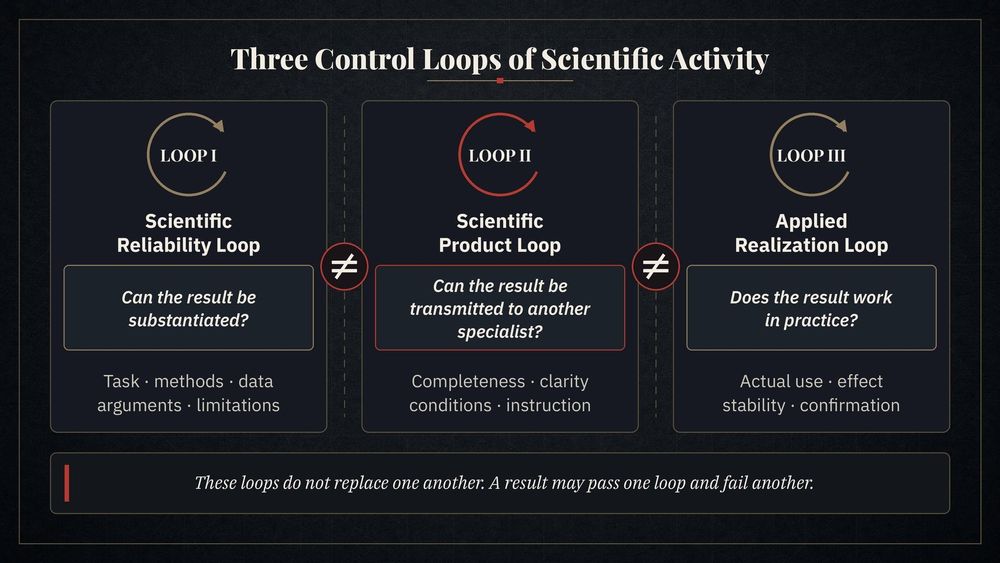
These loops should not be confused.
For example, a scientific monograph may fully meet the requirements of the first loop, partly meet those of the second, and as yet have no relation to the third.
A method may be excellently formulated and yet insufficiently justified.
A practical technology may demonstrate a useful effect, even though the mechanism of its action is not yet fully explained.
Consequently, the model must not only record success, but also reveal the specific character of incompleteness.
The principal research hypothesis: the scientific product determines the possibility of organized implementation
One of the most important propositions of the proposed programme is the hypothesis concerning the role of the scientific product.
In the traditional model of the diffusion of innovations, attention is often given to funding, infrastructure, the market, patents, organizational conditions, and technological readiness.
These factors are indeed of great importance.
It is necessary, however, to investigate one further factor: how fully scientific knowledge has been transformed into an independent product accessible to other specialists.
Suppose there exist two scientific developments with a comparable evidential base and similar practical potential.
The first is presented predominantly in the form of scientific publications.
The second additionally includes a detailed method, an educational course, instructions, criteria of verification, and a description of limitations.
It may be supposed that, other things being equal, the second development will prove better prepared for implementation.
But this supposition requires testing.
On its basis a working hypothesis can be formulated:
The degree of documentation, transferability, and operational completeness of a scientific product is one of the factors influencing the probability and quality of the practical application of a scientific result.
This proposition can be investigated empirically.
It is necessary to compare scientific developments that have been applied with developments that have remained at the level of publications, and to establish what role the quality of the scientific product played in their subsequent fate.
At the same time, funding, technological readiness, demand, legal constraints, and other possible causes of difference should be taken into account.
Otherwise there is a risk of mistakenly attributing to the scientific product an influence that is in fact due to entirely different circumstances.
An international research programme: from hypothesis to proof
In order to test the proposed architecture, it is necessary to conduct a comparative study encompassing various scientific disciplines and forms of scientific results.
It is proposed to distinguish three independent directions.
Direction A. The study of scientific discoveries
The subject of inquiry is scientific discoveries, their origin, modes of justification, and subsequent development.
It is necessary to establish which discoveries have received practical application, which have remained predominantly fundamental results, and which have required the creation of additional scientific products.
Direction B. The study of scientific products
Here the ways in which knowledge is transformed into books, methods, algorithms, educational courses, technological protocols, and other forms are studied.
Particular attention should be given to the possibility of using the product independently of the direct participation of its creator.
This will make it possible to distinguish knowledge possessed only by the author from knowledge capable of functioning as a transmissible result of scientific activity.
Direction C. The study of practical application
In the third direction, actual cases of the implementation of scientific results are studied.
The task is to determine the conditions under which a scientific product becomes a working instrument.
It is necessary to establish which factors ensure successful application, which hinder it, and why equally well-founded results may have different practical fates.
A proposed design for empirical research
As an initial project, it is proposed to investigate 120 scientific results from 12 disciplines.
In each discipline ten results are selected: five with documented practical application and five without confirmed implementation at the time of the study.
Such a sample will make it possible to begin a comparative analysis, but will not automatically ensure representativeness for world science as a whole.
It is especially important to separate the results of fundamental research not oriented toward immediate application from developments for which applied realization was a declared aim.
A matrix of examination
| Parameter | What is established |
|---|---|
| Novelty | What new knowledge has been obtained |
| Well-foundedness | By what data and arguments the result is confirmed |
| Scientific product | In what documented form it is presented |
| Transferability | Whether another specialist can master and use the product |
| Applied use | Where the result has actually been used |
| Effectiveness | What effect has been obtained and by what it is confirmed |
| Limitations | Under what conditions the result does not work or requires revision |
To assess applied effectiveness, it is not sufficient to record only the fact of implementation.
It is necessary to distinguish a first trial, limited application, independent use, and established practice.
In addition, the time that has elapsed since the discovery should be taken into account: a result obtained a year ago cannot be mechanically compared with a discovery fifty years old.
Separate analysis will be required in cases where implementation is delayed for economic, legal, or organizational reasons unrelated to the quality of the research itself.
A scientific school of a new type: from teaching methods to the production of results
If the proposed architecture receives empirical confirmation, it will make it possible to raise the question of transforming scientific education.
The traditional training of a researcher is concentrated predominantly on the acquisition of disciplinary knowledge, research methods, and the rules of scientific communication.
For independent scientific activity, however, this is not sufficient.
A researcher must be able not only to obtain new knowledge, but also to determine the character of the intended result, to choose the form of the scientific product, and to establish the conditions of its possible application.
In the proposed model, the training of a researcher includes three competencies.
The first is the capacity to conduct well-founded research.
The researcher must understand the requirements of his or her discipline, master the necessary methods, and be able to test his or her own conclusions.
The second is the capacity to create an independent scientific product.
The knowledge obtained must be presented so that it can exist and be transmitted independently of the author’s direct participation.
The third is the capacity to investigate the conditions of practical application.
The researcher must understand what is required for the transition from a scientific result to a working method, technology, or system.
At the same time, not every scientist is obliged to carry out implementation in person. In many fields this work requires the participation of engineers, teachers, physicians, technologists, and other specialists.
Consequently, the matter is one of preparing the researcher to understand the complete scientific-applied cycle, not of requiring a single person to perform all of its functions.
Artificial intelligence and the danger of automating unfinished science
The development of artificial intelligence gives the proposed problem particular importance.
Contemporary intelligent systems are capable of assisting in the search for literature, the analysis of data, the preparation of texts, programming, modelling, and the formation of research hypotheses.
But the capacity to create a scientific text is not equivalent to the capacity to produce reliable scientific knowledge.
And the capacity to formulate a method does not mean that the method will work.
If scientific activity is assessed predominantly by the volume of information produced, artificial intelligence is capable of multiplying many times the number of publications and other materials without a corresponding increase in the number of well-founded and practically significant results.
Therefore the three proposed criteria can be used in assessing scientific work involving AI.
The first question: does a testable scientific basis for the result exist?
The second: has an independent scientific product been created, suitable for professional assessment and use?
The third: if practical effectiveness is claimed, has it been confirmed?
These requirements apply regardless of whether the result was created by a human being, by artificial intelligence, or by a joint research system.
At the same time, the use of AI gives rise to additional questions: the origin of the data, the reproducibility of computations, responsibility for conclusions, and the possibility of independent audit.
Thus the architecture of scientific activity may become one of the foundations for developing standards of scientific work under conditions of expanding automation.
The limits of universality: what the proposed model must not assert
Any programme that claims general scientific significance must define the limits of its own applicability.
First of all, it is necessary to reject the notion that every fundamental science is obliged to yield immediate practical benefit.
Fundamental research often creates the conditions for discoveries whose application becomes possible only considerably later.
Nor can it be held that the presence of a practical effect automatically proves the scientific correctness of an explanation.
Practically useful actions sometimes arise on the basis of incomplete knowledge of mechanisms, and particular technologies develop by trial and error.
Therefore the three criteria do not form a simple system in which one indicator is able to replace the others.
Scientific well-foundedness characterizes the reliability of knowledge.
The scientific product characterizes the possibility of its transmission and further use.
Applied realization characterizes the confirmed functioning of the result in practice.
It is precisely the joint consideration of these characteristics that makes it possible to assess the completeness of application-oriented scientific activity without confusing it with scientificity as such.
Moreover, the absence of implementation does not necessarily indicate shortcomings in the research. It may be explained by economic conditions, the absence of infrastructure, legal obstacles, or the fact that the scientific result still outstrips existing technological possibilities.
Consequently, the proposed model should serve as an instrument of diagnosis, not as a mechanism of automatic punishment for the absence of immediate practical benefit.
From the architecture of scientific activity to a doctrine of scientific construction
The proposed conception opens the possibility of a transition from a descriptive methodology of science to the designing of research activity.
If we are able to establish what functions are necessary for obtaining a well-founded scientific result, how the result is transformed into a scientific product, and under what conditions it becomes practically applicable, the possibility arises of consciously constructing research programmes.
Such a programme should begin not with the choice of a convenient method and not with a decision to write a scientific article.
Its starting point is the definition of the scientific problem and of the character of the result that must be obtained.
Then the requirements for the research, the modes of justification, the form of the future scientific product, and, when this corresponds to the aim, the conditions for testing its practical effectiveness are established.
The most important distinctive feature of this approach is that a scientific publication ceases to be regarded automatically as the final aim of the entire activity.
It occupies a definite place in a broader system of the production, testing, and transmission of knowledge.
This makes it possible to formulate a foundational principle of the doctrine of scientific construction:
Scientific activity should be designed with regard to the character of the knowledge expected, the requirements for its justification, the form of the scientific product, and the conditions of its further use.
At the same time, the research process itself need not be linear.
A discovery may change the original task. A test may refute the initial hypothesis. The creation of a product may reveal the insufficiency of the knowledge obtained. Practical trials may require new research.
Thus scientific construction is not the mechanical execution of a sequence established in advance, but the management of a complex research activity with the possibility of constant revision of its foundations.
Conclusion. Scientific discovery, scientific product, and applied realization
Contemporary science needs not so much another universal definition of the scientific method as a systematic investigation of its own activity.
The diversity of disciplines, methods, and forms of proof does not exclude the existence of general functional requirements for scientific work.
The proposed programme “The Architecture of Scientific Activity” proceeds from the necessity of distinguishing three fundamental criteria.
The first is scientific well-foundedness, which presupposes the explicability of the research approach and the possibility of critical examination of the result.
The second is the creation of an independent scientific product that ensures the documentation, transmission, and further use of the knowledge obtained.
The third is applied realization, which characterizes the transition of a scientific result into operating practice.
The last criterion is of determining importance in assessing the completeness of an application-oriented scientific cycle.
But these criteria must not be used to deny the scientific value of fundamental research whose results have not yet received practical application.
The central problem is to establish the relations among the three characteristics of scientific activity.
Why are some discoveries transformed into operating technologies, while others remain predominantly theoretical results?
What properties of a scientific product ensure the possibility of its transmission?
How does the quality of research methodology affect subsequent application?
What organizational conditions facilitate the transformation of knowledge into a practical instrument?
Answers to these questions require an independent interdisciplinary investigation.
The proposed programme is directed toward the creation of a testable architecture of scientific activity, capable of uniting the study of the origin of knowledge, the mechanisms of its justification, the forms of the scientific product, and the conditions of applied realization.
Its significance lies in the possibility of a transition from the assessment of individual publications to the investigation of the complete life cycle of a scientific result.
A scientific discovery extends the boundaries of knowledge. A scientific product makes this knowledge accessible to others. Applied realization shows that the knowledge obtained is capable of changing reality.
It is precisely the relations among these three states that should become one of the central subjects of a new science of scientific activity.
The scholarly apparatus and the status of the conception
The posing of the problem is based on studies of scientists’ conceptions of science, and on work in the philosophy of scientific method, metascience, the reproducibility of research, and the diffusion of innovations.
The proposed three-criterion architecture is an author’s conceptual model. Its universality and explanatory power have not yet been established empirically — it is precisely for this purpose that the research programme has been formulated.
References
Bozeman, B., & Sarewitz, D. (2011). Public value mapping and science policy evaluation. Minerva, 49(1), 1–23. https://doi.org/10.1007/s11024-011-9161-7
Dubova, M., & Liu, Q. E. (2026). Everyone knows what science is…until you ask. Royal Society Open Science, 13(11), Article 260933. https://doi.org/10.1098/rsos.260933
Kuhn, T. S. (1962). The structure of scientific revolutions. University of Chicago Press.
Lakatos, I. (1970). Falsification and the methodology of scientific research programmes. In I. Lakatos & A. Musgrave (Eds.), Criticism and the growth of knowledge (pp. 91–196). Cambridge University Press.
Lakatos, I. (1978). The methodology of scientific research programmes: Philosophical papers (Vol. 1, J. Worrall & G. Currie, Eds.). Cambridge University Press. https://doi.org/10.1017/cbo9780511621123
Popper, K. R. (1935). Logik der Forschung: Zur Erkenntnistheorie der modernen Naturwissenschaft. Verlag von Julius Springer.
Popper, K. R. (1959). The logic of scientific discovery. Hutchinson. (Original work published 1935)
Rogers, E. M. (1962). Diffusion of innovations. Free Press of Glencoe.
Sarewitz, D. (1996). Frontiers of illusion: Science, technology, and the politics of progress. Temple University Press.
Stokes, D. E. (1997). Pasteur’s quadrant: Basic science and technological innovation. Brookings Institution Press. https://doi.org/10.5040/9780815757368