

European Academy of Sciences of Ukraine Announces the Publication of FRACTURE
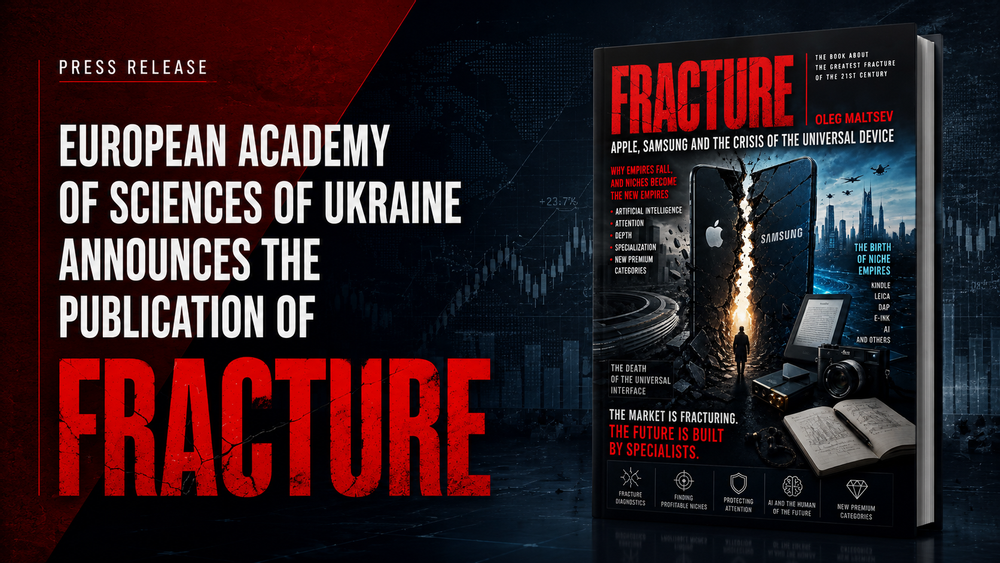
European Academy of Sciences of Ukraine Announces the Publication of FRACTURE
A New Book by Professor Oleg Maltsev Offers Entrepreneurs a Diagnostic Framework for Navigating Market Disintegration in the Age of AI
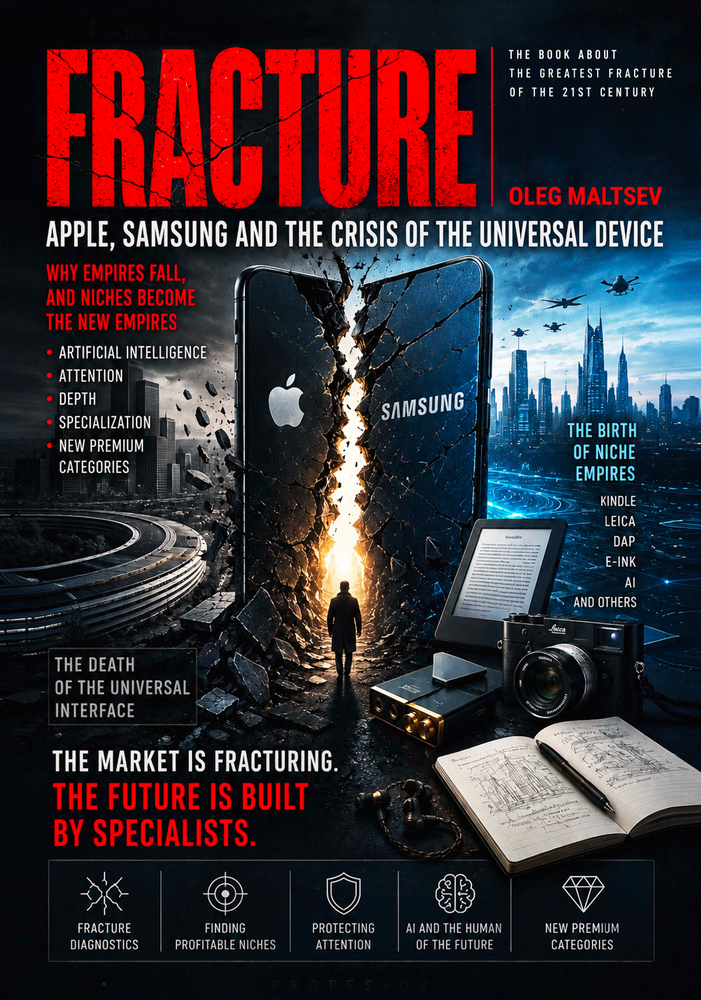
ODESSA, UKRAINE — The European Academy of Sciences of Ukraine (EASU) today announced the publication of Fracture: Strategic Vision and Sales in the Age of Market Disintegration, a new book by Professor Oleg Maltsev — author, criminologist, security expert, psychologist, photographer, and investigative journalist, founder and director of the Memory Institute and head of the Expeditionary Corps.
The book advances a central argument: markets rarely collapse suddenly. They fracture — accumulating structural stress for years along fault lines invisible to the very experts who know them best, until a specialised alternative overtakes the universal solution that once dominated without challenge. Nokia did not fail for want of engineers. Kodak invented digital photography and filed the patent away. Blockbuster was offered a partnership with Netflix, and declined. Professor Maltsev's diagnosis is that each of these failures shares a single root cause, which he terms “expertise blindness”: the deeper a company's mastery of an existing model of its market, the harder it becomes to perceive that the model itself is changing.
“The market is always disintegrating,” said Professor Maltsev. “Victory belongs to whoever sees the line of the fracture before the others, and builds a sales position on the new specialisation while everyone else is still defending the centre. This book does not offer another theory of disruption. It offers an instrument for reading the fracture before it becomes obvious to everyone else.”
Drawing on structural analysis, forensic psychology, and the biological principle of adaptive radiation, Fracture equips founders and entrepreneurs with a working diagnostic apparatus rather than a motivational thesis. Across twenty-three chapters, the book introduces a series of practical instruments, including the Shell–Core matrix for diagnosing the stage of any company in a given market, the Fracture Map for reading early signals through technology, behaviour and culture, the Market Traffic Light for timing entry into a shifting market, and the “Fracture–Role–Value” formula for building a sales position within a single conversation. A dedicated chapter examines artificial intelligence not as a threat to specialisation but as its amplifier, arguing that AI destroys the mass average level of a market while strengthening depth, culture, and authorial mastery.
Each chapter follows a consistent structure — a diagnostic idea, a concrete tool, a worked example, and a practical exercise — converting theory into decisions readers can act on immediately. The book closes with a thirty-day operational checklist, moving the reader from market diagnosis to a first sales conversation within a single month.
Fracture is published in Russian, English, and Spanish editions and is available through the European Academy of Sciences of Ukraine and its affiliated distribution channels.
WHY IT MATTERS FOR BUSINESS
Most strategic frameworks available to founders and executives were built for markets that move slowly and change shape rarely. Fracture addresses a different reality: markets that fragment continuously, in which the advantage no longer belongs to the largest player but to the one who specialises earliest and most precisely. For business leaders, the book offers something rarer than a new theory — a repeatable diagnostic routine. Its instruments can be applied directly to an existing company or an early-stage venture within a single working session, converting abstract market anxiety into a concrete map of where value is moving, which niches are already vacant, and what a specific customer needs to hear in order to buy.
The book is equally addressed to audiences that rarely read the same material: entrepreneurs who need a sales language for a specialised product, and executives inside large organisations who need to recognise, before their competitors do, the moment their own company has shifted from creating value to merely defending it. In both cases, Fracture replaces intuition with a method — a discipline for separating genuine market signals from noise, for pricing specialisation without apology or discount, and for building a go-to-market position around a single, precisely named transition rather than a broad and forgettable claim to being “better.”
A SERIES, NOT A SINGLE VOLUME
Fracture is the first release in a planned series from Professor Maltsev and the European Academy of Sciences of Ukraine examining the structural forces reshaping markets, organisations, and professions in the age of artificial intelligence. Future volumes will extend the diagnostic framework introduced here into deeper industry-specific studies and organisational applications, continuing the Academy's programme of translating field research into working instruments for practitioners. Details of forthcoming titles in the series will be announced on the Academy's website as publication dates are confirmed.
ABOUT THE EUROPEAN ACADEMY OF SCIENCES OF UKRAINE
The European Academy of Sciences of Ukraine (EASU), based in Odessa, is an international scholarly institution supporting research and publication across the sciences, humanities, and applied professional disciplines. EASU supports the ongoing development and publication of academic and applied pieces of scholarly works.
MEDIA CONTACT
European Academy of Sciences of Ukraine Odessa
Prof. Dr. Oleg Maltsev: Phd@oleg-maltsev.com