

The Market After Fracture: Specialization, Power, and New Centers of Influence
July 10, 2026
The European Academy of Sciences of Ukraine Announces the International Interdisciplinary Roundtable “The Market After Fracture: Specialization, Power, and New Centers of Influence”
Markets, digital platforms, cities, and institutions are entering a period in which the old center no longer holds the system together. The models that for decades organized mass markets, political reactions, customer behavior, trust, and public influence are beginning to fragment. What once appeared to be a stable model of growth and governance is now turning into a field of competing specialized environments.
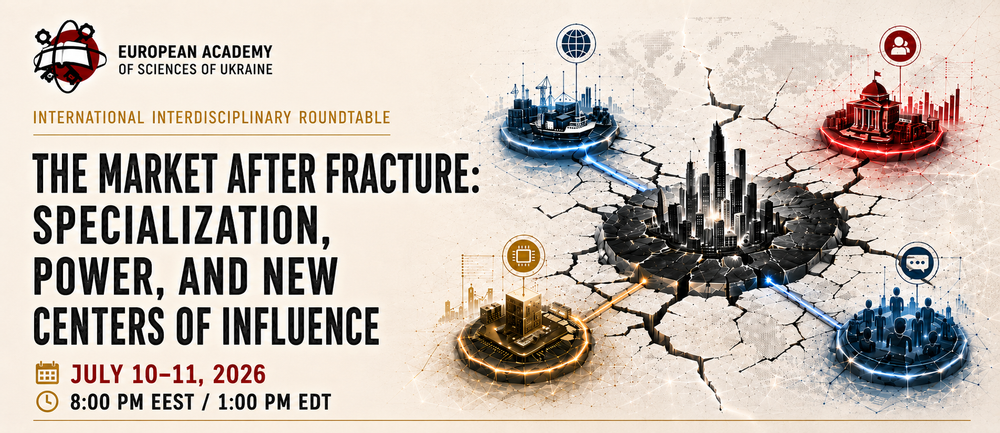
The European Academy of Sciences of Ukraine announces the international interdisciplinary roundtable “The Market After Fracture: Specialization, Power, and New Centers of Influence,” which will take place on July 10–11, 2026, at 8:00 PM EEST / 1:00 PM EDT.
The roundtable will bring together researchers and experts in economics, political science, criminology, urban studies, sociology, business strategy, and digital transformation to discuss a central question of the present moment: who gains influence when universal centers lose their ability to organize society, markets, security, and governance?
For decades, business, politics, and technology relied on the logic of large universal structures: mass markets, dominant platforms, centralized models of governance, megacities, institutional systems, and unified digital environments. Today, however, this logic is increasingly losing its stability. Markets are fragmenting, digital environments are breaking into multiple spheres of influence, and the old rules of scaling, trust, security, and governance no longer work with the same force.
Market fracture is not only an economic phenomenon. It is a transformation of the very architecture of influence. It affects state institutions, business, urban systems, digital platforms, expert communities, and civil society. The question is no longer only which companies will win in the new economy, but what forms of power, control, security, and trust will emerge after the collapse of universal models.
The practical task of the roundtable is not to limit itself to theoretical discussion, but to identify which signs of fracture can already be observed in markets, institutions, urban systems, and digital environments, as well as what new approaches are needed for analysis, governance, security, and strategic action under conditions of fragmentation.
During the discussion, participants will examine how specialization becomes a new principle of competition and governance, how power is redistributed among states, corporations, platforms, cities, and communities, and how new centers of influence emerge where previous market and institutional structures begin to break down.
The roundtable is based on the analytical line presented in recent EUASU materials on market fracture (link), the end of the era of the single digital center, and the transformation of business, governance, security, and public behavior in the age of specialization.
Discussion Questions
Day 1. Market Fracture, Power, and New Centers of Influence
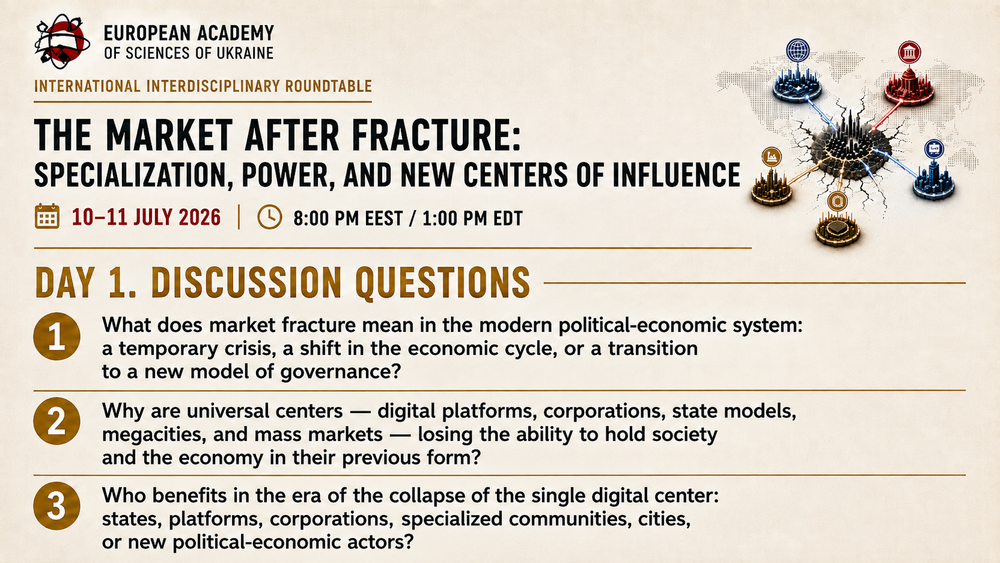
- What does market fracture mean in the modern political-economic system: a temporary crisis, a shift in the economic cycle, or a transition to a new model of governance?
- Why are universal centers — digital platforms, corporations, state models, megacities, and mass markets — losing the ability to hold society and the economy in their previous form?
- Who benefits in the era of the collapse of the single digital center: states, platforms, corporations, specialized communities, cities, or new political-economic actors?
Day 2. Governance, Security, and Institutional Adaptation
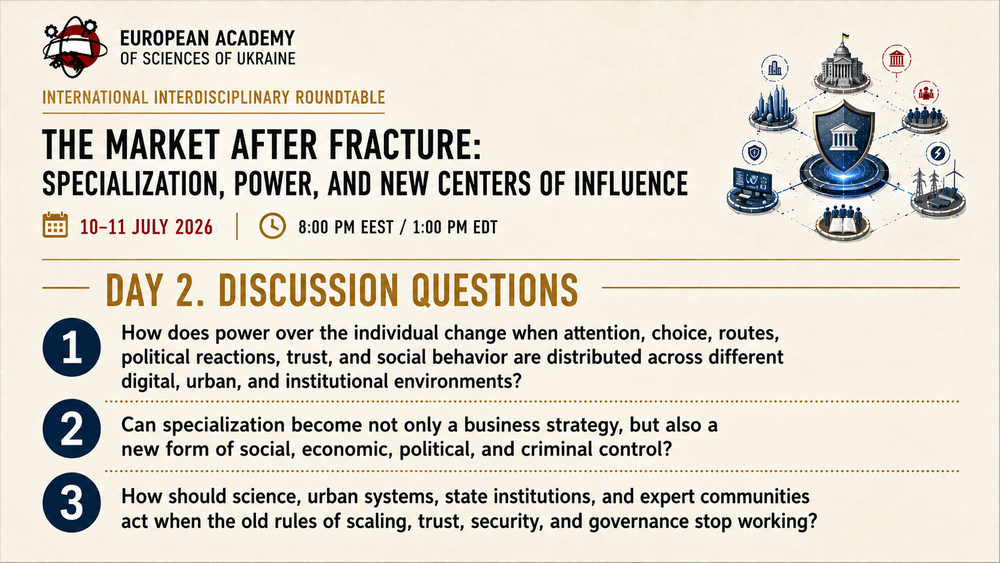
- How does power over the individual change when attention, choice, routes, political reactions, trust, and social behavior are distributed across different digital, urban, and institutional environments?
- Can specialization become not only a business strategy, but also a new form of social, economic, political, and criminal control?
- How should science, urban systems, state institutions, and expert communities act when the old rules of scaling, trust, security, and governance stop working?
The event is intended to create a shared academic and practical space for understanding how markets, institutions, cities, and digital environments are being reorganized under the pressure of fragmentation. The discussion will be especially relevant for researchers, entrepreneurs, analysts, and specialists working at the intersection of economics, security, technology, governance, and social transformation.
The European Academy of Sciences of Ukraine invites researchers, experts, and practitioners to join the discussion and contribute to the analysis of the new structures of influence emerging after the fracture of universal models.
To participate in the roundtable, please contact the European Academy of Sciences of Ukraine: info@euasu.org