

ANALYTICAL REPORT: THE END OF THE ERA OF THE SINGLE DIGITAL CENTER
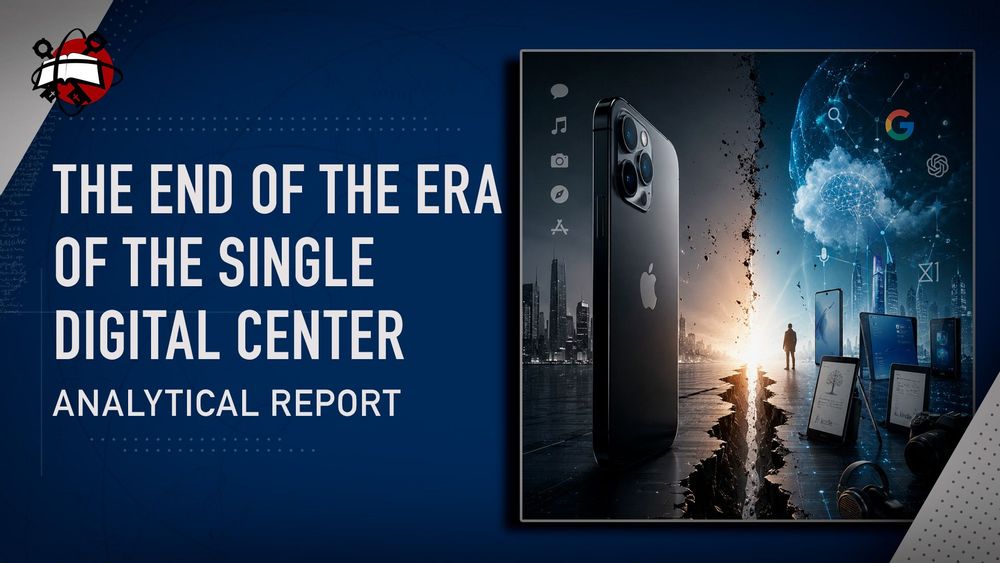
ANALYTICAL REPORT
THE END OF THE ERA OF THE SINGLE DIGITAL CENTER
The Fragmentation of the Universal Interface and the Rise of Distributed Intelligence
Specifically for the European Academy of Sciences of Ukraine in the tradition of strategic analytical memoranda by Ph.D Oleg Maltsev
ABSTRACT
For nearly two decades, the architecture of digital civilization was built around a single organizing principle: the universal device.
The smartphone — and above all the iPhone — became more than a technological product. It evolved into the primary interface between the individual and the digital world. Communication, photography, navigation, music, work, social interaction, media consumption, and personal identity were gradually consolidated into one seamless object.
This report argues that the historical phase defined by that model is approaching its structural limit.
The contemporary technological landscape increasingly reveals signs of fragmentation. What was once centralized inside a universal interface is beginning to separate into specialized cognitive environments, distributed intelligence systems, professional tools, and AI-driven infrastructures.
The central argument of this report is not that Apple is collapsing, nor that the smartphone is disappearing. The deeper transformation lies elsewhere.
The world is entering the end of the era of the single digital center.
What emerges in its place is not yet fully visible. However, the signs of transition are already reshaping the technological, economic, and cognitive foundations of modern civilization.
This report should therefore be understood not as a market review, but as a strategic warning document describing an unfolding civilizational shift.
INTRODUCTION
The Age of the Universal Interface
At the beginning of the twenty-first century, digital civilization entered a historically unprecedented phase.
For the first time, an enormous number of human functions were consolidated into a single portable object. The smartphone absorbed communication, memory, entertainment, orientation, photography, work processes, and access to global information systems. What was previously required to be multiple tools, devices, and infrastructure has become concentrated within the interface.
Apple emerged as the symbolic and architectural center of this transformation.
The significance of the iPhone was never limited to hardware innovation alone. Apple succeeded because it combined engineering discipline with emotional clarity. The company transformed technology into a coherent everyday environment. It created not simply products, but a psychological experience of continuity between the human being and the digital system.
For nearly twenty years, this model appeared historically irreversible.
The smartphone became the gravitational center of digital life. Entire industries reorganized themselves around it. Photography adapted to it. The media adapted to it. Music adapted to it. Communication, commerce, entertainment, and even human attention increasingly flowed through a single device ecosystem.
Yet historical systems often begin to fracture precisely at the moment of their greatest external stability.
Today, the first signs of structural separation are becoming visible.
The universal interface is no longer expanding. It is starting to lose exclusivity.
KEY I
The Empire of the Universal Device
Apple’s historical role cannot be reduced to corporate success.
The company became the cultural headquarters of the digital era. It shaped behavioral norms, visual language, interface expectations, and the emotional grammar of technological modernity.
Under Steve Jobs, Apple functioned as an expansionary system. It repeatedly destroyed existing categories in order to construct new ones. The company did not merely optimize markets; it reorganized them.
The iPhone represented the culmination of this logic.
It unified multiple fragmented digital experiences into a single coherent object. The device became a communication terminal, a media center, a camera, a navigation system, a music player, and a gateway to the internet simultaneously.
More importantly, it became a civilizational interface. At a certain point, Apple effectively occupied the position of a single digital center. Human interaction with technology increasingly passes through a single ecosystem, a single logic of design, a single architecture of experience.
This concentration generated enormous power.
But every empire built around centralization eventually confronts the same paradox: the more functions concentrated within the center, the more dangerous any architectural shift becomes.
KEY II
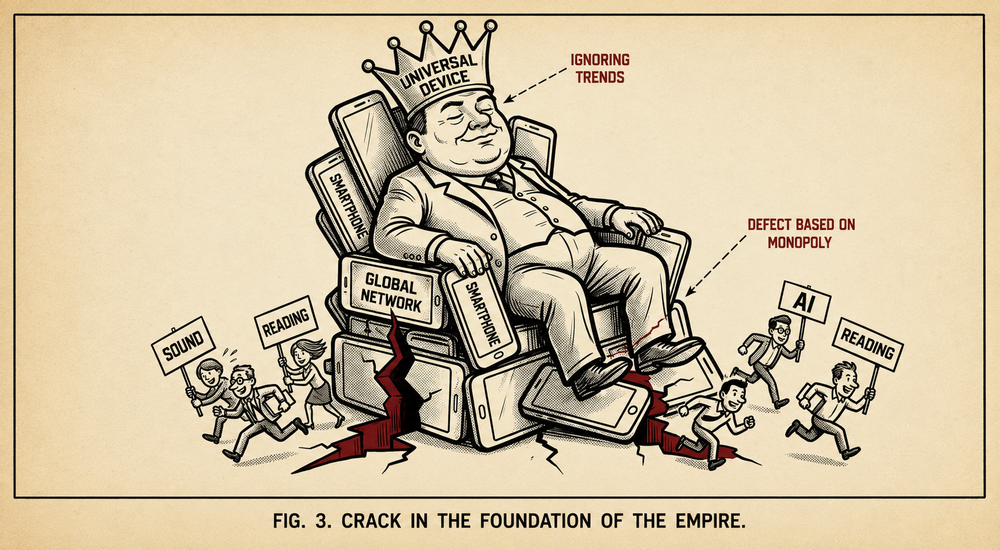
The Phase of Retention
Apple remains one of the strongest corporations in human history.
Its financial position, supply-chain discipline, ecosystem control, brand authority, and cultural influence remain extraordinary. From the perspective of classical market analysis, the company continues to appear fundamentally stable.
And yet this stability itself may conceal a deeper transformation.
There is an important difference between a system in expansion and a system in retention.
Earlier, Apple repeatedly risked destabilizing its own products in pursuit of new categories. The contemporary Apple increasingly appears focused on preserving the integrity of an already established ecosystem. The company protects infrastructure, minimizes volatility, and reinforces continuity.
This is not necessarily a managerial failure. It is a recognizable historical phase of mature systems.
Late empires often appear strongest externally precisely when their internal architecture has begun to lose dynamism.
The critical issue is not whether Apple remains profitable. The critical issue is whether the company still defines the direction of technological civilization itself.
This distinction changes the entire conversation.
KEY III
The Fragmentation of the Universal Interface
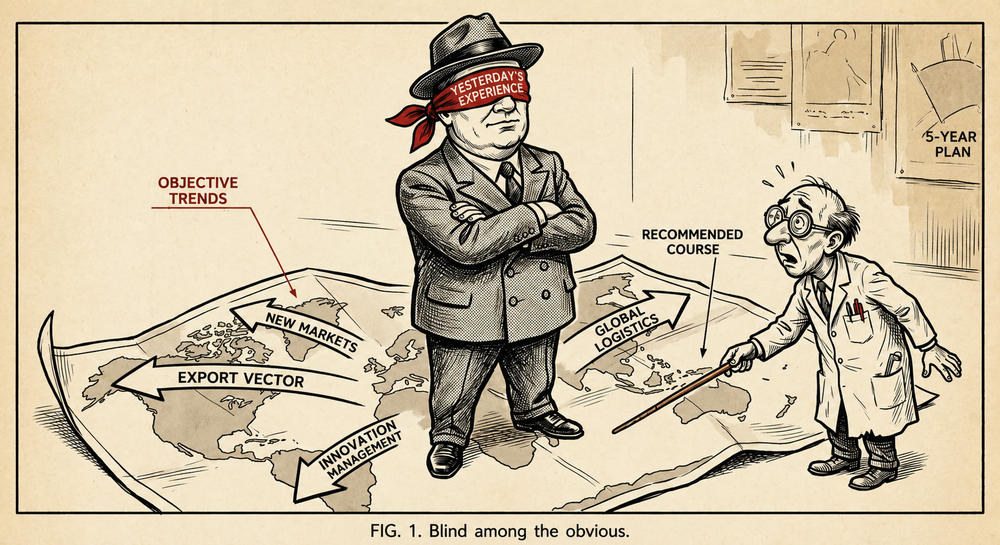
The most important transformation occurring today is not the disappearance of the smartphone.
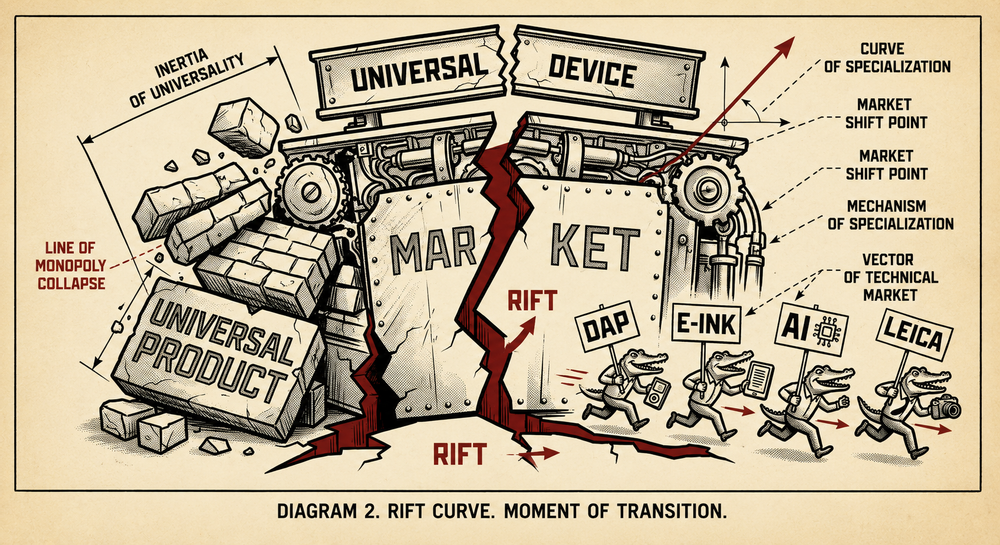
The transformation lies in the gradual dissolution of its monopoly.
Functions that were once successfully consolidated into one universal object are beginning to separate again into specialized environments.
The audio world offers one of the clearest examples. Portable hi-fi culture and dedicated audio systems increasingly exist outside the smartphone ecosystem. The return of specialized listening devices signals something deeper than consumer preference. It reflects a renewed demand for autonomous sensory environments.
A similar process is visible in reading and cognition. E-ink systems such as Kindle, reMarkable, Supernote, and Boox are not succeeding because they are technologically superior to tablets. In many respects, they are technologically more limited.
Their strength lies elsewhere.
They reduce noise.
They create concentration.
They restore a slower cognitive rhythm inside an increasingly overloaded information environment.
In this context, the device is no longer merely hardware. It becomes a cognitive territory.
The same fragmentation appears in photography. Professional imaging systems did not disappear under smartphone dominance. Instead, they retained something the universal device could never fully absorb: the philosophy of the image itself. Professional cameras increasingly function not as obsolete relics, but as sovereign creative instruments alongside mobile ecosystems.
Even multitasking environments reveal the same tendency. Stylus systems and flexible Android workflows anticipated an important shift that much of the market initially underestimated.
The stylus is not simply a creative accessory.
It is an instrument of thinking.
This distinction becomes increasingly significant in an economy shaped not only by consumption but by distributed intellectual work.
Taken together, these developments suggest that the era of one device doing everything may be approaching its historical limit.
KEY IV
AI and the Separation of Intelligence from the Device
The deepest rupture is not taking place in hardware.
It is taking place in the intelligence infrastructure.
For many years, the centrality of the smartphone depended on the fact that the device itself functioned as the main operational gateway to the digital world. Today, that logic is beginning to shift.
Artificial intelligence introduces a new layer between the human being and the machine environment.
Increasingly, the strategic center of digital civilization is migrating away from the object itself and toward language systems, AI agents, contextual computing, and distributed cloud intelligence.
This transition alters the hierarchy of technological power.
The crucial competition is no longer centered exclusively on who builds the best device. It increasingly concerns who controls the intelligence layer surrounding the device.
This is why Google, OpenAI, xAI, and other AI-centered systems occupy an increasingly strategic position.
The significance of this moment cannot be overstated.
For the first time in many years, Apple risks appearing not as the primary architect of the next technological phase, but as a participant adapting to an infrastructure being constructed elsewhere.
The implications of this shift extend far beyond the smartphone market.
They concern the future location of digital sovereignty itself.
KEY V
Google and the New Architecture of Power
Apple historically mastered the object.
Google increasingly masters the intelligence surrounding the object.
This distinction defines the emerging landscape.
The contemporary device is gradually becoming less important as an isolated technological artifact and more important as an access point into distributed systems of contextual intelligence.
In this environment, the smartphone transforms into something closer to an AI terminal.
The operating center moves outward — into search architecture, language models, recommendation systems, cloud cognition, predictive interaction, and invisible computational layers shaping user behavior before conscious decision-making even occurs.
If the previous era was defined by the universal device, the next era may be defined by the universal intelligence layer. And if that occurs, the center of digital civilization will no longer reside primarily inside hardware ecosystems.
It will reside inside systems capable of organizing cognition itself.
KEY VI
China and the Return of Expansionary Engineering
Another critical sign of structural transition can be observed in China.
Many Western technological ecosystems increasingly display characteristics of stabilization and infrastructural preservation. Chinese companies, by contrast, often operate with the logic of accelerated experimentation.
This difference produces an important psychological divergence.
Companies such as Xiaomi, Huawei, vivo, and OPPO frequently appear more willing to disrupt their own cycles, rapidly implement experimental technologies, and dissolve boundaries between premium and mass-market innovation.
This creates a technological culture defined less by equilibrium and more by movement.
The significance of this dynamic extends beyond hardware competition alone.
It suggests that different regions of the world may now occupy different historical phases simultaneously: some preserving mature systems, others still operating in a phase of expansionary engineering.
KEY VII
The Illusion of Stability
The most dangerous aspect of historical transitions is that they rarely begin with visible collapse.
They begin with shifts in gravity.
Externally, the existing order often appears remarkably intact. Financial indicators remain strong. Market capitalization remains enormous. Consumer loyalty persists. Infrastructure continues functioning.
And yet the organizing center quietly begins to move elsewhere.
This may be the defining condition of the present moment.
Apple remains extraordinarily powerful. The smartphone remains indispensable. The digital ecosystem continues to function at a planetary scale.
But intelligence is beginning to separate from the device. Professional tools are regaining autonomy.
Specialized cognitive environments are strengthening. AI increasingly positions itself as the primary mediator between human beings and digital systems.
The architecture of the previous era remains visible. But the internal center of gravity may already be shifting beyond it.
CONCLUSION
The End of the Single Digital Center
This report does not argue for the end of Apple. Nor does it predict the disappearance of the smartphone. The transformation underway is more profound than either of those outcomes.
What is approaching its historical limit is the era in which one universal interface functioned as the unquestioned center of digital civilization.
A different structure is beginning to emerge — one defined by distributed intelligence, specialized cognitive systems, AI infrastructures, professional technological environments, and multiple overlapping interfaces.
The central strategic question of the coming decade is therefore not simply which company will dominate the device market.
The more resonant question is this:
Where will the new center of digital power reside once intelligence itself detaches from the universal device?
It is around this question that the next phase of technological civilization is likely to be organized.
EXECUTIVE SUMMARY
The central argument of this report is that the contemporary digital order is entering a phase of structural decentralization.
For nearly two decades, the smartphone — and particularly the iPhone — functioned as the primary center of technological gravity. The universal device unified communication, media, photography, navigation, entertainment, and access to digital infrastructure within a single coherent interface. Apple consequently became not only a technology company, but a cultural and architectural center of the digital era.
This report argues that the exclusivity of that position is beginning to erode.
The smartphone is not disappearing. However, it is gradually losing its status as the unquestioned center of digital civilization. Functions once consolidated inside a universal interface are increasingly migrating toward specialized cognitive systems, professional technological environments, and distributed AI infrastructures.
Artificial intelligence now emerges as a strategic layer more significant than the operating system itself. Control over language systems, contextual computing, AI agents, and cloud intelligence increasingly determines the future architecture of digital power. In this transition, companies such as Google, OpenAI, and xAI are acquiring growing influence over the intellectual layer surrounding the device ecosystem.
Simultaneously, several industries once absorbed into smartphone centralization are regaining autonomy.
Portable hi-fi and DAP systems increasingly define an independent premium audio culture. E-ink ecosystems such as Kindle and reMarkable are establishing themselves not merely as devices, but as environments for concentration and deep reading inside overloaded digital conditions. Professional imaging systems preserve their role as sovereign creative instruments rather than disappearing under mobile photography dominance.
Samsung and broader Android multitasking environments continue strengthening their position as flexible platforms for distributed intellectual work, particularly in contexts where workflow complexity exceeds the logic of the universal consumer device.
At the same time, Chinese technological ecosystems increasingly operate in a phase of accelerated engineering expansion, demonstrating a higher tolerance for experimentation, rapid iteration, and aggressive hardware innovation.
Taken together, these developments suggest that the era of the single digital center is approaching its historical limit.
The report concludes that Apple is unlikely to disappear as a corporation or premium ecosystem. However, the company increasingly risks occupying a different historical position: not as the unquestioned center of digital civilization, but as a highly refined interface existing atop technological systems whose strategic core is progressively shifting elsewhere.