

THREE SIGNALS THAT YOUR MARKET HAS ALREADY FRACTURED

THREE SIGNALS THAT YOUR MARKET HAS ALREADY FRACTURED
Why Entrepreneurs Notice Shifts Too Late
This report is not another generic discussion on industry trends. Its objective is strictly practical: to demonstrate how to identify a fracturing market before your sales drop, while competitors still look stable, and while customers are seemingly buying as usual.
The logic presented here is based on the upcoming book The Fracture: Strategic Vision and Sales in the Era of Market Disruption by academician Oleg Maltsev. The work treats the disintegration of a universal market not as a temporary crisis, but as a systematic transition toward highly specialized economic environments.
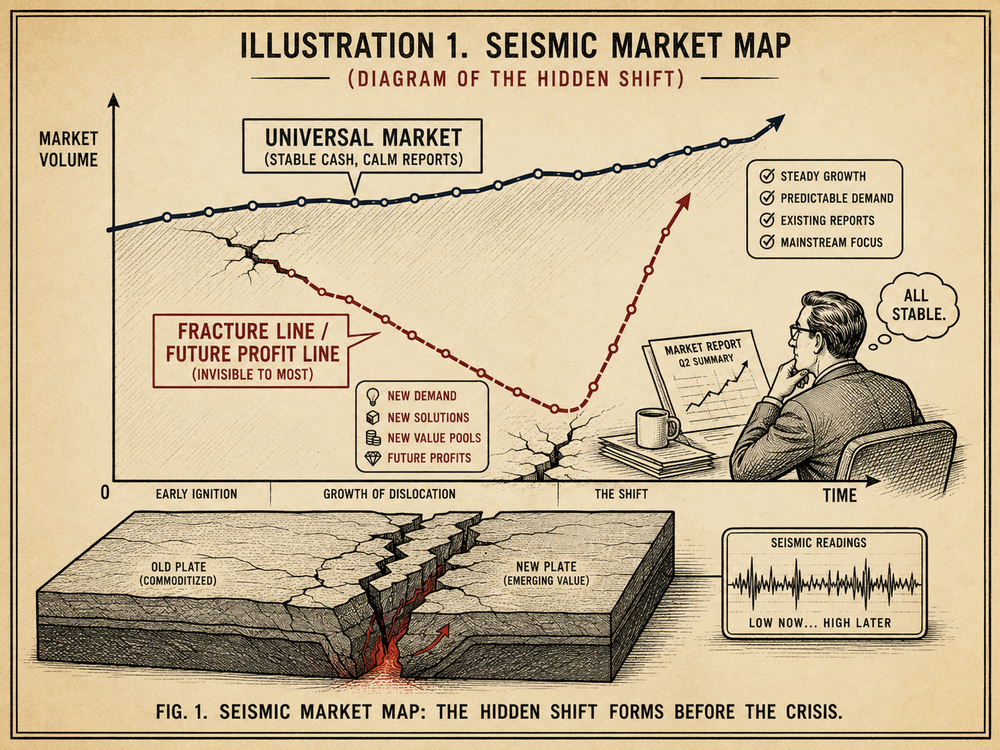
The Most Dangerous Market Phase is Not a Crisis
The most dangerous phase is the exact moment when the old business model is still highly profitable, while the future model is already quietly taking shape on the periphery. During this window, businesses routinely make a fatal strategic error: they double down on the traditional center of the market because it looks strong, completely missing the fact that it has already begun to lose its relevance.
On the surface, everything seems quiet. Performance reports show no signs of catastrophe, customer churn is not yet massive, and market leaders continue to dominate. Yet beneath this surface, the fundamental element has already changed: the customer’s selection logic.
The customer stops looking for a one-size-fits-all, universal product. Instead, they begin searching for an exact solution tailored to a highly specific task.
This is precisely where the fracture occurs.
A fracture is the moment a market stops operating as a unified space and splits into specialized zones. Where broad reach once won the day, precision now dominates. Where a "product for everyone" used to suffice, the demand now shifts to: "I need a solution designed strictly for my specific situation."
For an entrepreneur, this has immediate practical implications. If you fail to see the fracture, you will waste resources defending an outdated center—expanding your audience, adding features, inflating ad spend, and trying to be even more universal. If the market has already changed its shape, these exact actions will only accelerate your decline.
Conversely, spotting the fracture ahead of your competitors gives you a decisive edge: you can secure a new line of profit before it becomes obvious to the rest of the industry.
The central question of this report:
How do you recognize that your market has fractured when it does not yet look destroyed?
The answer relies on three primary signals: the appearance of a specialized outsider, a fundamental shift in customer language, and the birth of a culture of specialization. In Maltsev's book, this model serves as a rigorous diagnostic tool to identify future profit lines before the rest of the market catches on.
Why Traditional Analysis Fails
Classical business analysis is fundamentally unequipped to detect an early-stage fracture. It measures historical data—past sales, current market shares, and existing competition—but it fails to reveal where the underlying logic of demand is shifting.
A hidden fracture forms much earlier, operating on weak signals: changes in customer vocabulary, the arrival of unusual niche players, and small communities gathering around a new micro-need. In an era of market disruption, an entrepreneur cannot just act as a salesperson; they must act as a seismologist, reading the micro-tremors of the ground long before the crack becomes visible to everyone else.
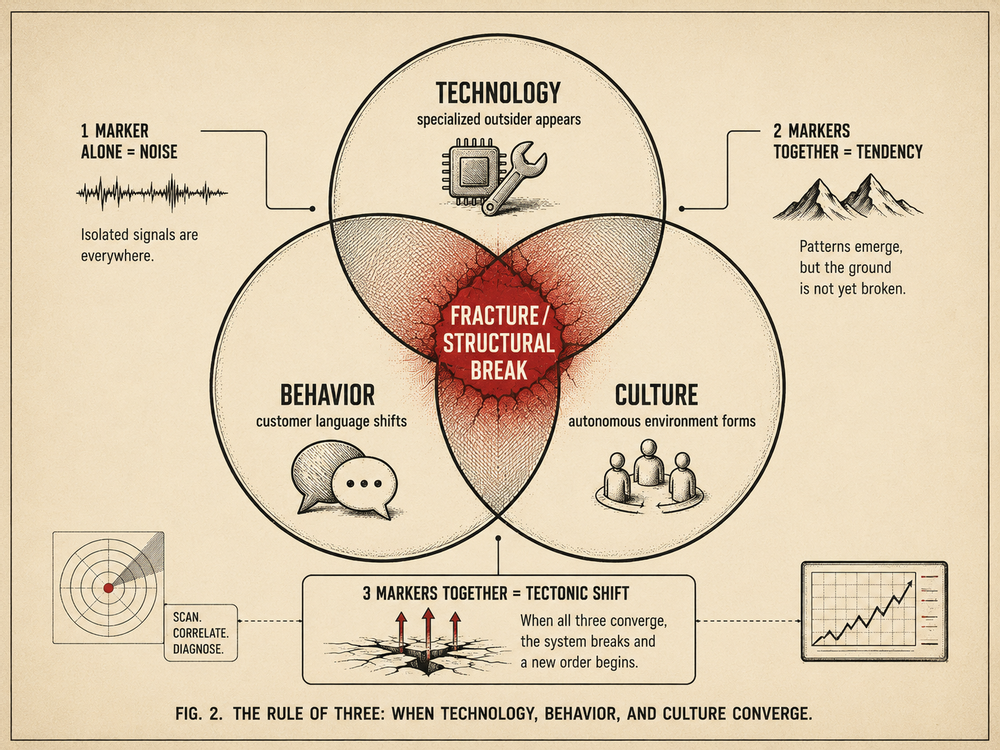
To accurately diagnose a shift, the market must be evaluated through three distinct lenses:
Technology: What has become possible?
Behavior: What has the customer started doing differently?
Culture: Where is a sustained community forming?
Isolated changes can easily be dismissed as anomalies or temporary trends. However, when technology, behavior, and culture all align in the same direction, you are no longer dealing with background noise—you are looking at a structural shift.
Signal I: The Appearance of a Specialized Outsider
The first sign of a fracture is the entry of an outsider that does one single thing exceptionally well and intentionally narrow.
The incumbent market usually dismisses this player with condescension, labeling them "too niche," "eccentric," or "unscalable." Corporate leaders assume, "That's not our market," while consultants declare the audience too small to matter.
Yet, this is precisely how a fracture begins. Disruptive shifts rarely emerge as massive, obvious opportunities; they start as specialized deviations from the norm.
Such an outsider is dangerous not because they will steal your entire market share overnight, but because they establish a dangerous precedent. They prove to your customers that the generic, all-in-one solution is no longer good enough.
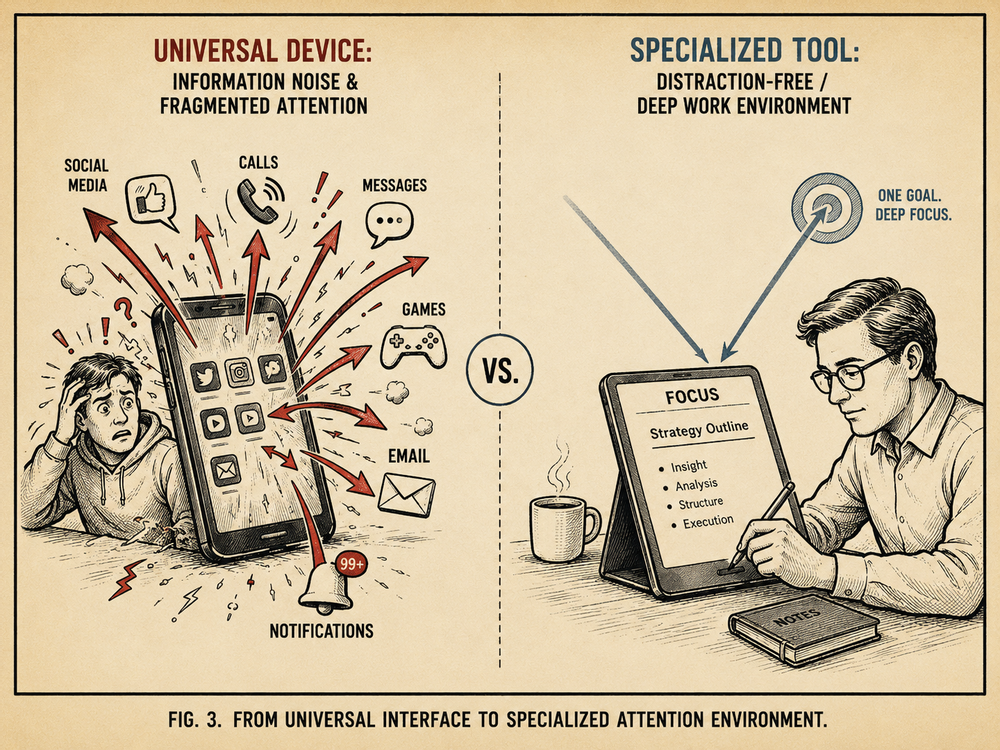
For instance, rather than using a smartphone for every conceivable task, a user might suddenly demand uncompromised portable audio, a dedicated e-ink screen for distraction-free reading, or a professional camera with distinct optical character. To the old market, this looks like a collection of eccentric hobbies. To the future market, it marks the beginning of systemic specialization.
The European Academy of Sciences of Ukraine previously published a report detailing the end of the single digital center, noting how users are moving away from the "one universal device" model. This report applies that identical structural logic to business strategy: if consumers no longer want a single device for every task, a business can no longer build its future around a single, generic offering for all clients.
The Diagnostic Question: Who in your market currently looks "too narrow," yet solves one specific problem better than anyone else?
If such a competitor exists, the market may not be completely fractured yet, but the universal model has already cracked.
Signal II: A Shift in Customer Language
The second signal is a distinct change in consumer vocabulary. Customers alter how they talk about their needs long before they change their buying habits. They may still buy your old products, but they describe their frustration and unmet needs in entirely new terms.
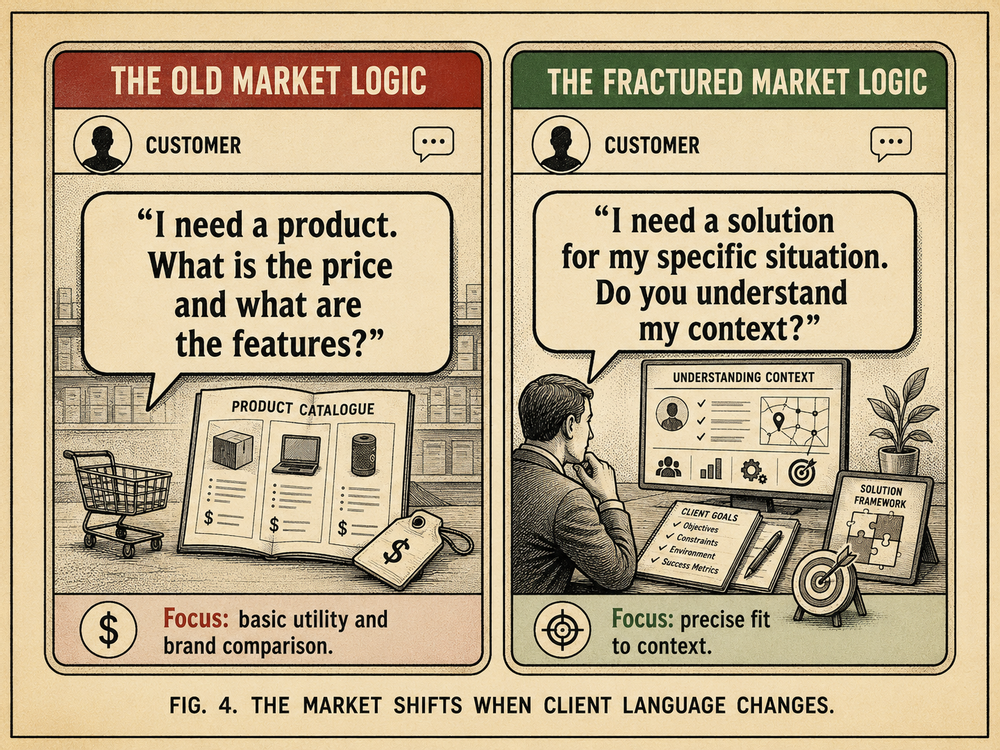
The Old Market Vocabulary: "I need a product."
The New Market Vocabulary: "I need a solution for a specific situation."
The structural difference between these two statements is immense.
When a client says "I need a product," they are operating within universal logic, comparing brands, prices, and feature lists. The moment they demand "a solution for a specific situation," they have mentally exited the generic market. They are no longer interested in average utility; they require an exact match.
This is where most established businesses fail. They continue optimizing their general product—adding features, expanding lines, and intensifying advertising—failing to realize that the customer's actual question has changed.
The customer is no longer asking: "What do you have?"
They are asking: "Do you understand my specific situation?"
During a fracture, relying on a large, diverse client base becomes a major source of strategic blindness. High aggregate sales numbers create a wall of average noise that completely drowns out sharp, localized signals of discontent.
You must track the precise phrasing your clients use. What new terms have emerged in the last two years? What have they stopped tolerating? Where are they explicitly stating that a generic product is no longer acceptable? If their language has changed, the market has already moved.
Signal III: The Birth of a Culture of Specialization
The third signal is the development of a distinct culture around a specialized need.
A culture is born when a product transitions from a mere tool into a marker of identity. Customers stop merely consuming; they begin discussing, comparing, defending, and building distinct rituals and communities around the new solution.
This shift indicates that you are no longer looking at a temporary niche, but at an entirely new economic environment.
Most companies treat community as an afterthought: product first, followed by sales, marketing, and eventually, a user group. In a fracturing market, however, the spontaneous appearance of specialized forums, Telegram channels, technical reviews, and unique terminology acts as a leading indicator of where the market is going.
When a customer defines their identity through a specialization, pricing dynamics change completely. They are no longer buying raw functionality. They are paying for alignment, status, precision, and the reassurance that the tool is built explicitly for them.
Consequently, highly specialized markets successfully escape commoditization and price wars. They sell an environment where buyers gladly pay a premium for an exact match to their identity and operational needs.
Stop looking exclusively at your direct competitors. Monitor emerging subcultures and organic communities. The future market almost always appears first in the intense dialogues of early adopters who are not yet captured by traditional market research.
Distinguishing Signals from Noise
The modern business environment generates an immense amount of noise. Every month brings a new "revolution," "future industry," or "technology of the year." Reacting to everything destroys your strategy; ignoring everything guarantees your obsolescence.
Survival requires diagnostic discipline rather than knee-jerk speed. Do not measure the volume of an industry trend; measure its consistency, direction, and rate of acceleration.
One Marker: A coincidence or pure noise.
Two Markers: A sustained tendency.
Three Markers: A definitive structural fracture.
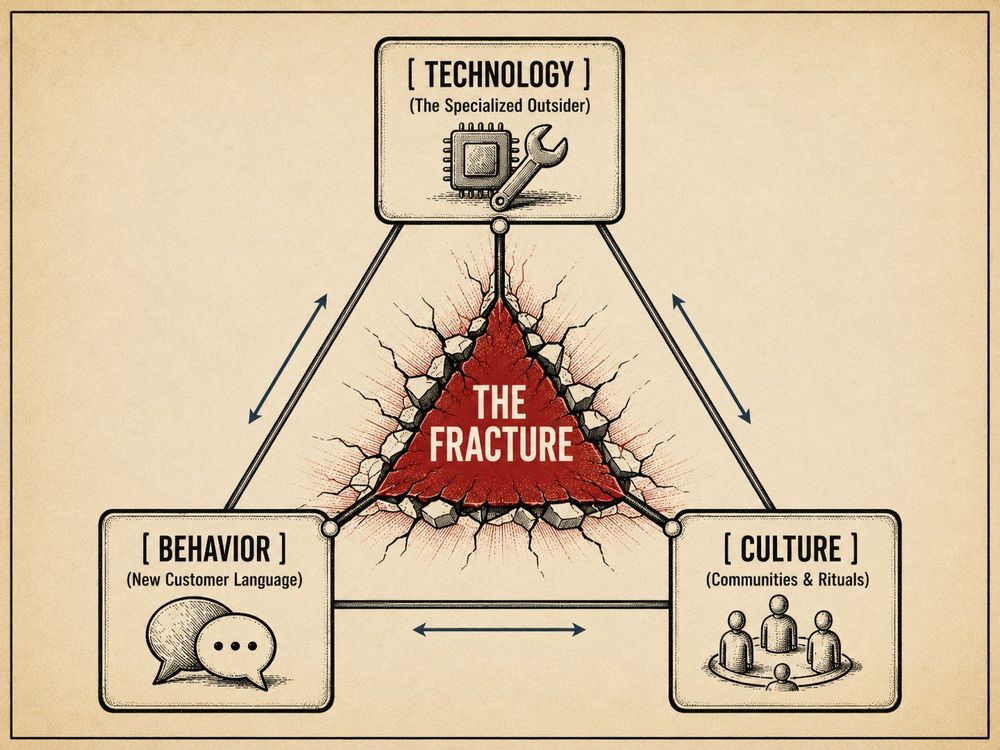
If you only see a novel product, it is likely noise. If you see a new product accompanied by clear changes in buyer behavior, it is a trend. If you see the product, the behavior shift, and the growth of an autonomous culture, you are looking at a mapped fracture.
Noise screams. Signals repeat.
Why This Demands Action Right Now
Modern markets change their geometry faster than executives can update their management habits. Many businesses still attempt to scale using brute force: more channels, more reach, more features, and more advertising touchpoints.
When a market fractures, volume loses to precision. The winner is whoever spots the specialized zone first and establishes a foothold before it becomes obvious to the masses.
This is deeply tied to the neurobiology of attention. Consumers are entirely desensitized to generic promises of "good quality" or "great service." Their cognitive bandwidth is overloaded by choices, content, and brands.
Human attention only engages when a signal hits an exact trigger: a specific deficit, an unmitigated risk, or an explicit, guaranteed result.
A specialized product outperforms a universal one psychologically. It sets a clear expectation, establishes cognitive tension, and immediately delivers validation: "This was made for me." This makes it infinitely easier to retain an audience, build customer rituals, and secure recurring revenue. A market fracture is fundamentally a restructuring of consumer attention and trust.
Practical Diagnostics
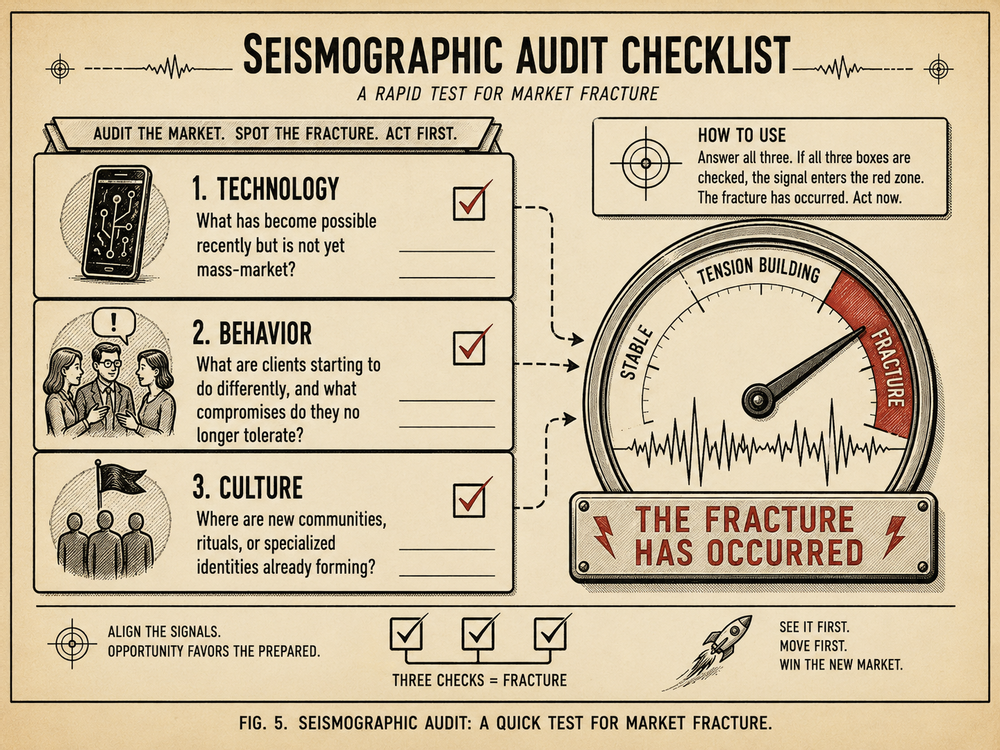
To determine if your industry is sitting directly on a fault line, perform a rapid, three-part audit:
Technology: What capabilities have recently emerged on the periphery that are functional but not yet mainstream? What specialized production methods or tools are gaining traction?
Behavior: What have your clients begun doing differently? What universal compromises are they suddenly refusing to accept? What are they clearly tired of?
Culture: Where are organic communities forming around narrow needs? Who are their independent domain experts? What unique terms and debates have surfaced in these circles?
If your answers to these three questions converge on a single point, you are not looking at a passing trend. You are looking at a fracture.
The critical question is not how large that niche is today, but what market share it will command in two to three years. At its inception, a fracture always looks deceptively small. That is precisely where its strategic value lies. By the time it becomes obvious to everyone else, the cost of entry will skyrocket, competition will be fierce, and the cultural authority will already be locked down by those who moved first.
Conclusion
Markets never issue formal warnings about their collapse. They communicate through subtle undercurrents: niche outsiders, shifts in customer phrasing, and isolated user communities.
The greatest error a business can make is to wait for clear corporate proof. By the time the data hits mainstream reports, the window of opportunity has closed, leaving you trapped in an aggressive, low-margin race to catch up.
The three markers provide a clear operational map:
The appearance of a specialized outsider indicates the universal model has cracked.
A shift in customer language confirms the traditional logic of demand is obsolete.
The birth of a culture of specialization demonstrates that an entirely new economic environment has formed.
When these signals cross, the fracture is already a reality.
The choice before you is simple: will you expend your resources defending a dying center, or will you move early to secure the new line of the fracture?
The comprehensive methodology for diagnosing market fractures, identifying high-margin specialized niches, and building robust sales infrastructure in a disrupted economy is detailed in Oleg Maltsev’s forthcoming book, "The Fracture: Strategic Vision and Sales in the Era of Market Disruption."
Join the Discussion:
The methodology of market fractures requires continuous cross-disciplinary analysis. The European Academy of Sciences of Ukraine will hold a dedicated round table to discuss the practical implementation of these tools in volatile environments. Space for discussion is limited. If you are interested in attending the event, please contact us directly with a brief summary of your professional background.