

The Student’s Side of the Problem: How Social Media and Mobile Phones Affect Intellectual Development
The Student’s Side of the Problem: How Social Media and Mobile Phones Affect Intellectual Development
By Iryna Lopatiuk
Abstract
This report examines the challenge of social media and mobile phones from the student’s own perspective. Rather than treating phone use simply as distraction or addiction, it focuses on the everyday difficulties students themselves describe: reaching for the phone automatically, losing time to doom-scrolling, finding boredom and difficult tasks harder to tolerate, struggling to begin academic work, experiencing long-form reading as increasingly demanding, and losing control of breaks. It also considers FOMO, the habit of filling every empty moment with screen activity, physical presence without full intellectual presence, and the cycle of guilt and anxiety that can follow lost study time.
The report argues that these experiences point to a broader question about intellectual development: at what point does a student stop choosing what deserves their attention and start simply following whatever captures it next? The issue is therefore not only the amount of time spent on a device, but the student’s relationship with attention, difficulty, choice, and the ability to initiate and sustain intellectual activity. The report deliberately begins with students’ lived experience rather than imposing diagnostic labels such as “distraction” or “addiction.”
The report was presented by Iryna Lopatyuk as part of a joint academic symposium organized by professors and students of the European Academy of Sciences of Ukraine and Academia Libera Mentis. The presentation contributed the student-centered perspective to the broader discussion of how social media and mobile technologies are changing the conditions of intellectual development and what questions this creates for contemporary academia.
Discussion
Every time we discuss mobile phones and social media in education, we often look at the problem from the outside. We see a student looking at a screen during a lecture, or someone checking a phone instead of reading a book, and we say: the student is distracted. However, this description appears to be too simple, that is the reason the author has atempted listening to students themselves.
Overall, the problem looks different. They do not necessarily say, “I do not want to study.” Quite often they say almost the opposite: “I want to study, but I cannot seem to make myself do it.”
This is where I would like to start.
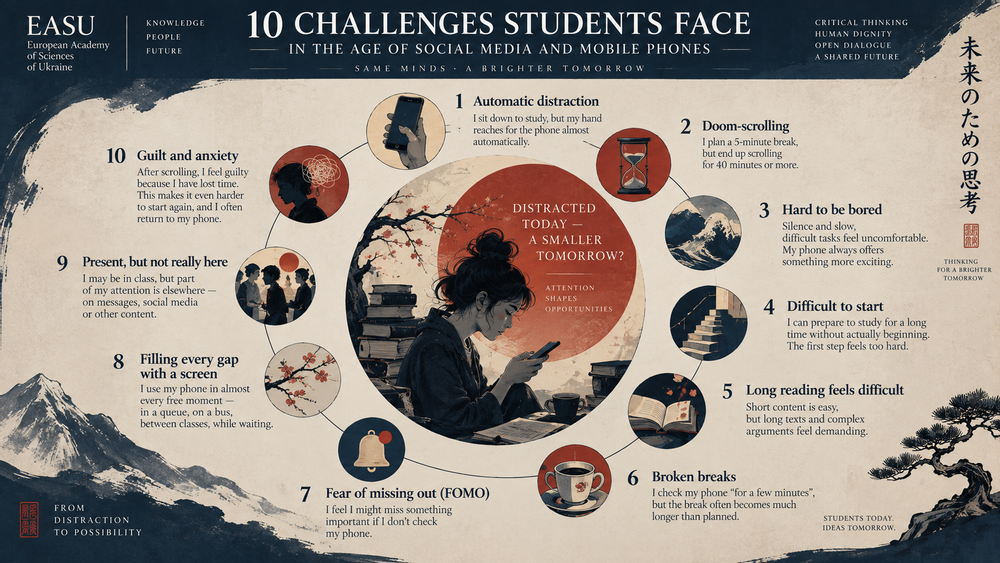
The first problem is: the phone can become an automatic action. A student may sit down to study, open a textbook, and then suddenly find the phone in his or her hand. There was no clear decision to stop studying. The hand simply reached for the phone. The student checks one message, then one video, then one post. The problem is not only distraction. It is that the moment of choice may become almost invisible.
The second problem is what students often describe as doom-scrolling. They may tell themselves, “I will take a five-minute break.” They open TikTok, Instagram, YouTube, Reddit, or another platform. Forty minutes later, they are still scrolling.
This creates a strange cycle. The student loses time, becomes worried about the work that has not been done, feels guilty, and then finds it even harder to return to the task. The phone has become not only a way to escape from work, but also a way to escape from the unpleasant feeling created by falling behind.
The third problem is the difficulty of being bored.
A student may understand that a lecture is useful or that a book is important, but still feel that it is simply too slow. A phone offers something new almost every second. A difficult academic text does not. There may be several minutes in which nothing particularly exciting happens.
This raises an important question: what happens to a student's ability to remain in an activity when the activity does not provide constant stimulation?
The fourth problem appears even earlier: starting a difficult task.
A student can spend twenty minutes preparing to study without actually beginning. The book is open. The laptop is ready. The notes are on the desk. But the first real step does not happen. A phone provides an immediate alternative that requires almost no effort.
So the problem may not be simply, “How long can I concentrate?” It may also be, “Can I begin something difficult before looking for something easier?”
The fifth problem is long-form reading.
Many students describe a strange experience: they want to read a book or an academic article, but after several pages they feel an impulse to check the phone. Short pieces of information are easy to consume. A long argument requires staying with the same subject.
This does not mean that every student has lost the ability to read long texts. But the repeated experience of moving quickly from one short piece of content to another may make long, continuous reading feel unusually demanding.
The sixth problem is the broken break.
A traditional break has a beginning and an end. You stop working, have coffee, walk outside, speak to someone, and then return.
A digital break can be different. There is no natural ending to the feed. After one video comes another. After one message comes another. The student may therefore return to studying not refreshed, but frustrated because the break became much longer than planned.
The seventh problem is FOMO — the fear of missing something.
A student may be sitting in class while thinking about what is happening online. Perhaps there is a new message. Perhaps friends are meeting somewhere. Perhaps something important has appeared in the feed.
Nothing dramatic has happened. But part of the student's attention remains somewhere else.
This leads to the eighth problem: the phone fills almost every empty moment.
- Waiting for a professor? Check the phone.
- Waiting for a bus? Check the phone.
- Five minutes before class? Check the phone.
- Standing in line? Check the phone.
The interesting question is what happens to a person when there is no longer any empty space in which nothing is happening. Those small moments can also be moments of observation, conversation, memory, imagination, or simply thinking about what has just happened.
The ninth problem is therefore physical presence without full intellectual presence.
A student can be sitting in the classroom, looking at the professor, and still be somewhere else mentally. The body is in the lecture hall, but attention is moving between the lecture, messages, social media, and other information.
For a student, this can create a particularly difficult situation: the lecture is not necessarily boring, but it is competing with an entire digital world.
And finally, there is the tenth problem: guilt.
A student scrolls instead of studying. Then the student realises that an hour has disappeared. There is anxiety: “I am behind.” The work now feels even more difficult. The student wants to avoid that feeling — and the phone is immediately available again.
Conclusions
Having analysed the 10 problems, we get to the point – somewhat of a heuristic circle as a core of the cognitive issues:
difficulty → phone → lost time → guilt → more difficulty → phone again.
Looking at these ten problems together, I would not describe the student simply as “distracted” or “addicted.” Those words already give us an interpretation.
Perhaps the central question is not simply how much time students spend on their phones.
Perhaps it is:
At what point does a student stop choosing what deserves his or her attention and start simply following whatever captures it next?
And if this question is significant, then the next question belongs to academia:
What kind of educational environment could help students understand and regain that choice?
Prospects for Further Research
The student’s perspective suggests that the educational problem cannot be reduced to the simple question of whether smartphones are “good” or “bad” for learning. The more productive object of study is the changing relationship between the student, attention, difficulty, and choice. The recurring experiences described by students may indicate that the important issue is not only how much digital content they consume, but what happens to their ability to initiate an activity, remain with it, tolerate the absence of immediate stimulation, and return to a task after interruption.
This makes further research particularly promising. Instead of measuring only screen time, future studies could examine the structure of students’ intellectual activity: how they begin tasks, how often they switch between activities, what happens when they encounter difficulty, how they use breaks, and whether they can deliberately choose where their attention goes. Such research could connect students’ own experiences with observable patterns of learning and, ultimately, help academia develop educational environments that strengthen intellectual autonomy rather than simply restricting or accepting digital technologies.