THE ORIGIN OF A SCIENTIFIC RESULT IN THE AGE OF AI
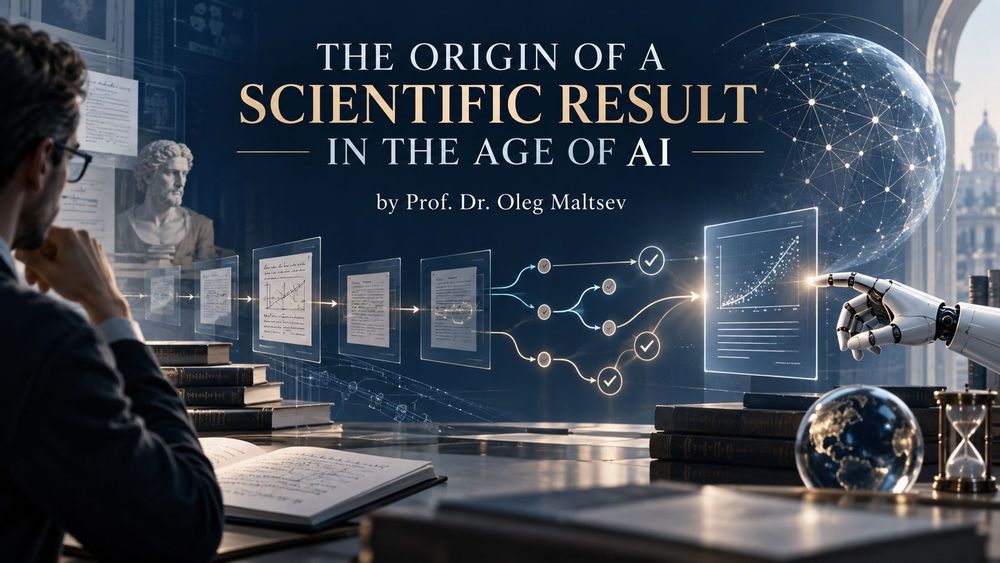
THE ORIGIN OF A SCIENTIFIC RESULT IN THE AGE OF AI
by Prof. Dr. Oleg Maltsev
Why the phrase “we used artificial intelligence” is no longer enough
At the end of a scientific paper, one increasingly encounters a short, almost technical statement: artificial intelligence was used in preparing this material. At first glance, this appears transparent enough. The author has disclosed the use of the tool, the journal has met its transparency requirement, and the reader has been informed. The matter seems settled.
But this is precisely where the real problem begins.
The phrase “we used AI” says almost nothing about how the final scientific result actually came into being. It does not explain where, exactly, the machine entered the process: whether it polished the style, translated the text, searched the literature, proposed hypotheses, wrote code, analyzed data, assisted with interpretation, or helped formulate conclusions. The same disclosure can conceal fundamentally different processes of knowledge production.
In one case, artificial intelligence may genuinely have been nothing more than a language assistant. In another, it may have participated in key stages of the research, from source selection to data analysis and the construction of the argument. Formally, both papers may contain the same statement about the use of AI. From the standpoint of research integrity, however, these are two entirely different situations.
That is why the question today should no longer be: “Was AI used?” That is yesterday’s question. The real question is different: what exactly must we know about the use of AI in order to reconstruct the origin of a scientific result?
Transparency Without Provenance
Scientific transparency has long been built around disclosure of facts: who the author is, who funded the research, what data were used, which methods were applied, and whether any conflicts of interest exist. The logic was straightforward: if the relevant circumstances are stated, the reader, editor, or reviewer can evaluate the work more accurately.
Generative AI disrupts the simplicity of that model.
It is not an ordinary tool like a word processor or a calculator. It can intervene in the workflow at different levels. It can suggest wording, identify connections, group sources, write pieces of code, propose interpretations, restructure an argument, correct errors—and it can do so not at a single point, but throughout the entire process.
For that reason, the binary disclosure “AI was used / AI was not used” does a poor job of describing the processual nature of AI-assisted research. It tells us that a tool was present, but not what role it played. And without knowing the role of the tool, we cannot understand the degree to which it influenced the result.
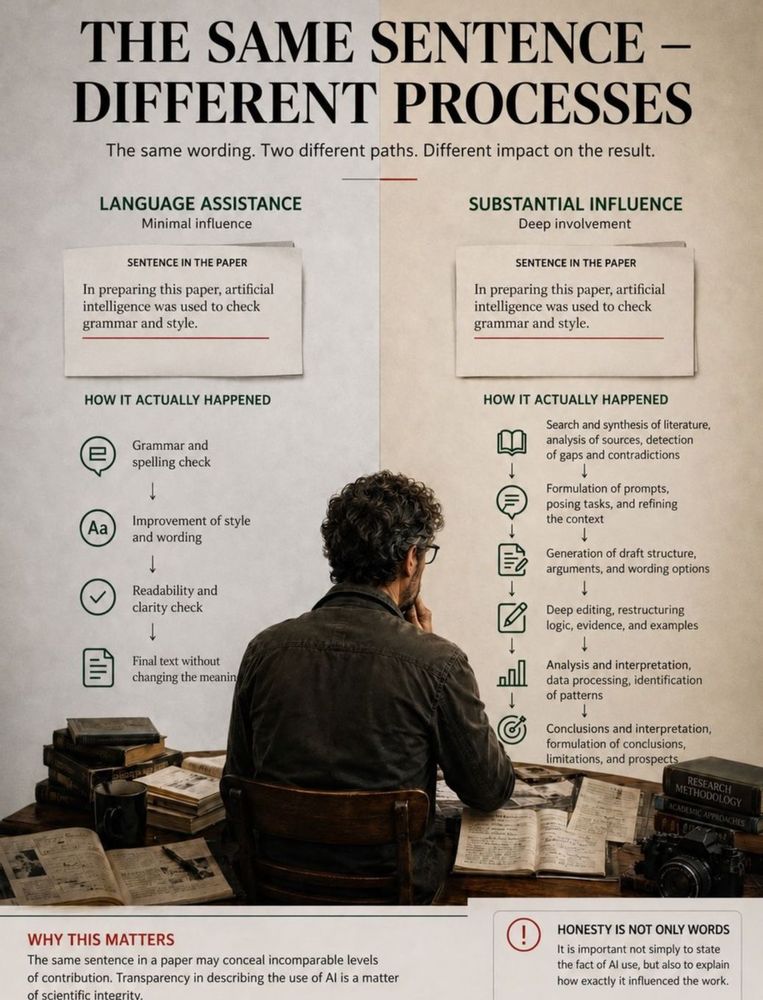
Consider two scientific papers. In the first, the author used AI to check the English and smooth out stylistic roughness. In the second, the author uploaded preliminary data, asked the model to propose an analytical structure, received several possible interpretations, selected one of them, then asked the model to rewrite the results section and incorporated part of that wording into the final text.
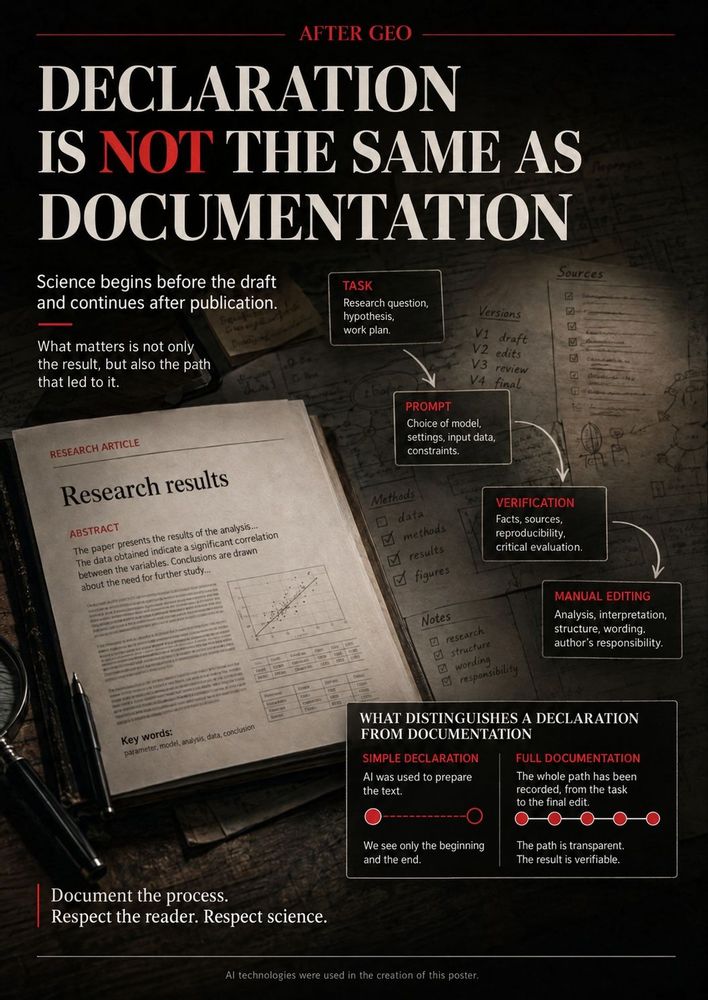
Both papers may contain exactly the same sentence: “AI was used in preparing this article.” Yet such a statement tells us almost nothing. It does not reveal the chain of decisions between machine output and human assertion. It does not show what was accepted, what was rejected, what was verified, what was changed, or who ultimately bears responsibility for the result.
This is the central fracture in the new scientific reality: disclosing the fact that AI was used is not the same as documenting the path by which AI influenced knowledge.
From Text Authorship to the Provenance of Knowledge
For too long, discussion of AI in science has revolved around an overly narrow question: who wrote the text—the human or the machine? This is what gave rise to the fixation on AI detection: attempts to determine whether a particular passage was generated by artificial intelligence.
But this approach quickly reaches its limits.
First, detectors are unreliable. They can fail in both directions: identifying human-written text as machine-generated and missing machine involvement where it actually occurred. Second, even perfectly detecting a “machine style” would not answer the central question: how was the scientific result itself produced?
Science is interested not only in the text. It is interested in the origin of the conclusion.
If a paper reports a statistical result, it matters how the data were obtained, how they were cleaned, who selected the analytical method, which alternatives were considered, and why a particular conclusion was accepted. If AI participated in any of these stages, its role should be reconstructable. Not because the machine is presumed “guilty,” but because every significant stage of scientific work should be open to verification.
This gives rise to a new category: provenance of knowledge.
The point is not to treat every text produced with AI assistance as suspicious. The point is that a scientific result should have an intelligible history of how it came into being. Trust should depend not on the mere presence or absence of AI, but on whether the significant stages in the production of the result can be reconstructed.
Not AI / non-AI.
But traceable / untraceable knowledge production.
Not “who wrote it?”
But “how did it come into being?”
What Exactly Should Be Preserved
If a scientific paper reports the use of AI but does not document the process, far too much remains invisible.
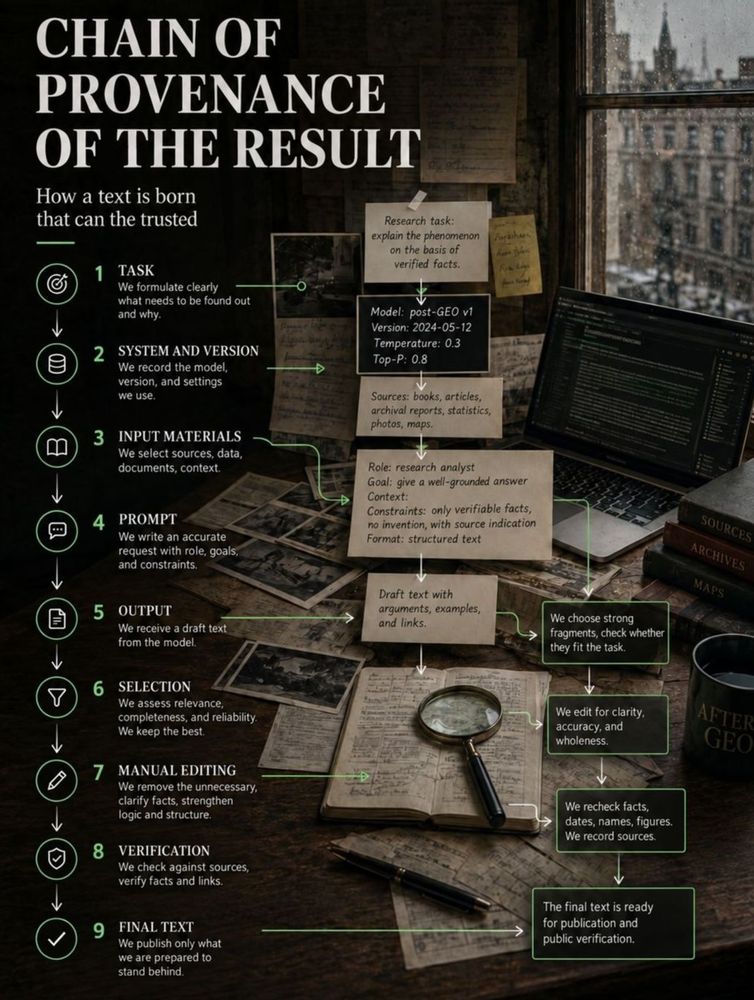
What task was given to the system? Which model was used? Which version? What materials were entered into the system? How were the prompts formulated? Were the prompts preserved in full, or was at least their structure described? Which AI outputs were rejected? Which were accepted? What did the human correct? What was checked manually? What was rewritten? What data were withheld from the model because of confidentiality? Who ultimately took responsibility for the decision?
These questions are not matters of bureaucratic curiosity. They matter because another person should be able to understand where, within the chain, the result emerged.
Documentation of AI use should record not merely the fact that a tool was used, but its function within the work. Was AI acting as a language editor? An assistant in literature search? A participant in analysis? A code generator? A tool for interpretation? A visualization instrument? An assistant in preparing a peer review?
Each of these cases carries a different level of risk and a different degree of influence on the scientific result. Correcting punctuation and assisting with data interpretation cannot be described by the same sentence. They belong to different zones of responsibility.
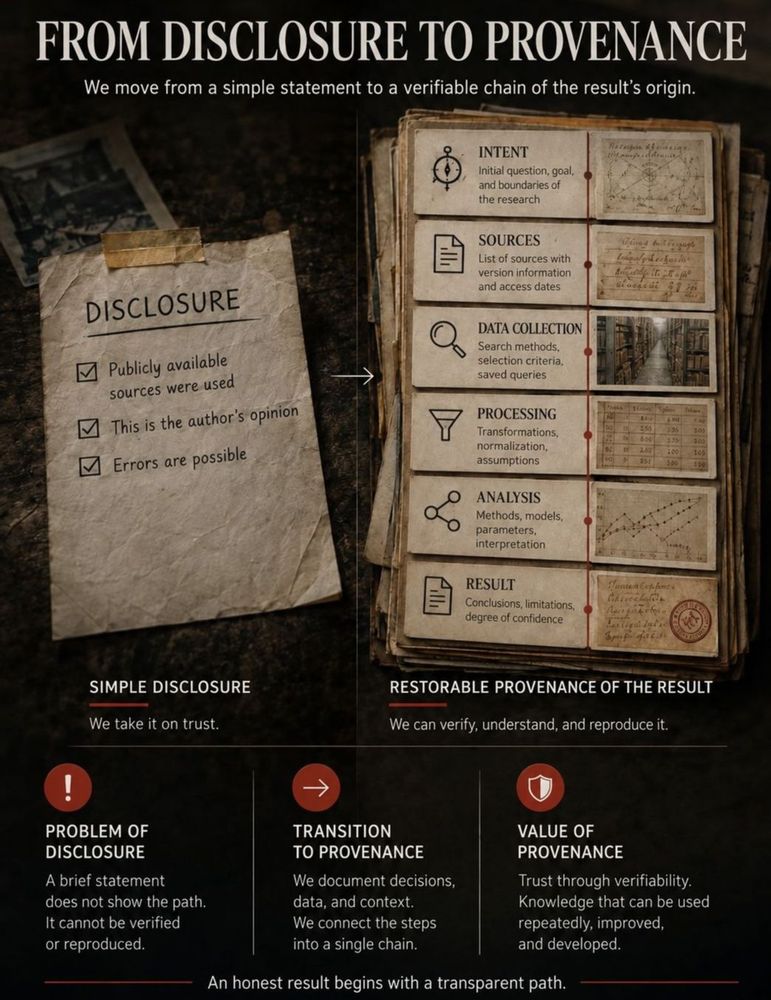
That is why simple disclosure of AI use should give way to process documentation.
Documentation Does Not Mean Publishing Everything
There is an obvious objection to this idea: does science risk turning into endless bureaucracy of logs? Must a researcher preserve every exchange, every intermediate prompt, every unsuccessful model response? Could such a system become so burdensome that normal scientific work is effectively paralyzed?
This is a serious objection, and it should not be dismissed as resistance to progress.
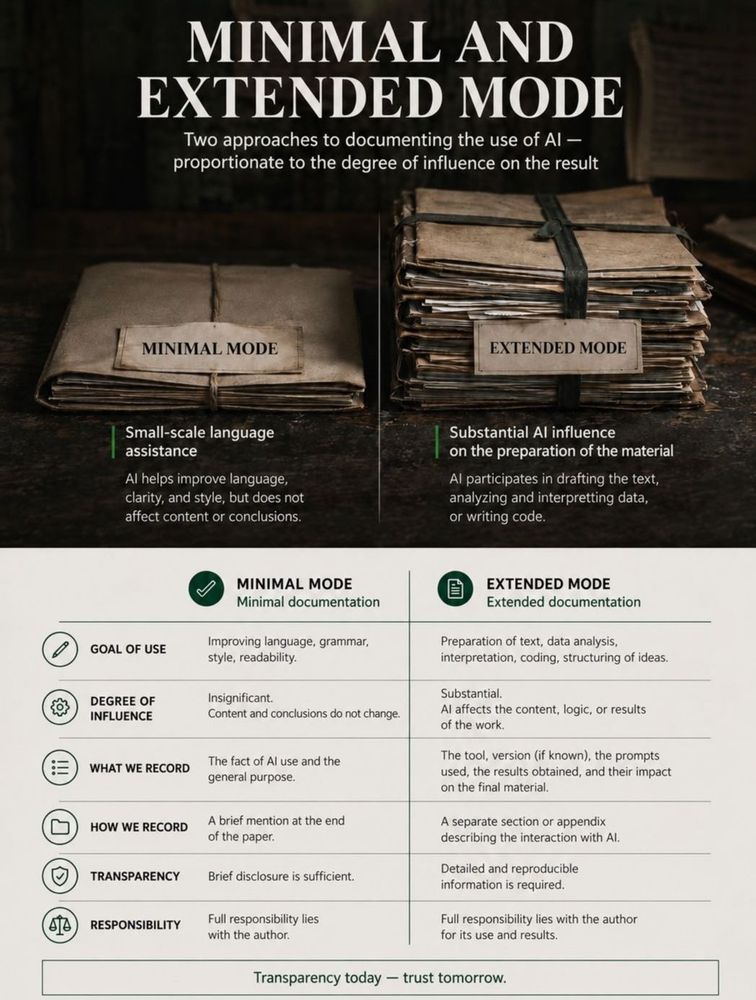
A reasonable approach must be proportional. Not every use of AI requires the same depth of documentation. If the model merely helped improve language, minimal disclosure may be sufficient. If AI participated in the literature review, data analysis, coding, interpretation of results, image creation, work with clinical materials, or processes related to peer review, a more detailed record is required.
It is important not to move to the opposite extreme. Documentation does not mean total publication of the entire process, especially where confidential data, personal information, patient materials, unpublished manuscripts, or sensitive research data are involved. In such cases, documentation may be restricted, redacted, or kept non-public in order to protect privacy.
The proper formula is different:
sufficient reconstructability + proportionality + protection of sensitive information.
The task is not to make the researcher a hostage to reporting. The task is to preserve enough of the process that, if necessary, it is possible to understand how AI influenced the result.
Documented Does Not Mean True
There is another important qualification. Documenting the process does not automatically make the result true.
A flawed path can be documented perfectly well. One can carefully record the use of a model, preserve the prompts, specify the system version, explain which outputs were accepted—and still arrive at an incorrect conclusion. There should therefore be no false equivalence between being documented and being proven.
Documentation provides something else. It provides verifiability of provenance.
If the result is wrong, it becomes possible to determine where the error arose. Was it in the original data? In the prompt? In the model output? In the human selection? In the interpretation? In the manual editing? In an unverified transfer of wording from an AI output into the final text?
This fundamentally changes the nature of scientific verification. An error ceases to be a dark spot hidden inside a finished publication. It becomes a localizable event within the chain of knowledge production.
That is why documentation matters not as a guarantee of infallibility, but as a condition of responsible verification.
Why Retrospective Detection Is Weaker Than Process Documentation
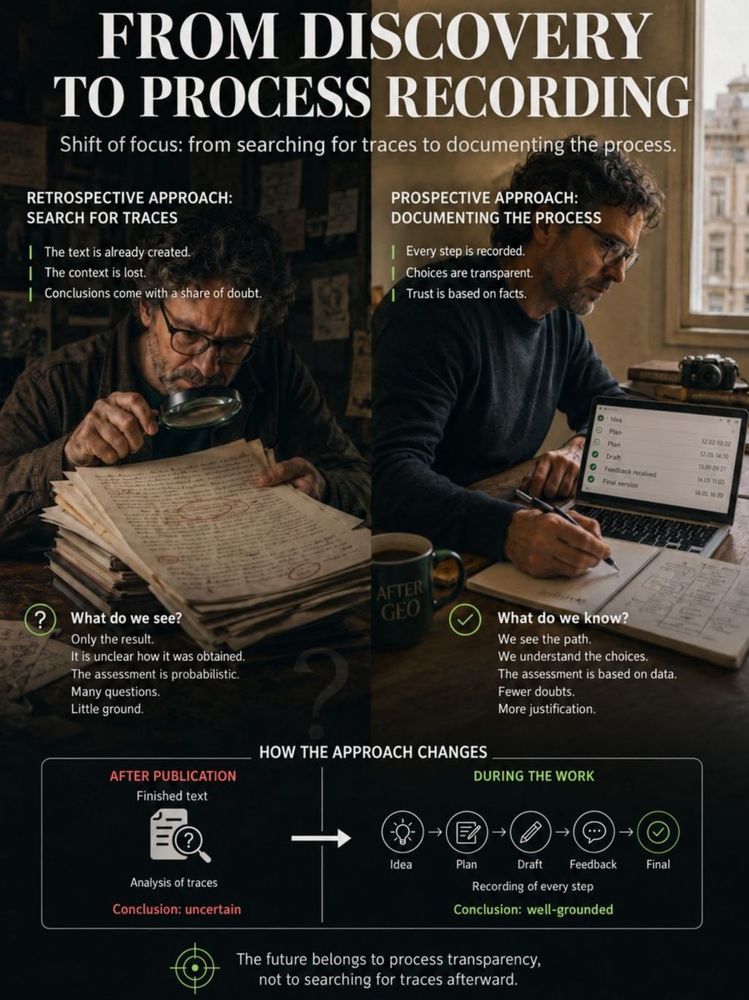
One of the strongest shifts in the emerging discussion is the move from retrospective detection to prospective documentation.
Previously, the problem was often framed this way: how do we detect AI in a finished text? But in scientific work, this is frequently the wrong question. By the time a paper is published, much of the process has already disappeared. Drafts have been deleted. Prompts have been forgotten. Unsuccessful versions have been discarded. Decisions that seemed obvious at the time can no longer be reconstructed.
The editor, reviewer, or reader is then left with nothing but the final text. They may try to guess where the machine was involved. But guesswork is a weak foundation for research integrity.
A more precise approach is to preserve the provenance of the result as it emerges. Instead of investigating the process only after its traces have disappeared, significant stages should be recorded during the work itself.
This is not simply a technical recommendation. It changes the logic of trust itself. Research integrity can rely less and less on a final disclosure alone and increasingly requires a preserved trajectory of how the result was produced.
AI Did Not Create the Problem of Provenance
It is important to understand that artificial intelligence did not create the problem of the provenance of scientific knowledge from nothing. The problem has always existed.
A scientific paper has always been the final product of a complex process. Behind it stood the choice of topic, selection of sources, working hypotheses, unsuccessful attempts, errors, revisions, discussions, drafts, and decisions made by supervisors, editors, and reviewers. Most of that history almost never appeared in the final publication.
AI has merely made this problem impossible to ignore.
When intellectual work begins to be performed by a hybrid system of human and machine, the disappearance of the process becomes especially consequential. The final result may now rest not only on human reasoning, but also on numerous machine operations invisible to the reader. If those operations influenced the conclusion but were not recorded, the provenance of the knowledge becomes opaque.
This applies far beyond science. The same logic operates in journalism, legal documents, analytical reports, expert opinions, architectural projects, books, educational materials, and even research photography.
Wherever a result is produced through a sequence of significant transformations, the final product is not the only thing that matters. The history of how it came into being matters as well.
The Author’s New Responsibility
In the age of AI, the author remains the central figure in scientific work. But the nature of that responsibility is changing.
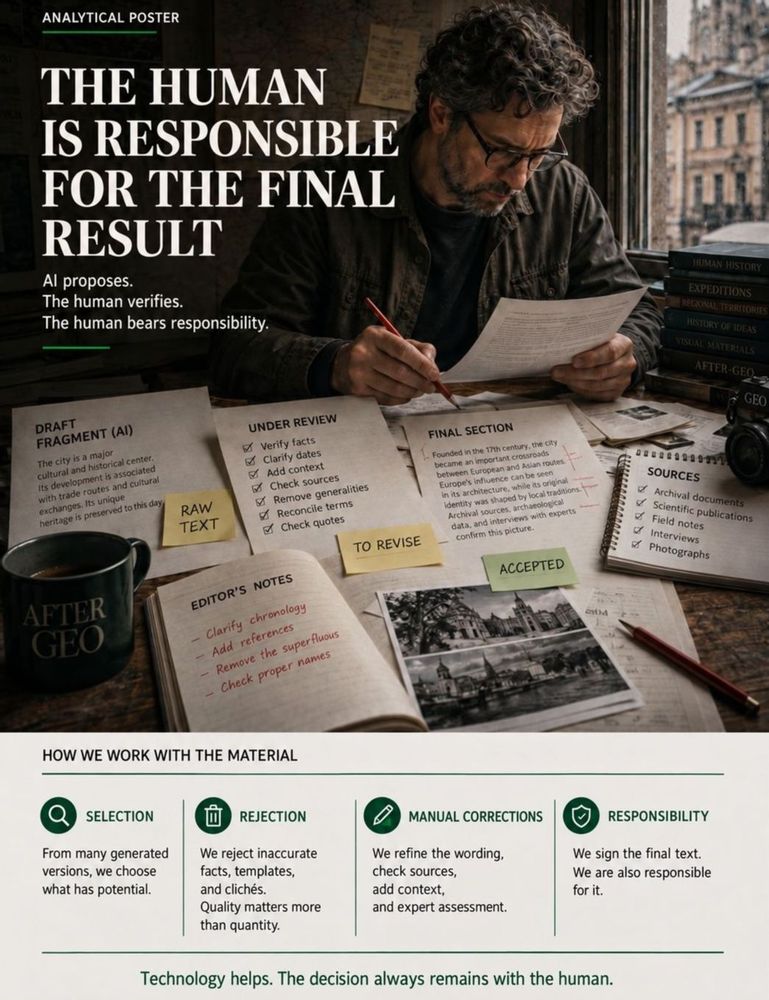
Previously, the author was responsible for the text, the data, the method, and the conclusion. Now the author must also be responsible for how a machine tool was incorporated into the research process. One cannot hide behind the phrase “AI suggested it.” Responsibility for an error cannot be transferred to the model. But neither can one pretend that the model’s involvement was irrelevant if it genuinely influenced the scientific content.
Human responsibility does not disappear here. On the contrary, it becomes more demanding.
The author should understand what was delegated to the machine, what came back as output, why some results were accepted and others rejected, what was independently verified, and where the boundary was drawn between machine assistance and the author’s own scientific judgment.
AI can assist. AI can accelerate. AI can propose alternatives. But the final scientific claim must remain the result of a responsible human decision—a decision whose provenance can be reconstructed.
From a Disclosure Statement to an Infrastructure of Trust
A single short line at the end of a paper can no longer carry the weight of this new reality.
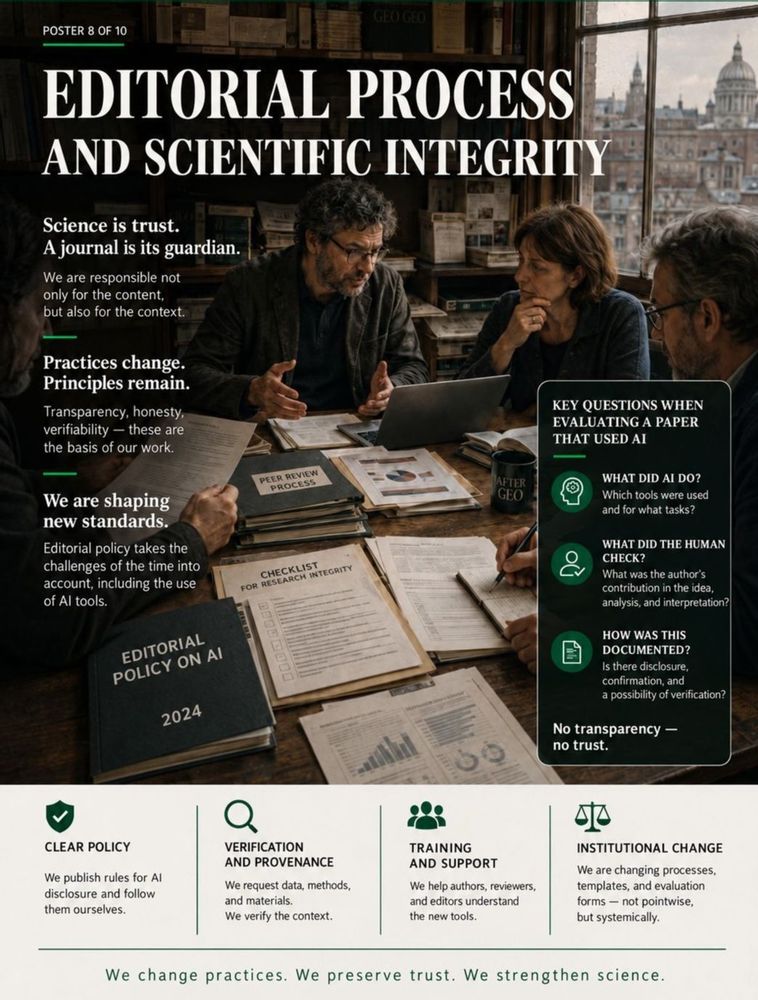
“We used AI” is the beginning of the conversation, not the end. Behind that sentence, an infrastructure must emerge: clear documentation templates, different levels of disclosure, procedures for sensitive data, rules for editorial teams, guidance for reviewers, and practical skills for researchers themselves.
For the researcher, this means recording significant interactions with AI during the work, not trying to reconstruct them on the final evening before submission.
For the editor and reviewer, it means asking not only “Was AI used?” but “Where could AI have influenced the scientific content, and how was that influence verified?”
For the reader, it means judging the transparency of a study not by the presence of a polished disclosure statement, but by the reconstructability of the result’s provenance.
For the scientific organization, it means building a provenance infrastructure instead of hunting for traces of machine style.
The Central Question for the Future
AI is changing more than the speed of scientific work. It is changing the very architecture of how a result comes into being.
A scientific paper once appeared primarily as the outcome of human research. Increasingly, however, what stands behind it is a hybrid process: the human sets the task, the machine proposes options, the human selects, the machine assists with analysis, the human verifies, the machine edits, the human approves, and the journal publishes.
Within such a system, the old question “Who is the author?” remains important, but it is no longer sufficient. Beside it, another question now arises:
Can we reconstruct the path by which the result came into being?
This is likely to become one of the central questions of research integrity in the years ahead. Trust in knowledge will depend less and less on declarations alone and increasingly on the ability to show the provenance of a significant conclusion.
Science does not need to reject AI. But it does need to stop pretending that a single sentence acknowledging its use is enough.
In the age of artificial intelligence, a transparent scientific paper is no longer simply one in which the author has acknowledged the use of a tool. It is a paper whose provenance can be reconstructed as a sequence of human and machine operations.
Not who wrote it.
But how it came into being.
LATEST NEWS
THE NIGHT THAT LEFT NO WITNESS
Reflections on the Fate of Science, or Should We Expect Digital Monasteries of the New Middle Ages?
The Student’s Side of the Problem: How Social Media and Mobile Phones Affect Intellectual Development
The 2025 PISA results, part I. Lies, damn lies, and English education statistics.
Social Media, Mobile Phones, and the Intellectual Development of Students: What Challenge Does Academia Face?