

THE NIGHT THAT LEFT NO WITNESS
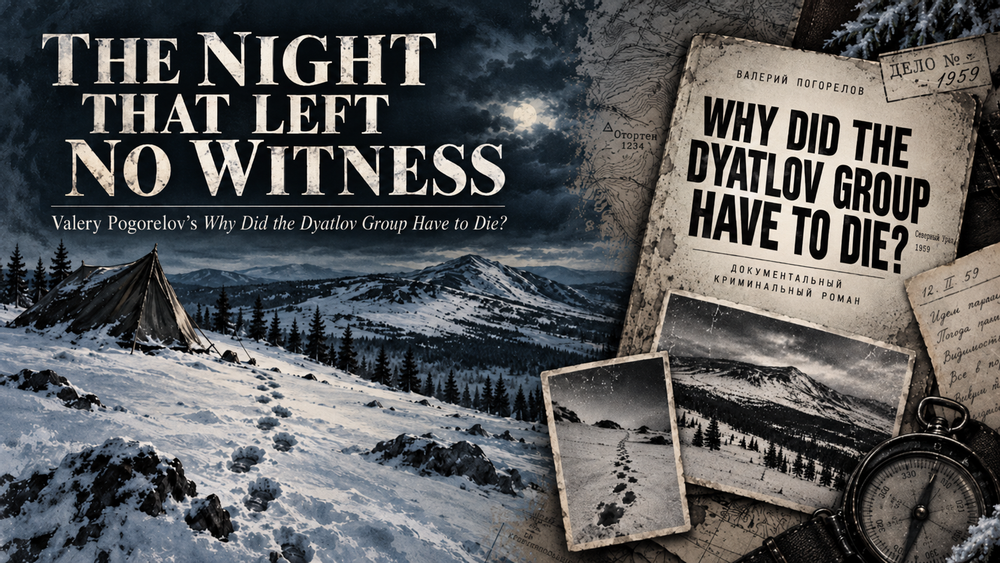
Valeriy Pogorelov’s Why Did the Dyatlov Group Have to Die? invites readers into a different kind of criminal investigation
There is a peculiar difficulty in investigating an event when its consequences have survived, but the event itself has not.
A tent stands on a mountainside. Footprints descend through the snow. Clothing, personal belongings and provisions remain behind. Bodies are found at different locations, bearing injuries that demand explanation. There are photographs, diaries, witness statements and official documents. Each item records something real. Yet none can tell the whole story.
Somewhere between the last known moments of nine living people and the discovery of their bodies lies a night that no surviving witness could reconstruct from personal knowledge. The evidence begins to speak only after the decisive events have already taken place. Everything that came before must be recovered indirectly, through traces left by people who are no longer able to explain what they did, what they saw or what they feared.
This is the extraordinary problem at the heart of the Dyatlov Pass tragedy. It is also the point from which Valeriy Pogorelov begins his new book, Why Did the Dyatlov Group Have to Die?, published by the European Academy of Sciences of Ukraine in 2026.
A story with a missing centre
In late January 1959, a group of nine experienced hikers led by Igor Dyatlov set out on a demanding winter expedition across the northern Urals. They were young people with their own characters, ambitions and reasons for undertaking a difficult route. They had prepared their equipment, planned their journey and expected to return. Their diaries and photographs preserve fragments of that ordinary human world, captured before anyone could know what the expedition would become.
By February, the group had disappeared from its expected itinerary. Searchers eventually found the abandoned tent on an exposed slope. The hikers had left behind much of their footwear and warm clothing, while their bodies were discovered at different locations on the mountain and below it. Some had suffered severe injuries. An official investigation followed, and its conclusion entered the historical record.
However, a record of the aftermath is not the same as an account of the event. The mysterious issue that continues to draw investigators, historians and readers to the Dyatlov Pass is not simply how nine people died in the winter wilderness. It is what happened during the interval that separates the expedition as it was last known from the scene that confronted those who came looking for it. What caused the group to leave the tent? What sequence of decisions and events followed? Which details can be explained by the physical conditions, and which continue to resist a satisfactory reconstruction?
Over the decades, the missing interval has attracted an extraordinary number of explanations. The tragedy has become a landscape of competing narratives, each offering its own way through the silence. Some explanations appeal to natural forces; others imagine circumstances beyond the ordinary. The more familiar the story becomes, the easier it is to forget that a compelling narrative and a demonstrated sequence of events are not the same thing.
A mystery might acquire a hundred explanations without acquiring a single eyewitness to its decisive moment.
Pogorelov approaches this difficulty from an unusual direction. Rather than beginning with a theory and arranging the available details around it, he treats the surviving evidence as a problem of reconstruction. The task is not merely to produce an account that sounds plausible. It is to determine what happened, what may have happened and where the evidence no longer permits a confident answer.
The criminologist’s method: follow the event backwards
A criminologist does not have the luxury of asking only whether a story makes sense. A story may be coherent and still be wrong. Its details may fit together because the author has selected those that support the conclusion and overlooked those that do not. In a difficult case, the most seductive explanation is often the one that makes uncertainty disappear too quickly.
Pogorelov’s approach starts with a different discipline: separating what has been established from what has been inferred, and separating both from what remains hypothetical. The distinction may sound simple, but it changes the entire character of the investigation. A footprint is not a motive. An injury is not, by itself, an explanation of the event that caused it. The location of a body may constrain a reconstruction without revealing every movement that preceded it. A missing witness does not give an investigator permission to invent one.
Working with the criminal case materials, photographs, diaries, witness accounts and forensic medical findings, Pogorelov examines the circumstances surrounding the expedition and attempts to reconstruct its final hours. His method is particularly concerned with sequence: what must have happened before something else could happen, which actions are consistent with the physical evidence, and which proposed links require assumptions that the surviving record cannot independently confirm.
This is where the book departs from the familiar architecture of popular mystery. The reader is not simply offered a succession of suspicious details followed by a dramatic answer. Instead, the details are made to carry their proper weight. A documented fact remains a fact; a plausible inference remains an inference; an imagined scene is not allowed to masquerade as an eyewitness account.
The distinction becomes especially important when Pogorelov advances his own criminological hypothesis. The book considers the possibility of an attack and the staging of an apparent accident, a proposition that challenges conventional explanations of the tragedy. But the hypothesis is not itself proof that an attack occurred. Its significance lies in the questions it raises, the evidence it attempts to connect and the demands it places on any reconstruction that seeks to account for the same facts.
The reader is therefore invited to do something more demanding than choose a preferred theory. The reader must examine how the theory is built.
When a document becomes a clue
In a conventional detective story, a clue is often a small object that points towards a hidden answer. In a documentary investigation, the problem is more complicated. A clue may be perfectly authentic and still be ambiguous. Its meaning depends on context, sequence and the relationship between it and the other surviving evidence.
Consider the abandoned tent. Its condition and contents are not merely atmospheric details in a story about a winter disaster. They form part of the physical record from which explanations must be constructed. The tracks leading away from the tent, the locations where the hikers were later found, the distribution of clothing and the medical findings all impose conditions on any account of what happened. A satisfactory reconstruction must explain how these elements belong together without pretending that every missing movement has been observed.
Pogorelov follows the case through its distinct physical and documentary stages: the preparation for the expedition, the discovery of the tent, the search for the missing hikers, the forensic examination of the bodies, the consideration of possible outsiders and the eventual reconstruction of the night. The book moves between the human story of the nine participants and the technical demands of the investigation, allowing the reader to see both the people whose lives were lost and the evidence through which their final hours must now be approached.
Its narrative method combines documentary material with explicitly identified literary reconstructions. These reconstructed scenes help the reader imagine the circumstances in which decisions might have been made, but the distinction between scene and proof remains essential. The imaginative element gives the investigation human scale; the documentary checks determine how far the imagination may legitimately travel.
That combination gives the book its particular character. It is a documentary crime novel, not a conventional academic report and not an unrestricted work of speculation. It uses the momentum of a criminal investigation to lead the reader through difficult material while keeping the question of evidential support in view.
The result is a story in which the most important revelation may not be a spectacular discovery, but a change in how a familiar detail is understood.
The danger of an explanation that arrives too easily
There is another question beneath the mystery itself: what happens to an investigation when its conclusion becomes more familiar than the evidence on which it rests?
A case may be closed for sound procedural reasons. An investigator may reach an honest conclusion on the basis of incomplete information. A reconstruction may be persuasive in some respects and uncertain in others. These possibilities must not be confused with deliberate deception, which requires its own evidence. Doubt is not proof of a cover-up, just as the existence of an official explanation does not automatically resolve every question about the event.
This distinction is central to Pogorelov’s treatment of the case. His challenge is not to replace one unquestionable story with another. It is to return the competing explanations to the evidence and ask what each can actually sustain. Where a document supports a conclusion, the connection should be shown. Where several mechanisms remain possible, that uncertainty should be acknowledged. Where a proposed event has no direct confirmation, it must remain a hypothesis.
Such restraint is not a weakness in the investigation. It is one of its most demanding requirements.
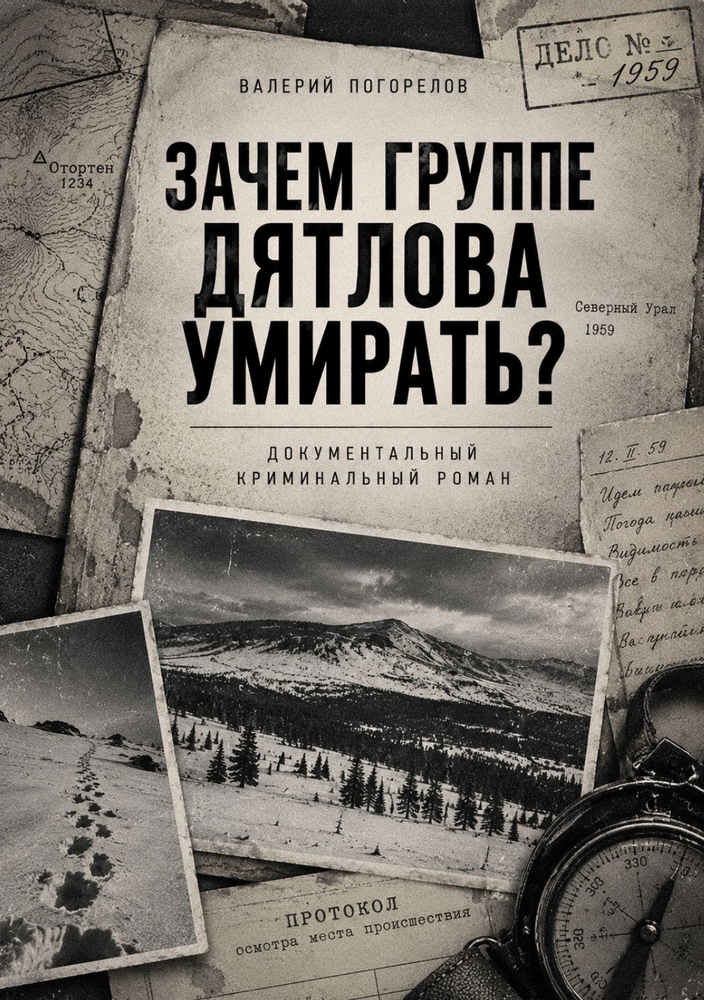
The title, Why Did the Dyatlov Group Have to Die?, places a pointed question before the reader, but the book’s deeper challenge concerns the relationship between an event and the stories subsequently built around it. Can we distinguish what happened from what we have grown accustomed to believing happened? Can we resist the satisfaction of a complete explanation when the evidence offers only a partial one? And can we continue investigating when the honest result may be a narrower conclusion rather than a final answer?
These questions extend beyond a single tragedy in the Urals. They concern the way historical events are reconstructed whenever direct testimony has disappeared and the surviving record must bear the weight of competing interpretations.
An expedition for the reader
A reader opening Pogorelov’s book should not expect to remain a spectator for long. The investigation asks for attention, patience and a willingness to revise an initial impression when another piece of evidence changes the picture. It invites the reader to notice the difference between a fact and an assumption, to follow a proposed sequence of events and to ask whether every link in that sequence is strong enough to bear the weight placed upon it.
This is an intellectual journey into a landscape where the cold is physical, the documents are tangible and the central absence cannot be filled by imagination alone. The reader travels from the ordinary preparations of a group of young hikers to the exposed slope where their tent was found, from the material details recorded by searchers to the medical evidence examined by specialists, and from the established record into the difficult territory of competing reconstructions.
There is no guarantee that every question will find a definitive answer. That is precisely what makes the journey worthwhile. A serious investigation does not promise certainty in exchange for attention; it offers a method for discovering which uncertainties can be reduced and which remain.
So, if you decide to follow Valeriy Pogorelov into the Dyatlov Pass case, dress warmly. Pack provisions for a long journey, bring a notebook, and leave a little room in your luggage for doubts. You will need them. The route leads through old case files, conflicting explanations, forensic details and the uncomfortable spaces between what is known and what is merely believed.
Above all, resist the temptation to reach the summit before examining the trail. The task is not to arrive with an answer already prepared. It is to follow the evidence, test the reconstruction and discover how far a disciplined mind can travel into a night that left no witness.
The investigation is open. The next step is yours to take.