
THE ALGORITHM HAS NO PLAN B. Why Execution Is Not the Same as Problem-Solving
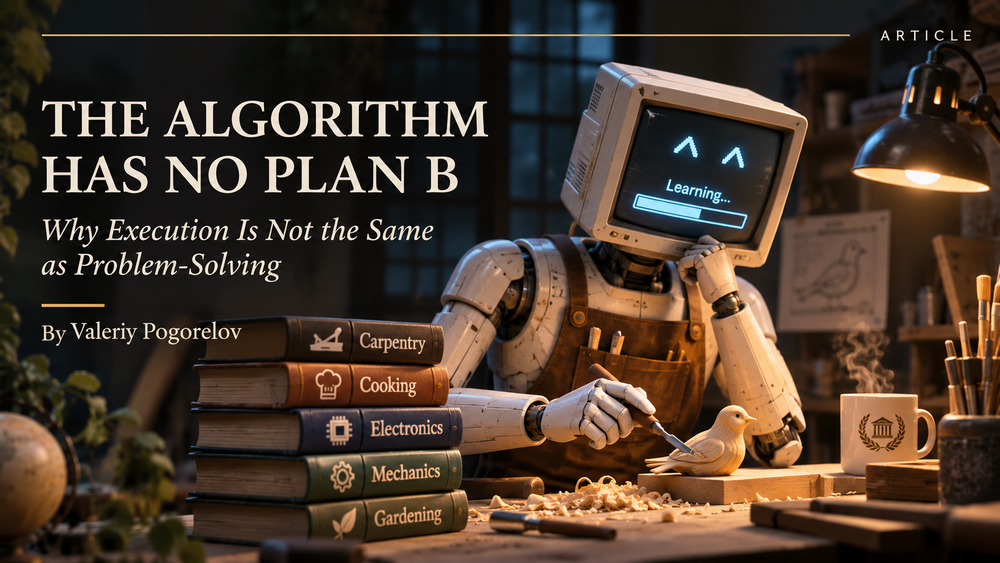
THE ALGORITHM HAS NO PLAN B. Why Execution Is Not the Same as Problem-Solving
By Dr. Valeriy Pogorelov
Abstract
The growing speed, precision, and complexity of computational systems have dramatically expanded the range of tasks that machines can perform. Yet a system may execute every instruction correctly and still fail to solve the problem it encounters. This becomes particularly evident when operating conditions change and the procedure on which the system relies no longer produces the intended result.
The essay examines the distinction between algorithmic execution, feedback-based correction, learning, and problem-solving as different functional dimensions of machine activity. Beginning with a practical engineering scenario in which an automated system continues to follow its programmed instructions despite their growing inadequacy, the discussion explores the limits of predefined procedures and the role of feedback in correcting machine actions. It then considers the difference between adjusting an immediate response and changing future behavior through experience, before examining the importance of internal models in anticipating the consequences of possible actions. The central argument is that the development of intelligent systems requires more than increasing computational speed or refining existing algorithms. It also requires the capacity to recognize when an established method is insufficient and to search for an alternative way of achieving a goal.
Keywords
Algorithmic execution; problem-solving; feedback control; machine learning; adaptation; computational models; artificial intelligence; engineering systems.
I. THE MACHINE THAT EXECUTES
It is three o’clock in the morning. A production line is running through another shift, performing the same sequence of operations it performed yesterday, last week, and thousands of times before. Sensors register the temperature, the control system receives the measurements, and the machine adjusts its operation according to the instructions it has been given. No one needs to stand beside it and supervise every movement. The process has been described, its sequence established, its operating conditions defined, and its rules transferred into an automated system.
This is one of the great achievements of engineering: the ability to take an organized procedure and make a machine perform it with speed, precision, and consistency. A human operator may become tired, lose concentration, overlook a measurement, or make a mistake after repeating the same operation for several hours. A properly designed machine does not experience fatigue in this way. It can repeat the same procedure thousands or millions of times, maintaining the prescribed sequence without the fluctuations associated with human attention.
The principle is straightforward, although its consequences are considerable. A person determines what must be done, establishes the order of operations, defines the conditions under which one action should follow another, and specifies what the system must do when particular conditions arise. The machine receives this organized description and carries it into operation. In this arrangement, automation does not simply replace human physical effort with mechanical power. It transfers the organization of work—the sequence, the rules, and the prescribed transitions—from the human operator to the machine.
The development of computing made this arrangement increasingly powerful. A procedure that once required continuous human attention could be expressed as a sequence of formal operations and executed automatically. The machine could process information, compare values, follow conditional instructions, and produce results at a speed that would be impossible for a human operator to maintain. The relationship between computation and intelligent activity became a central question in the history of computer science, notably in Alan Turing’s exploration of whether machines could exhibit behavior associated with thinking (Turing, 1950). Later work on symbolic processing and search examined how computational systems could operate on representations of problems rather than merely perform numerical calculations (Newell & Simon, 1976).
But the engineering achievement of execution contains a distinction that is easy to overlook. A machine can perform a procedure without having determined whether that procedure is still appropriate. It can select an action according to a condition without having invented the alternatives from which it selects. It can operate with extraordinary precision inside an established arrangement while remaining dependent on the assumptions built into that arrangement.
This is not a defect in execution. It is a question about what execution actually provides. The machine may be exceptionally reliable at carrying out a known method, but reliability within a method does not by itself establish the ability to find another method when the first one becomes inadequate. To understand that difference, we must look more closely at the architecture of the algorithm—and at what happens when the world presents a condition that its designer did not anticipate.
II. THE ONE HUNDRED AND FIRST SITUATION
Imagine an automated sorting facility designed to process thousands of packages an hour. Each item is scanned, measured, classified, and directed toward the appropriate conveyor. The system has rules for damaged labels, unusual dimensions, missing codes, and packages that cannot be matched to a destination. When a familiar exception occurs, the machine follows the corresponding branch of its program. The process is fast, consistent, and largely independent of human intervention.
Now imagine a package that does not fit any of the categories the system recognizes. Its label is partly damaged, its dimensions fall between two established classifications, and the available information points toward different destinations. The machine can repeat the scan, apply its existing checks, or send the item to a predefined exception channel. It may even select the least problematic option among those available. But if none of these actions addresses the actual situation, the system has reached a boundary that cannot be crossed simply by executing its instructions more efficiently.
This is the problem of the hundred and first situation. The number is not important; it represents the condition that was not included in the original design. A system may contain hundreds of rules and thousands of conditional branches, yet the existence of many possible instructions does not mean that every relevant circumstance has been anticipated. The world does not arrange itself according to the classification scheme of the machine.

A conditional algorithm can create the appearance of choice. If one condition is satisfied, the system performs one operation; if another condition applies, it performs a different one. From the outside, this may look like decision-making. Yet, the alternatives, the criteria for selecting between them, and the consequences assigned to each branch have already been specified within the system's design. The machine selects among available transitions; it does not necessarily construct a new transition when the existing ones prove inadequate.
This distinction matters because problem-solving is not always a matter of choosing correctly from a prepared set of alternatives. Sometimes the difficulty lies precisely in the fact that the available alternatives do not adequately represent the problem. Research on human problem-solving has long examined the role of problem representation, search, and the organization of possible operations in reaching a solution (Newell & Simon, 1972). The structure of a problem determines, in part, what should be searched for and which paths should be considered meaningful.
The same issue becomes particularly important when a task is poorly structured. In such cases, the problem may not arrive with clearly defined boundaries, stable criteria, or an agreed procedure. Its representation may itself need to be developed as the investigation proceeds (Simon, 1973). A system cannot resolve this difficulty merely by moving faster through a search space whose structure is inadequate.
The limitation, therefore, is not that the machine has too few instructions in some simple numerical sense. It is that the method encoded in those instructions may no longer correspond to the situation in front of it. Adding more branches can extend the range of anticipated conditions, but it does not eliminate the possibility of encountering circumstances that were not anticipated. At some point, the central question changes: instead of asking which instruction should be executed, the system must somehow establish whether its existing way of approaching the problem is still appropriate.
That is where the difference between execution and problem-solving gets more and more difficult to ignore. A machine can be perfectly consistent and still be consistently wrong for the situation it faces. Its next step cannot always be another instruction of the same kind. Sometimes the problem requires a different lens for capturing what is happening.
III. WHY FEEDBACK IS NOT ENOUGH
A machine that receives an instruction and performs it without checking the result operates in an open loop. It may execute the command exactly as specified, yet have no way of knowing whether the intended outcome has actually been achieved. The distinction is fundamental: completing an operation and reaching a goal are not necessarily the same thing.
Consider a mechanism that must move a component exactly one metre. The controller activates the motor for a predetermined period and then switches it off. Under normal conditions, the component travels the required distance. But suppose the load is heavier than expected. The motor runs for the prescribed time, the command is executed, and the component moves only seventy centimetres. From the perspective of the program, everything happened correctly. From the perspective of the task, the result is incomplete.
The solution is to return information about the result to the system that controls the action. A sensor measures the actual displacement; the controller compares it with the target and identifies the difference. If the component has moved only seventy centimetres, the system receives an error of thirty centimetres and can adjust its next action accordingly. The process turns into a continuous cycle: act, measure, compare, correct, and act again.
This is the principle of feedback control. It connects an action with its consequences and makes the behavior of a system responsive to what is actually happening, rather than exclusively to what its designer expected to happen. In engineering, feedback is not simply a technical addition to an otherwise complete machine. It changes the architecture of control by making the result part of the information available for the next decision (Åström & Murray, 2021).
Yet feedback introduces a new problem. A correction can be too strong, too weak, or too late. Anyone who has tried to adjust an old shower tap knows the effect: turn the hot water up, wait, receive boiling water, turn it down, and find yourself under a stream of ice-cold water. The system oscillates around the desired temperature because the correction does not properly account for delay and intensity. In technical systems, the corresponding question is one of stability: whether corrective action brings the system toward its target or produces increasingly pronounced fluctuations (Åström & Murray, 2021).
There is also a more important boundary. Feedback can tell a machine that its action has not produced the desired result. It can provide the information needed to correct that action. But it does not, by itself, determine whether the original goal remains appropriate, whether the method should be replaced, or whether the problem has been represented correctly. A thermostat can maintain a temperature of twenty-two degrees with considerable precision, but the reason for choosing twenty-two degrees still comes from outside the control loop.
Feedback therefore changes the relationship between action and reality, but it does not automatically change the method by which the system approaches its task. The machine can correct its course without reconsidering the destination or inventing a different route. To understand what lies beyond this capacity, we need to distinguish correction from learning.
IV. FROM CORRECTION TO LEARNING
A thermostat provides a useful example of why feedback and learning should not be confused. When the temperature falls below the prescribed level, it activates the heating system. When the temperature reaches the target, it reduces or stops the heating. If the temperature falls again, the same sequence is repeated. The machine responds to changing conditions, measures the result, and corrects its action. Yet tomorrow it will behave exactly as it did today, unless someone changes its settings or its control mechanism.
The thermostat has feedback, but it does not necessarily learn from experience. It does not remember that the room becomes colder every morning at six, reconsider its behavior, and begin heating earlier. Its response is determined by the same established relationship between the measured temperature and the desired value. The system corrects what it is doing now, but its future behavior remains unchanged.
Learning introduces a different possibility. A system can use information accumulated through previous interactions to modify the way it acts in subsequent situations. Its behavior is no longer determined exclusively by the current measurement and a fixed corrective rule. Past experience becomes relevant to future action. In machine learning, this capacity is commonly described in terms of improving performance through experience rather than simply executing a predetermined procedure (Mitchell, 1997).
One important example is reinforcement learning, in which a system interacts with an environment, receives information about the consequences of its actions, and adjusts its behavior in pursuit of a defined objective. The system must discover which actions tend to produce better outcomes, often through repeated attempts and accumulated experience. Its task is not merely to correct a single deviation, but to develop a more effective way of acting over time (Sutton & Barto, 2018).
However, learning does not automatically mean that a system can reconsider every aspect of the problem it has been given. A machine may improve its strategy while continuing to operate within an established objective, representation of the environment, and framework of possible actions. It can become better at finding a route without necessarily questioning whether the available routes are sufficient or whether the destination itself should be reconsidered.
This distinction becomes especially important in systems designed to support human learning. An educational program may present material in small stages, evaluate a student's answers, and select the next exercise according to the results. The student changes through the process; the program may continue to operate according to the same instructional architecture. The feedback loop is helping one participant learn without necessarily changing the other.
We can therefore distinguish three different functions. Execution carries out an established procedure. Feedback uses the result of an action to correct what happens next. Learning allows previous experience to modify future behavior. Each adds a new capability, but none of these distinctions should be mistaken for an automatic ability to construct an entirely new method when the existing one becomes inadequate.
That brings us to the next engineering question. If a machine must do more than repeat, correct, or improve its established behavior, what allows it to anticipate the consequences of alternative actions and determine which way forward might work?
V. BEYOND THE EXISTING PROCEDURE
Consider an aircraft in flight. Its speed, altitude, weight, engine thrust, fuel consumption, and position are not independent measurements. They are connected. An adjustment to one parameter may affect several others, sometimes in ways that are not immediately visible. A control system that responds to each measurement separately may correct one deviation while creating another. To manage such an object, the machine needs more than information about its present condition. It needs a representation of how the system behaves.
This is the purpose of an internal model. It describes an object through selected variables, relationships between them, operating conditions, and constraints. The model is not the object itself. It is a constructed representation that makes it possible to estimate how the object may respond to different actions. Its value lies not in reproducing every detail of reality, but in preserving the relationships necessary for a particular task.
The decisive change occurs when the machine can use this representation to examine possible actions before carrying them out. Suppose a system identifies three possible ways to reach a target. It can estimate the consequences of each, compare their expected results, and select one according to a defined criterion. Instead of learning only through the consequences of actions already performed, it can test alternatives within the model. In this respect, the process resembles the search through possible problem states described in classical work on human problem-solving (Newell & Simon, 1972).
A model therefore creates a space of possible futures. But this space has boundaries. It contains only those variables, relationships, alternatives, and conditions that the model makes available. The system may calculate with great precision and still produce an inadequate decision if the representation itself excludes an important factor. As research on ill-structured problems suggests, some difficulties cannot be resolved simply by applying a more efficient search procedure; the problem representation itself may need reconsideration (Simon, 1973).
This is the next boundary in the development of machine problem-solving. A system can move beyond a fixed sequence of instructions by calculating alternatives, predicting consequences, and selecting among possible actions. Yet it may remain dependent on a picture of the situation constructed in advance. It can find the best route on its map without recognizing that the map no longer describes the territory.
The engineering question is no longer only how to make a machine choose among available actions. It is how to create a system capable of recognizing when its own representation of the problem has become insufficient—and of changing that representation rather than continuing to optimize within it.
VI. THE LIMITS OF A “PERFECT SOLUTION”
We have followed a progression from the machine that executes instructions to the system that can respond to results, learn from experience, and use an internal model to anticipate the consequences of possible actions. Each step expands the range of what a machine can do. Yet each also reveals a new boundary.
Execution depends on a procedure established in advance. Feedback makes it possible to correct an action when its result differs from the target. Learning allows experience to influence future behavior. An internal model makes it possible to examine alternatives before acting and to select among them according to a defined objective. These are not competing approaches. They are successive and complementary elements in the engineering of increasingly capable systems.
But one question remains unresolved. What happens when the difficulty lies not in the execution of a procedure, not in the accuracy of feedback, and not even in the choice among available alternatives, but in the inadequacy of the method itself? A system may search more extensively, calculate more precisely, and learn to perform more effectively, while continuing to approach the problem through a representation that no longer corresponds to the situation. It may optimize its answer without discovering that it is asking the wrong question.
This is where the distinction between solving a problem and reconsidering the method of its solution becomes decisive. The next step is not simply to give a machine more instructions or a larger set of possible actions. It is to investigate whether a system can recognize the limits of its own model, identify what its current method fails to account for, and construct an alternative approach. Such a capacity would involve not only selecting a solution within an established framework, but also examining the framework through which solutions are generated.

This is the direction of the further research that Dr. Pogorelov will address: the engineering principles behind a machine capable of questioning the adequacy of its own method. The problem opens several connected lines of inquiry: how a system detects that its current representation has become insufficient; how it distinguishes an unexpected result from a fundamental failure of its approach; how it can reorganize the way a problem is represented; and how a new method can be tested before it is trusted in operation.
The title of this article points to the difficulty in deliberately simple terms. An algorithm has no Plan B unless the architecture of the system provides a way to develop one. Greater speed does not create that capacity. More data does not guarantee it. Nor does the ability to learn within an existing framework necessarily provide a way beyond it.
The engineering challenge, therefore, is not merely to construct machines that serve better, correct themselves faster, or calculate more possible solutions. It is to understand how a machine might recognize that the way it has been trying to solve a problem is no longer sufficient—and what kind of architecture would allow it to find another way.
References
Åström, K. J., & Murray, R. M. (2021). Feedback systems: An introduction for scientists and engineers (2nd ed.). Princeton University Press.
Mitchell, T. M. (1997). Machine learning. McGraw-Hill.
Newell, A., & Simon, H. A. (1972). Human problem solving. Prentice-Hall.
Newell, A., & Simon, H. A. (1976). Computer science as empirical inquiry: Symbols and search. Communications of the ACM, 19(3), 113–126. https://doi.org/10.1145/360018.360022
Simon, H. A. (1973). The structure of ill structured problems. Artificial Intelligence, 4(3–4), 181–201. https://doi.org/10.1016/0004-3702(73)90011-8
Sutton, R. S., & Barto, A. G. (2018). Reinforcement learning: An introduction (2nd ed.). MIT Press.
Turing, A. M. (1950). Computing machinery and intelligence. Mind, 59(236), 433–460. https://doi.org/10.1093/mind/LIX.236.433