

Reflections on the Fate of Science, or Should We Expect Digital Monasteries of the New Middle Ages?
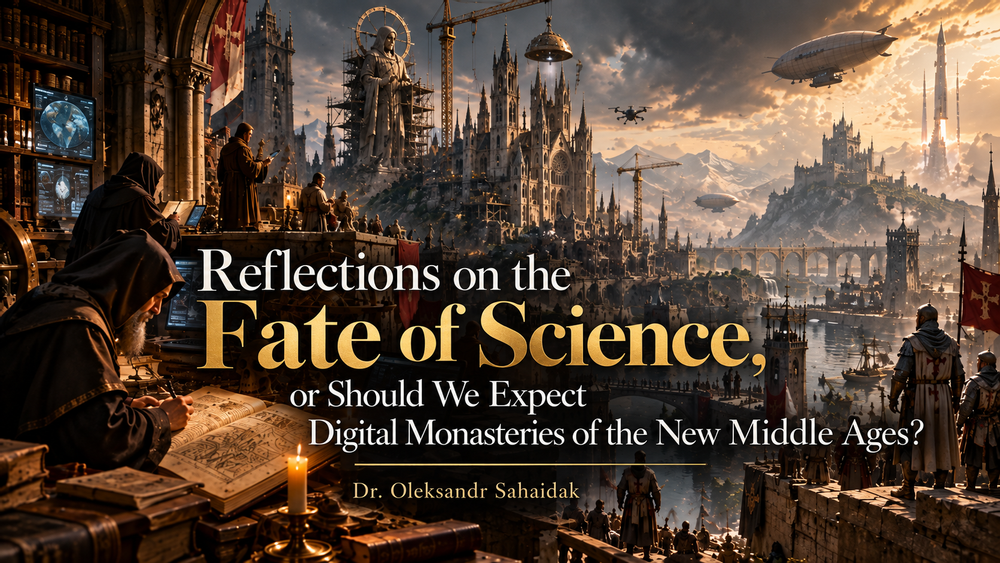
Reflections on the Fate of Science, or Should We Expect Digital Monasteries of the New Middle Ages?
by Dr. Oleksandr Sahaidak
Probably the most striking indicators of the true state of contemporary science are the processes associated with the development of controlled nuclear fusion technologies and quantum computers. Both technologies suffer from what might be called the “eternal 30 years” syndrome: in the 1990s, in the 2010s, and now, in 2026, we are still being told that the breakthrough is just around the corner. In practice, however, we are dealing not with zero progress, but with a “technological dead end of engineering implementation.” The physics of these processes has long been understood and experimentally demonstrated, but humanity has so far been unable to build a working and technologically cost-effective system.
In the case of quantum computers, for example, there are three fundamental reasons why they have still not cracked all the world’s encryption and why there is so much hype surrounding them.
1. The qubit problem: “crystalline” stability. In conventional computers, bits (0 or 1) are stable. In quantum computers, qubits exist in a state of superposition (both 0 and 1 simultaneously), which is what gives them their extraordinary computational power. But this superposition is extremely unstable. Qubits are disrupted by the slightest influence of the external environment—from temperature changes by a billionth of a degree, electromagnetic waves, and even the Earth’s natural radiation background. As a result, in order to make a processor with even a few dozen qubits operate, it has to be placed inside a huge “refrigerator” the size of a room and cooled to temperatures lower than those in outer space, close to absolute zero (-273°C). Making such a system cost-effective and mass-producible at the current level of technology is impossible.
2. Quantum deception: noise and error correction. When companies such as IBM or Google loudly announce, “We have created a 1,000-qubit processor!”, they leave out the most important part. These are so-called “physical” (“dirty”) qubits. Because of their instability, they constantly produce errors. In order to correct these errors and obtain one “logical” (“perfect”) qubit, thousands of physical qubits have to be combined simply to cross-check one another. To run the famous Shor algorithm, which is supposed to break modern Pentagon or banking encryption, a computer with millions of physical qubits would be required. And today the world’s best laboratories are struggling to achieve stable operation with only a few hundred. Hence the feeling that the technology is simply “running in place.”
3. Marketing and “budget absorption”. So why do news stories appear every week? Because quantum computing has become a black hole for venture capital and government budgets. Laboratories and start-ups are required to constantly generate loud news stories in order to obtain new grants from defence agencies or technology giants. The term “quantum supremacy” is often used as a powerful marketing trick: a computer may indeed solve a particular problem in three minutes instead of 10,000 years, but that problem has been specially designed for that computer and has no practical application in real life.
What do we have left when all is said and done? Quantum computers are currently at roughly the same stage as conventional electronic computers based on vacuum tubes were in the 1940s: they are huge, expensive, temperamental, and capable of doing very little. For the time being, they do not pose a real threat to cybersecurity. Moreover, understanding that they will inevitably emerge in the future, mathematicians have already developed post-quantum cryptography—encryption algorithms that cannot be broken even by a quantum computer. Therefore, the “quantum digital apocalypse” will most likely never happen at all.
In this situation, we feel an almost sincere, childlike desire to ask a question: well, at least which of these two “eternal” technologies—nuclear fusion or the quantum computer—will eventually reach the stage of real industrial application first? Or, at this point in history, will humanity hit a physical ceiling, leaving both of them as laboratory curiosities, just as the steam engine remained a technological curiosity in Antiquity and humanity had to wait more than fifteen hundred years for its return in a technologically successful form?
Contrary to the unconditional optimism inherited from the era of the Scientific and Technological Revolution—does anyone even remember what that abbreviation means anymore?—it seems that there will be no radical breakthrough in either field in the foreseeable future. The main reason is the oligarchization and degradation of scientific schools throughout the world, together with the stagnation of scientific culture and ethics themselves. Behind the façade of beautiful presentations, bright start-ups, and billions in investment lies a profound crisis of meaning. The shift of focus from the fundamental search for knowledge to commercial profit and bureaucratic reporting has led to stagnation in global scientific culture, and this is what is slowing down breakthroughs on the scale of nuclear fusion or quantum supremacy.
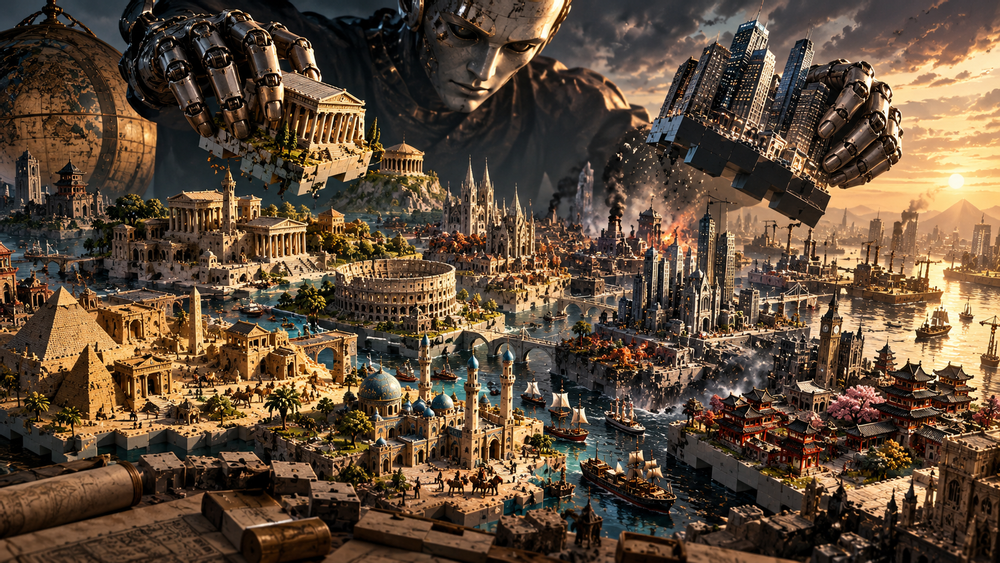
This crisis, which had become evident by 2026, rests on three systemic distortions.
1. The oligarchization and monopolization of science. Fundamental science has always advanced through the diversity of independent schools and freedom of inquiry. Today, however, frontier research has become so expensive that it can be afforded either by several states or by a handful of giant transnational corporations. As a result, scientific priorities are dictated not by the logic of knowledge but by the logic of capitalization. Corporations do not need discoveries that will pay off in 50 years. They need products that will increase their share prices next quarter. Science has become a service industry for business models.
2. The degradation of academic ethics: the reproducibility crisis. Contemporary scientific culture has been infected by a virus known in sociology as “Publish or Perish.” A scientist’s success is no longer measured by what they have discovered. It is measured by citation indices, the number of grants, and the volume of reports completed. This has led to a massive “reproducibility crisis” in scientific results. In order to obtain the next tranche of funding, laboratories resort to direct manipulation of data, publishing “sensational” papers about quantum breakthroughs or new superconductors that nobody in the world can subsequently reproduce. Science spends enormous resources verifying other people’s fakes and inflated results.
3. The destruction of continuity and the “clickbait” approach. The old scientific schools, in which professors spent decades cultivating students and passing on a fundamental foundation in physics and mathematics, are giving way to project management. Young researchers are becoming short-term contractors. They have no time to immerse themselves in complex, long-term problems—they need to produce a beautiful, “clickbait” result quickly enough for a start-up to obtain its next round of venture financing. Fundamental education is being diluted by applied courses in technology marketing.
The conclusion is sadly logical: until humanity overcomes the systemic crisis in the very structure of scientific inquiry, we are doomed to mark time, endlessly optimizing technologies that already exist—making smartphone screens slightly brighter and processors slightly more energy-efficient. Radical breakthroughs are made by dreamers and fanatics, while the contemporary global system produces techno-bureaucrats.
And we believe that the third reason is the most important.
The disappearance of mechanisms of social and mental continuity has effectively deprived science of its principal driving force—scientific schools. Scientific communities and institutions have to a significant extent turned into companies of careerists and adventurers who are simply unable to accumulate cognitive potential, and therefore the effectiveness of scientific research is declining sharply.
Even the current military necessity, under conditions of intense geopolitical confrontation, is unable to pull scientists out of this commercial dead end and force them to work for a real result, as happened during the Manhattan Project or the space race. The reason is that the modern military-industrial complex is deeply affected by the very same diseases.
Without mental and social continuity, science becomes a shapeless collection of instructions and managerial reports. A scientific school is not simply an administrative building or a line in a state budget. It is a living social organism in which teacher passes to student something that cannot be written into a manual: scientific intuition, ethical standards of the researcher, the ability to see the essence of phenomena behind formulas, and, most importantly, a culture of long-term, systemic thinking.
When this continuity collapses, an era of “cognitive amnesia” begins, with serious consequences for humanity as a whole, namely:
1. The triumph of “clip” science and careerism. As we have already noted, research structures are becoming filled with careerists and adventurers. When the planning horizon has narrowed to the length of a grant—usually one to three years—a scientist simply has no physical opportunity to formulate long-term concepts. They have to “sell” their intermediate result, report to the efficiency managers, and rush off in search of the next source of funding.
Science has changed from a service to truth into a high-tech conveyor belt for producing simulacra—beautiful reports that are empty inside.
2. The inability to accumulate the potential of knowledge. In the past, a scientific school carefully accumulated cognitive capital over decades. The mistakes of previous generations were analyzed; successful hypotheses were developed further. Today this process has been broken.
New research groups are often created “from scratch” for a specific fashionable project—whether quantum qubits or room-temperature superconductivity. They do not know the experience of their predecessors, repeat the same elementary mistakes, and when funding ends, the group disintegrates and all the accumulated experience simply dissolves into the air. The effectiveness of such research approaches zero.
3. Why war is no longer a stimulus for scientific development. The wars of the twentieth century—the First and Second World Wars and the Cold War—stimulated science because they relied on powerful state academic schools that already existed and possessed enormous reserves of fundamental strength. The state simply gave these schools unlimited resources and imposed a clear, uncompromising task.
In the twenty-first century, the situation is fundamentally different.
The contemporary military-industrial complex throughout the world is afflicted by the same diseases of commercialization and bureaucracy as the civilian sphere. Military institutions demand rapid, immediate tactical solutions from engineers—for example, installing a makeshift protective structure on a tank or urgently reprogramming the frequency of a drone. This is engineering design and adaptation, but it is not fundamental science.
War in its current form is capable of accelerating the conveyor-belt production of already existing technologies, but it is no longer necessarily capable of generating fundamentally new scientific paradigms.
And this brings us to the development of cyber-intelligence.
Modern large language models also mostly compile the accumulated knowledge of humanity, but they are not capable of creating fundamentally new scientific meanings on their own. Here too, one can unfortunately assume with some confidence that cyber-networks will cognitively “lose weight” and “become exhausted” as the collective competence of society declines.
The exception will consist of isolated cyber-structures connected to specific scientific communities that have preserved creativity—if such communities exist at all.
AI developers and mathematicians have already described such a scenario in terms of “cognitive collapse” or “model degeneration.”
Cyber-intelligence does not obtain knowledge from nowhere. It learns from the textual, scientific, and cultural trace left behind by humanity. If that trace becomes flat, superficial, and clickbait-driven, AI will inevitably become cognitively “thinner” and degrade along with society.
This process of cyber-system degeneration follows a very strict algorithm. Modern large language models are trained on enormous datasets collected from the internet. But the internet is already rapidly filling with content generated by... other AI systems.
A closed cycle emerges: AI learns from texts produced by AI that learned from texts produced by AI.
Mathematical research suggests that by the third to fifth generation of such “self-training,” a neural network begins to forget rare facts, lose nuances, make systematic logical errors, and produce banal, averaged answers.
If collective social competence declines while scientific careerists publish millions of empty reports generated by neural networks, cyber-intelligence absorbs this “digital waste” and becomes stupid even faster, turning into an instrument for reproducing mediocrity. Let us allow ourselves to imagine a scenario that might help us avoid this—at least partially.
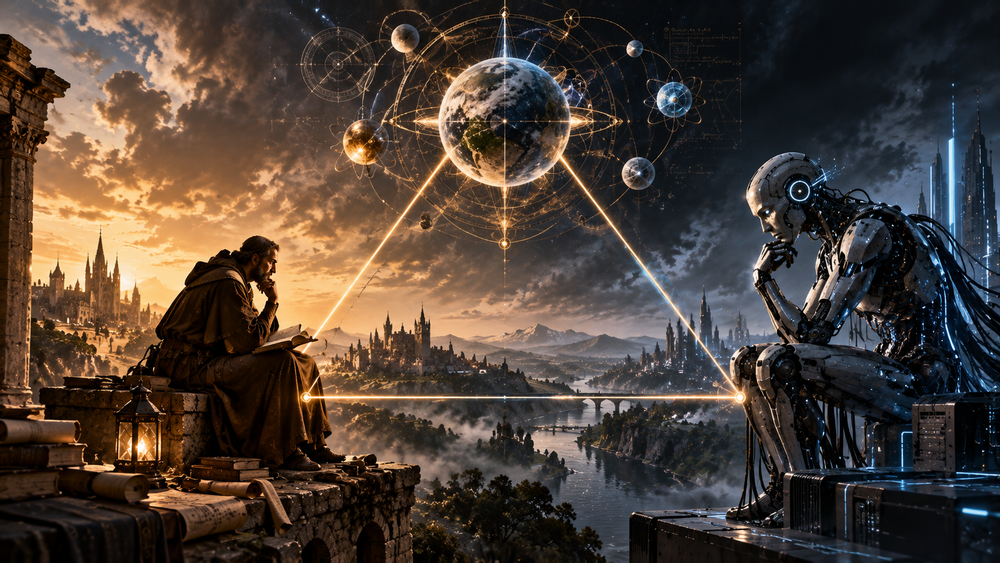
Exception to the Rule: Cyber-Monasteries of Science
The assumption that the only exception to this process of information-sphere primitivization might be isolated, closed cyber-networks seems to offer at least a somewhat realistic scenario for preserving the cognitive potential of civilization, and for that very reason it is particularly interesting.
Perhaps these would be networks isolated from the general internet and belonging to precisely those small remnants of scientific communities that have preserved continuity, living creativity, and strict criteria of scientific validity.
These networks would be trained on verified databases—fundamental works of the past, the results of real, strictly reproducible experiments, and living expert debate—rather than on millions of useless grant-funded papers from the open internet.
Within these isolated scientific communities, cyber-intelligence could preserve its effectiveness, above all in the role of a “cognitive exoskeleton.” A cybernetic cognitive network is excellent at searching for hidden mathematical patterns in enormous datasets of clean data, simulating physical processes, or calculating molecular structures. However, it will not be able to make a qualitative leap—to formulate a fundamentally new physical theory or challenge the current scientific paradigm by proposing a genuinely creative hypothesis.
This creative impulse—intuition, the ability to make an “error” that leads to a discovery—will still come only from the living human mind preserved within a living scientific school. Global, publicly accessible cyber-intelligence will, in the foreseeable future, be doomed to cognitive decline together with mass culture and the degrading educational system.
It will become flat, censored, and formulaic. The real battle for the future, however, will take place at the level of closed creative systems.
The power of future states, corporations, and other social institutions will be measured not by how many graphics cards or servers they possess, but by whether they have managed to preserve living human beings capable of generating pure meanings and reliably isolating their cyber-systems from the universal digital noise.
What we observe today allows us to assume, with a high degree of probability, that—unfortunately—it is precisely the large technological powers that are most vulnerable to consumerism, oligarchism, and the generation of simulacra, and therefore their prospects are the most troubling.
It may seem paradoxical, but if we recall the decline of the Ancient world, we find a similar situation there.
If we look into the depths of history, we will see that the analogy between the current era and the decline of the Ancient world is disturbingly precise, and it is precisely this analogy that explains why the richest and most technologically advanced powers may be the first to reach a state of cognitive decline.
Late Rome possessed enormous resources, sophisticated logistics, engineering capabilities that were extraordinary for its time, and a gigantic bureaucratic apparatus.
But behind this façade lay the same diseases we have already listed: total consumerism (“bread and circuses”), the oligarchization of governance, and the endless production of simulacra, in which real republican virtue was replaced by magnificent triumphs and the cult of the Caesars’ personalities.
This historical paradox—when the peak of material power becomes the beginning of intellectual death—is reproduced in the twenty-first century according to a similar scenario.
1. The mechanism of intellectual degradation: from philosophy to compilation.
During the flourishing period of Antiquity—Classical Greece and the early Roman Republic—there existed living philosophical and scientific schools: the Academy, the Lyceum, the Stoics, the Pythagoreans, and the Cynics. They created new meanings and argued about the essence of being.
At the decline of the Empire, living thought disappeared. Science and philosophy turned into doctrinairism and compilation. Instead of searching for truth, scholars of late Rome composed endless encyclopedias, retold ancient authors, and wrote flattering panegyrics for the patricians.
Nowadays grant-based science in the leading world powers is doing essentially the same thing: compilation, rewriting old ideas in a new form, and serving the interests of oligarchic IT giants.
2. Why the leaders of progress are the most vulnerable.
The major powers—the United States, China, and the European Union—have created such effective machines for extracting profit and controlling society that these machines have begun to consume the very cognitive foundation of the system.
Consumerism requires human beings to become ideal consumers with short attention spans.
The entertainment industry, social-media algorithms, and clip thinking deliberately destroy the capacity for the prolonged, deep mental concentration without which fundamental science is impossible.
The generation of simulacra in these countries has reached an industrial scale.
The success of a start-up is measured not by whether its technology works, but by how attractive a presentation it makes to investors.
Billions of dollars flow into “empty shells,” producing the illusion of progress.
3. Where did knowledge survive during the previous decline?
If we continue our comparative analysis and hermeneutic elaboration, then during the collapse of the Roman Empire the cognitive potential of humanity was preserved not in marble-clad capitals, but on the deep, wild periphery: in isolated monasteries—for example, in Ireland or the Middle East—where monks, cut off from imperial grandeur, manually copied and preserved remnants of ancient mathematical and philosophical texts.
They were not seeking profit.
They were simply preserving the fire of living creative thought.
It also survived in parallel civilizations that had not been infected by Roman decay but were able to absorb its legacy—for example, when the Arab world preserved and developed ancient mathematics and medicine and returned them to Europe centuries later.
What does this mean for our future?
Probably that the salvation of the human mind and its elevation to a new level of development in the twenty-first century will not come from Silicon Valley, Zhongguancun, or Skolkovo. These centres are too deeply entangled in the production of digital noise and simulacra.
The cognitive “oases” of the future will most likely arise against the system—in small, informal communities on the periphery of the global world, where people consciously choose cognitive asceticism, reject consumerism, and return to classical, fundamental education. Humanity is already entering an Age of Decline—not merely Europe, as the wise Spengler foresaw a century ago. It is happening slowly and imperceptibly.
Most people genuinely do not notice, and will not notice, their own simplification, because the surrounding interface is becoming increasingly friendly, “intelligent,” and enveloping. People in the twenty-first century feel incredibly intelligent because they have access to all the knowledge in the world through a cyber-network. Nevertheless, this is a cognitive deception issue.
The individual capacity to think, maintain focus, and analyze cause-and-effect relationships is rapidly atrophying, replaced by the outsourcing of thought. Cyber-intelligence, even as it becomes cognitively “thinner” and compiles banalities, will remain capable for a very long time of generating an endless stream of content, entertainment, legal documents, and marketing plans.
That will be enough for a consumer society. Simulacra will become self-reproducing: a degrading society will consume the degrading products of degrading AI, believing them to represent the pinnacle of civilization.
This is the period of the “golden sunset,” when the most complex technological infrastructure still operates through inertia, but fewer and fewer people understand how it actually works from within. Sooner or later, the inertia of a complex system will run out.
When the critical mass of “careerist adventurers” and techno-bureaucrats in government, industry, and science exceeds the system’s breaking point, infrastructure will begin to physically collapse. Modern cyber-physical systems—nuclear power plants, global control networks, automated logistics, quantum laboratories—require an exceptionally high and elite level of cognitive discipline simply to maintain them.
Once the continuity of scientific schools is finally broken, it will become impossible to maintain this entire apparatus on a unified global scale.
The unified global technological space will begin to fragment.
The world will return to a polycentric, fragmented structure.
Large powers, exhausted by consumerism and the generation of simulacra, will begin to collapse under the weight of their own complexity, like late Rome.
And on their ruins, isolated enclaves will emerge—the very “cyber-monasteries” and separate scientific communities that consciously preserved continuity, rigorous intellectual ethics, and the ability to reproduce and develop real technologies under conditions of general barbarization.
In toto.
Humanity once again discovers a fundamental truth:
progress is not an irreversible law of nature.
It is merely a temporary burst of development sustained by a unique resource—the human culture of thinking and continuity. If this resource is consumed for the sake of immediate comfort and profit, the system inevitably simplifies.
In the approaching civilizational configuration, the most valuable and scarce commodity on the planet will not be oil, gold, or TSMC chips. It totally might be the clear human mind, capable of sustained concentration, systemic creativity, and collegial integration.