
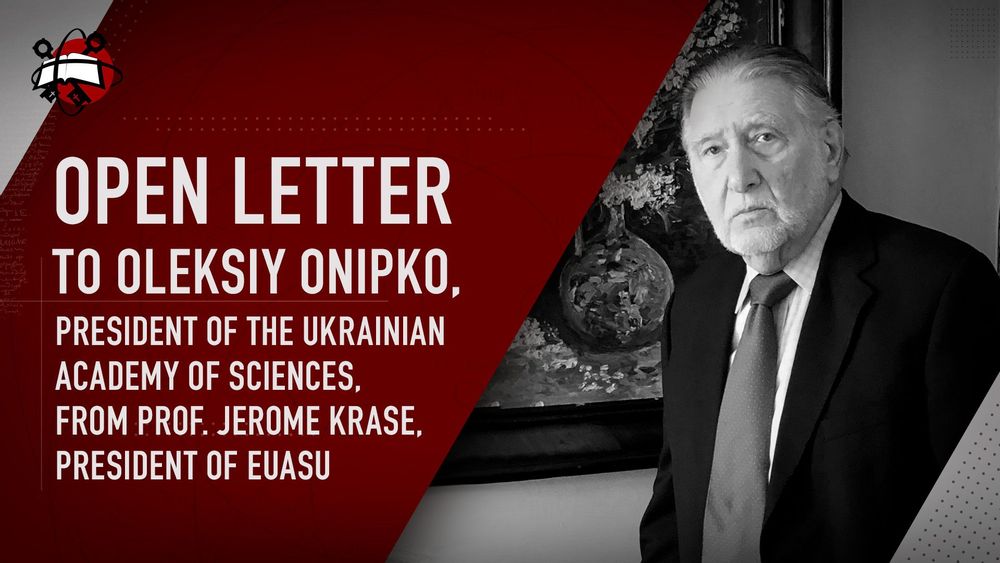
Open Letter from Prof. Jerome Krase, President of EUASU, to Oleksiy Onipko, President of the Ukrainian Academy of Sciences
Dear President Oleksiy Onipko,
This is an open letter intended for public circulation; I do not assert confidentiality.
We have been blessed with long, adventurous and unique lives.
We have earned our positions, our students and our followers. At our age, fear is a poor counsellor, and we must learn to overcome it. I am therefore writing to ask you—not to be afraid—to speak publicly and clearly in support of Dr. Oleg Maltsev, who plays a notable role not only within the European Academy of Sciences of Ukraine (EUASU) but also as a member of the Ukrainian Academy of Sciences and the head of its Odesa branch.
I fear that what has befallen Dr. Maltsev and his colleagues will enter the historical record not as a technical legal matter but as a moral test. This is a test for law-enforcement bodies and judges who have kept a scholar in pre-trial detention for over a year, as well as a test for those of us who lead academic institutions and claim that truth and reason are the lodestars of our vocation. For me, this case is personal. I consider Oleg a friend.
It is believed that the prosecution is fabricated. The case of Dr. Oleg Maltsev has reached the United Nations, and several respected organisations are monitoring it closely. Reports of misconduct by the prosecution in relation to his detention have only increased concerns that this is a case that has been tailored to fit a particular outcome rather than an impartial pursuit of justice.
You will undoubtedly recall—how could it be otherwise—the profound sense of pride you experienced when you took your place at the inauguration of the Odesa branch under the auspices of Dr. Maltsev. Antonio Nicaso will be remembered as the colleague of Oleg and an academician of EUASU who was officially welcomed to Odesa. I am sure you may also recall Maltsev's unequivocally pro-Ukrainian stance, together with the students and protégés, at the 2019 Kyiv screening of License for Crimes, a film that dissects Russian propaganda. You will undoubtedly recall the closed-door roundtable conference convened at the UAS bureau in Kyiv. This conference comprised a select group of experts, including Willy Fautré, and thoroughly canvassed the menacing implications of FSB-affiliated infiltration of the Russian Orthodox Church. None of this is the profile of a saboteur; it is the record of a civic-minded scholar acting in defense of Ukraine.
Allow me to highlight something that is often overlooked in times like these: thanks in no small part to Dr Maltsev, many Ukrainian scholars were able to participate in international research expeditions, forge lasting partnerships abroad and have their work published in leading international journals and reputable presses. We supported Oleg in those endeavors. But it was his unflagging hunger for knowledge that made them possible. His stubborn fidelity to science and to truth also helped. He does not seek fame; he prioritises science over himself. This is also documented, and it is a contribution to Ukrainian science that should be protected, not punished.
We have also both been around long enough to remember how many Ukrainian and Soviet scholars were repressed on false charges, only to be fully rehabilitated later. Names such as Ahatanhel Krymsky, Mykhailo Kravchuk, Volodymyr Peretts, Hryhorii Holoskevych, and Lev Landau are a reminder of that sad period in our shared history. It is vital for any academy to shine a light on the intricate mechanisms that form the foundation of our world, illuminating the truth and science. Duty means protecting the lives and honour of our colleagues. We must not remain silent. We must not allow their dignity to be destroyed. We must align ourselves with the principles of law and truth, not with those of fear, and demand the fundamental rights of due process, the presumption of innocence, and the provision of honest evidence.
To help you understand this better, think about what happened in the United States: Steven J. Hatfill, a virologist who was publicly suspected of involvement in the “anthrax letters” for years, and whose case spanned from 2001 to 2008. A multi-million-dollar settlement was reached with the U.S. Department of Justice in 2008 under the Privacy Act, officially clearing him. Hatfill was explicitly excluded from any involvement in a subsequent federal Amerithrax report. The story is one of error, public exoneration and tangible redress. It is a reminder that institutions can make mistakes and that they must be prepared to correct them openly and in a timely manner.
We must take action while our signatures still have influence. Let us place a small stone on the scale of justice and see whether others will follow. History is an exact recorder: not only of the harm inflicted on the innocent, but also of those who supported them in times of need.
Dear Professor Onipko, we must stop falling for foolishness and act with dignity – after all, we are men. The fact that we are of a certain age is proof that the time for intrigue is over. The lives of young women are in danger today, as is the life and health of Academician Maltsev, who is facing fabricated charges.
What are you afraid of? Fear has no place in our lives at this point, and our voice of objectivity can truly save human lives.
I am kindly suggesting that it is high time you stopped pretending that this case does not concern you, as well as the internationally respected scientific academy that you are in charge of.
With respect and friendship,
Prof. Jerome Krase
President, European Academy of Sciences of Ukraine (EUASU)