
Oleg Maltsev, FRACTURE. Strategic Vision and Sales in the Age of Market Disintegration.
Oleg Maltsev, FRACTURE. Strategic Vision and Sales in the Age of Market Disintegration.
Review by Jerome Krase, PhD
Emeritus and Murray Koppelman Professor
Brooklyn College of The City University of New York
Despite the widespread uncritical acceptance of the aphorism "Great minds think alike, but fools seldom differ", actually, great minds do NOT think totally alike. This is clearly demonstrated by Oleg Maltsev in his newest book FRACTURE. Strategic Vision and Sales in the Age of Market Disintegration. As a veritable polymath, Maltsev has an intellectually annoying habit of finding important connections between ideas and events that might seem to other scholars to have little connection at all. Such is his description and analysis of the complex and occasionally puzzling reasons he stitched together to demonstrate why some technologically induced economic disasters might also be promising opportunities.
The litany of prior theories about the rises and falls or otherwise cycling of empires, civilizations and cultures covers a not so unexpectedly wide range of historical periods and places on the globe. In the course of my own research, I have attained a modicum of familiarity with some of the most, and least ,widely cited theories and observations such as those by Ibn Kaldun (1967), George Wilhelm Hegel (2010), Karl Marx (1867), Arnold J. Toynbee (1987), Oswald Spengler (1918) and Thomas Cole (Noble 1853).
As Curtius explains, in the 14th century Ibn Kaldun argued that empires follow five predictable stages of growth and development:
1. Nomadic, barbarian tribes move in to occupy a sedentary, “civilized” culture by force or infiltration. They implant themselves and influence the pre-existing culture in a variety of ways.
2. The need for order grows, now that there is more to govern. Thus the tribal chief takes on the duties of a monarch. Monarchies, Ibn Khaldun correctly notes, are the most common form of government in history for good reason.
3. Slowly a new civilization is created that combines elements of the nomadic conqueror with the civilized conquered. New types of cities are created. Achievements in art, architecture, literature, science, and philosophy follow from this hybrid vigor.
4. As wealth and power grow, a slow but sure weakness begins to creep into the hearts of the citizenry. The binding force of religion begins to lose its hold on the minds of men; effeminate qualities begin to appear that undermine traditional masculine, martial virtues; and men begin to prefer luxury to work.
5. This luxury and weakness attracts the attention of probing barbarians on the society’s frontiers. Hungry mouths are drawn the sight of urbanized weakness. New nomads move in, destroying or changing the civilization, and beginning the cycle again. (Curtius 2017. See also Kahldun 1967)
George Wilhelm Hegel's theory of change, or dialectic, proposes that history and reality evolve not linearly, but through conflict. An initial concept or state (thesis) generates its opposing force (antithesis). Their clash creates tension until the conflict is resolved into a new, higher state (synthesis) that incorporates elements of both. While Hegel rarely used the exact terms thesis, antithesis, and synthesis, this triad forms the backbone of his dialectical method. Change, according to Hegel, is driven by the resolution of inherent contradictions, which pushes human consciousness and history toward greater freedom and self-awareness. As to the last sentence, I am sure that the father of western cyclical theorists is incorrect.
As I have observed at a distance as well as very up-close about this perhaps natural process, is the reaction by the extant dominant powers to first co-opt the newly emerging power centers and to recentralize (i.e. recapture) the system... of course they do this with some adaptations to the new environment. Yes, decentralization has led to recentralization but not necessarily to a better world. Many other theories have similar unfulfilled rosy predictions for the future. While they recognize that new conditions create new and often unexpected possibilities, only Maltsev has suggested how to personally take advantage of them.
Karl Marx held that societal development takes place via class conflict. In the capitalist mode of production, a necessary conflict emerges between the ruling classes (the bourgeoisie) controlling the means of production and the working classes (the proletariat) who find it necessary to sell their labor for wages that are worth less than its value. Marx believed (wished?) that capitalism produces internal contradictions, as was true in previous socioeconomic systems such as feudalism, and this would in turn lead to its self-destruction and replacement by a new system. However, on the "positive" side of this destruction, these tensions lead to development among the working class of class-consciousness. This result makes it possible for them to successfully revolt, gain political power and establish a classless, stateless, moneyless society directed by the free association of producers. To which I would add -- "devoutly to be wished."
Arnold Toynbee's approach is similar to that employed by Oswald Spengler in The Decline of the West. He rejected, however, ('s deterministic view that the rise and fall of civilizations was a natural and inevitable cycle. In his best-known work, A Study of History (1934–1961). Toynbee examined the rise and fall of twenty-six civilizations and concluded that they rose by responding successfully to challenges under the leadership of creative minorities composed of elite leaders. As to his oft-quoted aphorism that "civilizations die from "suicide, not murder," change is the result of unsuccessful responses to existential challenges. Thus weakened, the civilization stagnates, loses social unity and collapses or dissolves into a successor state.
The concept of historical philosophy of Oswald Spengler in The Decline of the West (1918)
As he eloquently put it, "Cultures are organisms, and world-history is their collective biography...Mankind has no aim, no idea, no plan, any more than the family of butterflies or orchids. Mankind is a zoological expression, or an empty word. I see in place of that empty figment of one linear history which can only be kept up by shutting one's eyes to the overwhelming multitude of the facts, the drama of a number of mighty cultures, each springing with primitive strength from the soil of a mother region to which it remains firmly bound throughout its whole life cycle; each stamping its material, it's mankind in its own image; each having its own idea, its own passions, its own life, will and feeling, its own death. (Spengler 1926: 21)
He posited that each culture progressed through age-phrases like individual humans -- childhood, youth, manhood and old age. In the late stage it becomes a petrified civilization (Zivilisation); shackled by technology, imperialism, and mass society leading to its fossilization and ultimate decline.
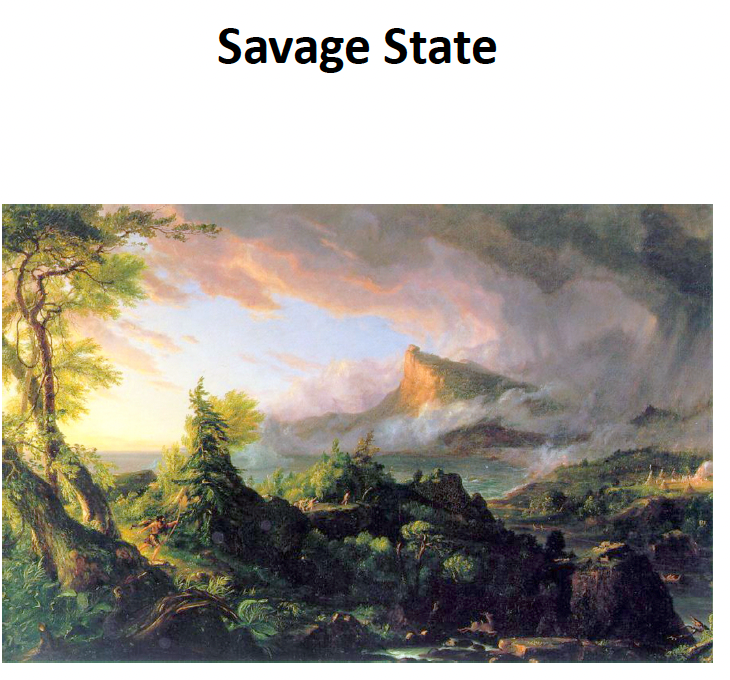
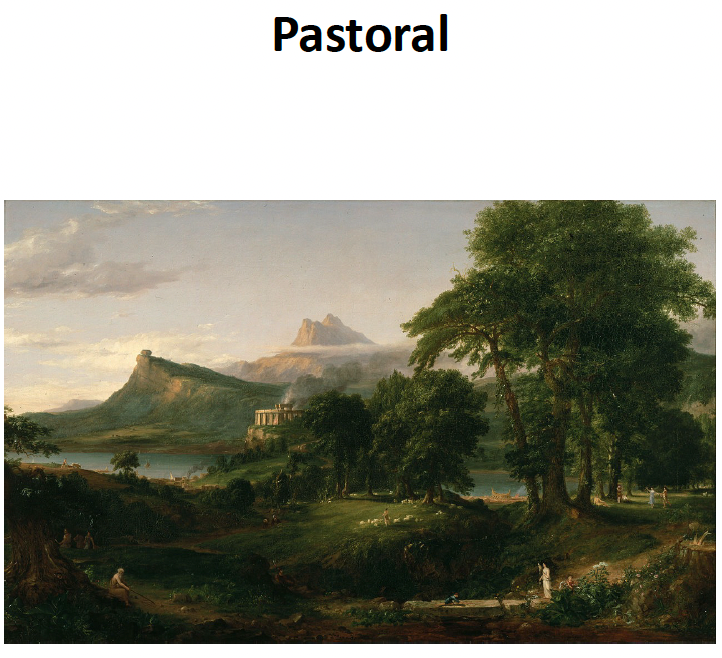
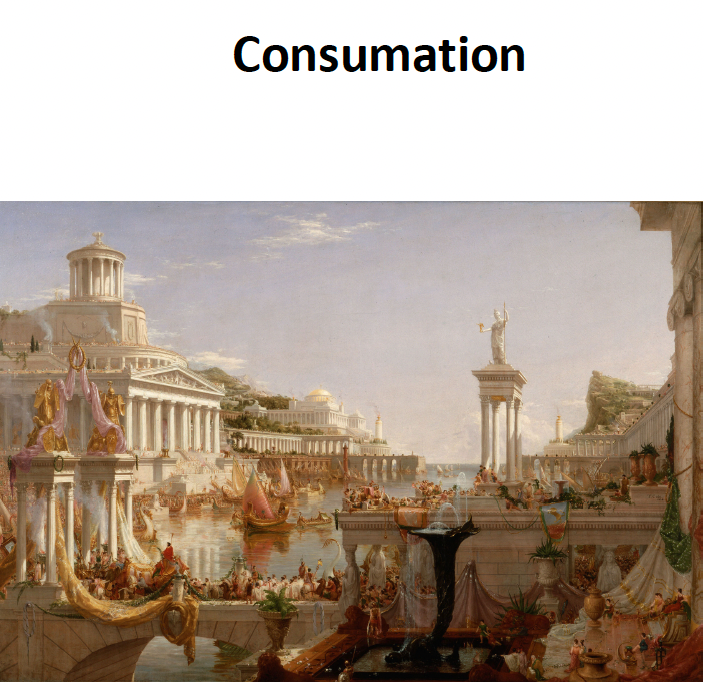
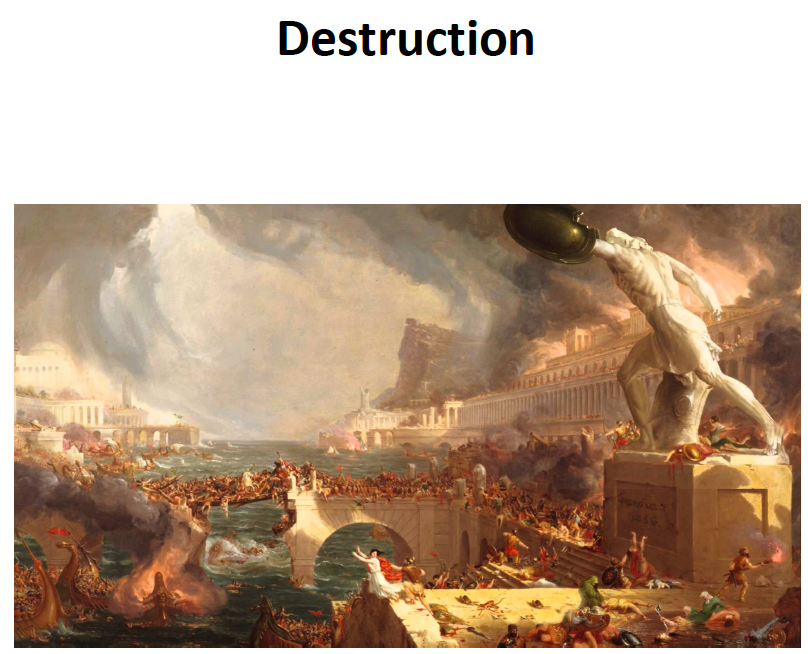
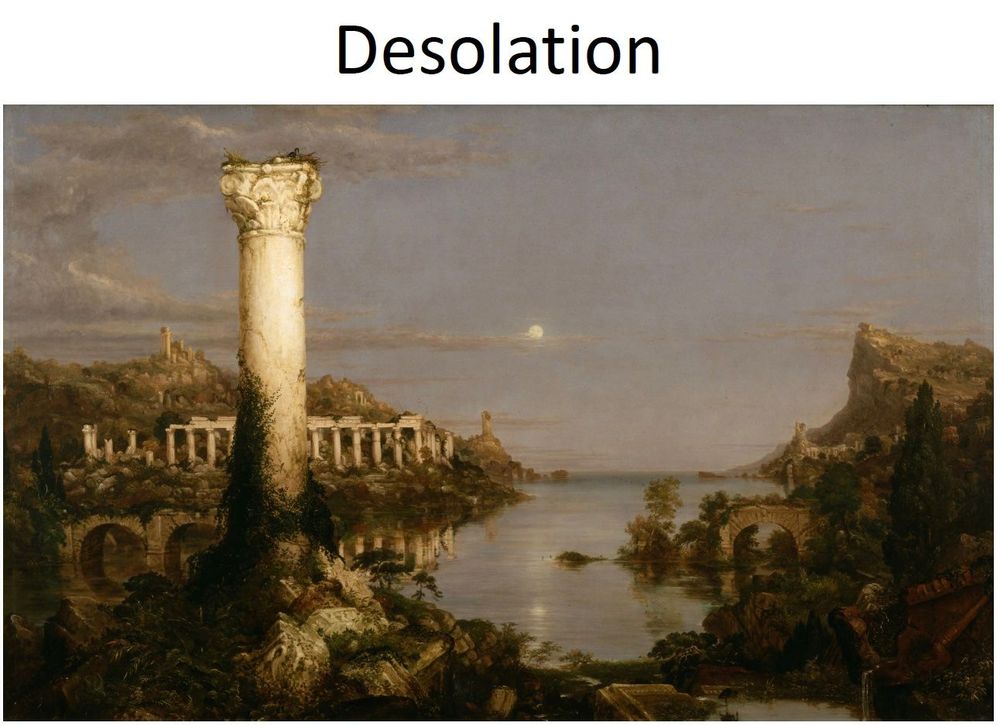
The artist Thomas Cole painted a five-part series between 1833 and 1836, entitled "The Course of Empire," which charts human society from a primitive wilderness to the height of urban civilization and eventual collapse (Noble 1853)
The Savage State: Features a pristine, uncultivated landscape at dawn with a lone hunter, representing humanity's initial, nomadic relationship with nature.
The Arcadian or Pastoral State: Shows the rise of agriculture, settled communities, and early architecture like a simple stone temple.
The Consummation of Empire: Depicts a massive, opulent classical city filled with marble colonnades, monuments, and celebratory processions.
Destruction: Captures the violent sacking and chaotic ruin of the great city by invaders.
Desolation: Reveals the site decades later, reclaimed entirely by plants, trees, and wildlife as human works fade into memory.
All these theories obviously share a great deal in common. However, none of those earlier great minds, except perhaps Karl Marx, saw opportunities for economic benefits embedded in their ideas of inevitable social change as does Oleg Maltsev. For him, "Every empire carries within it the seeds of its own decline. This is not philosophy. It is an engineering fact." Adding "It is about how you look at the market. what you see and not see. "About how to sell at the very moment the market is changing shape beneath your feet." (2026:7) In his scheme of things, there are Two Types of Entrepreneurs. The first sees the market as it is currently. The second the market as it will be in three to five years. The second notices the cracks in the walls and builds in the opening in order to sell, not simply a new product but a place in the world to come. He refers to his book as a textbook (manual perhaps?) for the second type of entrepreneur.
Maltsev's analyses range from the psychological through the economic to the sociological and back again. He offers insights to these opportunities and how to take advantage of them in twenty-three chapters. Each chapter is broken into constituent parts, and thankfully each has a summary. A sample from the list of chapter titles provides a glimpse of the logic and practical orientation of his theory. For example, as to market opportunities, one should avoid being "Blind Amid the Obvious," so we must understand the "The Physics of the Fracture," and recognize "Specialisation as Evolution," "Specialisation as a Weapon and "The Price of Specialisation."
The chapters are followed by two endpapers and three appendices which provide examples as well as tools for applying his theory of Fractures to the current and future markets. A glossary and Bibliography are further enhancements to the text,. I should note that as in all Maltsev's publications, the instructional and explanatory graphics are spectacular as one might find in such a invaluable "instruction manual".
Because there is much too many insight as Strategic Vision and Sales in the Age of Market Disintegration to digest in a single sitting, I will offer some of Maltsev's chunks of profitable wisdom.
"Markets do not usually die all at once. They fracture — quietly, for years, along lines invisible to the very experts who know them best — until the moment a specialised alternative outpaces the universal solution that once ruled unchallenged the biological principle of adaptive radiation, FRACTURE gives founders and entrepreneurs a working diagnostic apparatus rather than a motivational thesis: instruments for reading, a concrete tool, a worked example, and a practical exercise — theory converted, deliberately, into a decision a reader can make on Monday morning." (Ibid: 3)
The book closes not with a forecast but with an instruction: identify the fracture already taking place. "This textbook ends here. Fractures never end....Look at the horizon. Three fractures have already begun — and by 2030 will have changed most markets." (Ibid: 70)
"Most entrepreneurs look at AI the wrong way. They believe: “AI will replace people.” This is far too primitive a model. AI does something different. AI destroys: the average level, the standardised service, mass compromise, standard expertise. AI does not weaken specialisation. When the iPhone appeared, it changed more than the market. It changed behaviour, attention, thought, the rhythm of life. The universal smartphone created a universal digital human — a human of constant switching, of endless stream, of a life lived inside a single screen." (Ibid: 95)
"A fracture is not only a matter of markets and technology. A fracture is a change in the human being himself. The twentieth century: the human of production. The early twenty first century: the human of the universal interface." (Ibid: 97)
"You have closed the textbook. In twenty minutes —everyday life resumes. Calls, tasks, urgent matters. In a week, the textbook sits on a shelf. The instruments livein your head, but not in your hands. In a month, nothing has changed. This is the normal outcome for most people. But not for you. Thirty days is not a deadline. It is the minimal unit of strategic action. Any less, and there is not enough time to test. Any more, and momentum is lost. (Ibid: 105)
REFERENCES
Curtius, Quintus. 2015. Fortress of the Mind.
https://qcurtius.com/2015/05/08/the-rise-and-fall-of-empires-ibn-khalduns-theory-of-social-development/. Accessed August 1, 2026
Hegel, Georege William Friedrich. 2010. Georg Wilhelm Friedrich Hegel: Encyclopedia of the Philosophical Sciences in Basic Outline. Brinkmann K, Dahlstrom D.O, Eds.. Cambridge University Press.
Khaldūn, Ibn. 1967. The Muqaddimah: An introduction to history Trans. and Ed. Franz Rosenthal, N.J. Dawood. (Abridged).
Marx, Karl. 1867. Capital: A critique of political economy. Volume 1, Part 1: The process of capitalist production. New York, NY: Cosimo.
Noble, Louis Legrand. 1853. The Life and Works of Thomas Cole . Black Dome Press. (https://books.google.co m/books?id=xYcfAAAAYAAJ)
Rockmore Tom. 1986. Hegel's Circular Epistemology. Bloomington, IND: Indiana University Press. (https://publish.iupress.indiana.edu/projects/hegel-s-circular-epistemology)
Spengler, Oswald. 1918/1991. The Decline of the West. Helmut Werner, et al , Eds. Oxford University Press.
Spengler, Oswald. 1926. The Decline of the West . V. 1, New York: Alfred A. Knopf. (https://archive.org/stream/Decline-Of-The-West -Oswald-Spengler/Decline_Of_The_West#page/n12/mode/1up)
Toynbee, Arnold. J. 1987. A Study of History, Vol. 1: Abridgement of Volumes I-VI. Oxford University Press.