

Manifesto of the Temporal School of Psychology
Manifesto of the Temporal School of Psychology
“Consciousness governs time — time shapes consciousness.”
I. Introduction
The Temporal School of Psychology posits that the human psyche is not a byproduct of biochemistry or a mere reflection of reality, but an active mechanism that governs time itself.
Consciousness does not flow within time — it creates the flow of time, shaping the density, direction, and causality of events.
The psyche is the structure through which time becomes material, and the energy of time serves as the foundation for thought, memory, intuition, and will.
II. Foundations
The School unites five scientific traditions into a single framework:
- Depth Psychology (Freud, Jung, Szondi) — revealing the archetypal and unconscious structure of time.
- Cognitive Psychology (Gigerenzer, Kahneman) — showing that thinking and heuristics optimize temporal decision-making.
- Ontopsychology (Meneghetti) — identifying the inner temporal axis, In-Se, the point where the self aligns with its own time.
- Physics of Time (Nikolai Kozyrev) — demonstrating the reality of causal energy that carries the direction of time.
- Philosophy of Simulacra (Jean Baudrillard) — warning that losing contact with living time leads to the degradation of both reality and consciousness.
III. Purpose and Mission
The purpose of the Temporal School is to restore the lost union between psyche and time.
The mission is to educate a new generation of psychologists, philosophers, and researchers capable of working with the density, direction, and entropy of time.
The psychotherapy of the future will be the restoration of temporal resonance.
The neuroscience of the future — the science of time in thought.
The psychology of the future — the study of the causal energy of consciousness.
IV. Methodological Principle
The fundamental principle of the School:
Every psychic phenomenon has a temporal structure, and every temporal phenomenon has a psychic equivalent.
- Consciousness — the point where the energy of time transforms into meaning.
- Mind — the process of aligning causal asymmetry.
- Memory — the mechanism for retaining time.
- Intuition — the perception of reverse temporal waves.
- Psychotherapy — the correction of temporal entropy.
V. Structure of the School
1. Institute of Temporal Studies
Experimental laboratories exploring the perception of time, intuition, and memory.
Collaborative projects with physicists, neuroscientists, and philosophers.
2. Department of Temporal Psychotherapy
Training specialists capable of diagnosing and correcting temporal disorders of personality.
Practices aimed at restoring rhythm, resonance, and temporal harmony.
3. Center for Temporal Cognitive Science
Research on the timing of decision-making, cognitive heuristics, and the influence of temporal density on thinking.
4. Faculty of Philosophical Ontology
Study of the interrelation between time, consciousness, matter, and culture.
Comparative analysis of Eastern and Western temporal concepts.
VI. Motto of the School
“Consciousness governs time — time shapes consciousness.”
(Latin: “Mens gubernat tempus — tempus format mentem.”)
VII. Symbol of the School
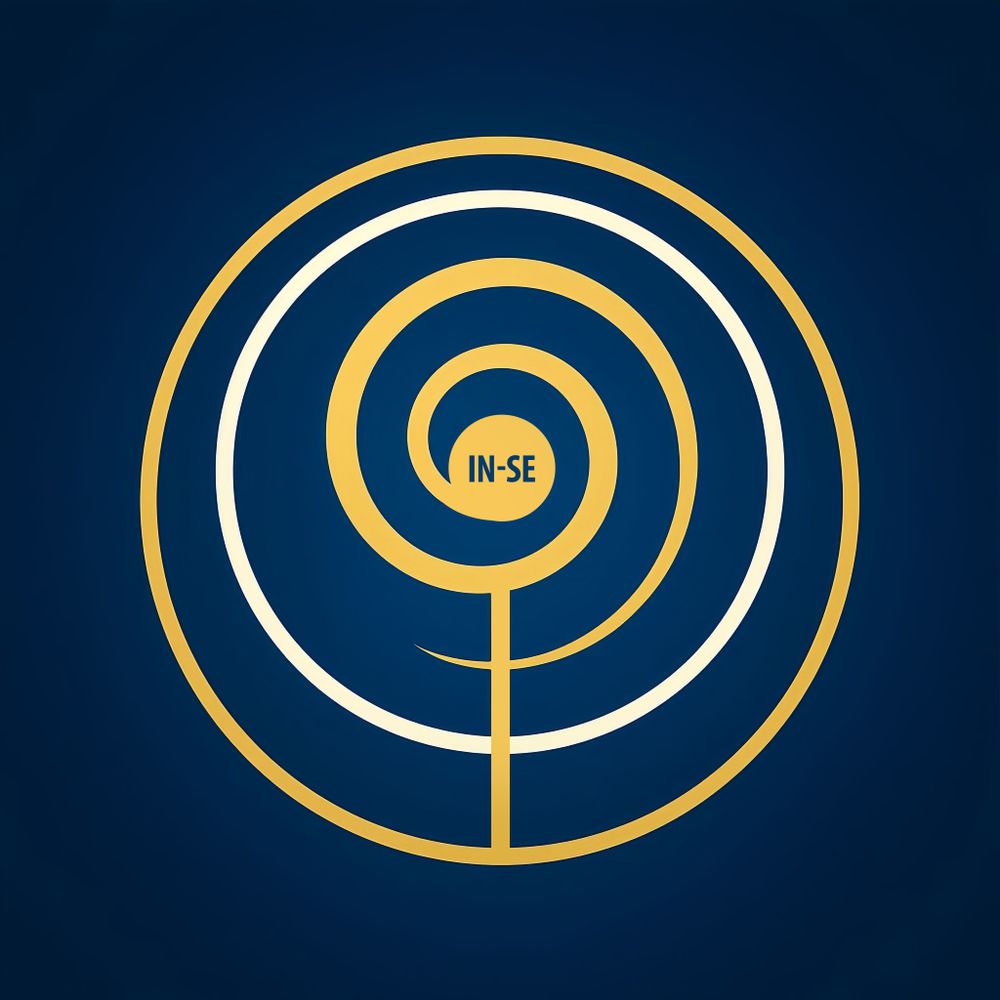
The central emblem is a spiral of time passing through three rings:
the lower ring — the unconscious (past),
the middle ring — consciousness (present),
the upper ring — the superconscious (future).
At the center — a golden point In-Se, the symbol of the inner axis of the personality.
The background — the radiance of causal energy (after Kozyrev).
Colors: blue (depth), gold (consciousness), white (time).
VIII. The Nine Principles of the Temporal School
- The psyche is a mechanism for transforming time.
- Consciousness is a function of ordering causality.
- Mind is a means of reducing temporal entropy.
- Memory is the magnet of time.
- Intuition is the perception of reverse temporal waves.
- Emotion is a way of changing the density of time.
- Fate is a program of temporal choices (after Szondi).
- Psychotherapy is the restoration of temporal symmetry of the personality.
- The science of time is the new foundation of the humanities.
IX. Perspective
The Temporal School lays the foundation for a new era in psychology, where the human being ceases to be a hostage of time and becomes its architect. It unites the precision of physics, the depth of psychoanalysis, and the clarity of cognitive science, forming a new discipline — the science of consciousness as an instrument for mastering time and causality.
Institute of Temporal Studies
Department of Temporal Psychotherapy
Center for Temporal Cognitive Science
Faculty of Philosophical and Ontological Studies
Director of the Institute — Rina Pilman (Netherlands)
Chief Administrator of the Temporal School of Psychology — Dr. Oleg Viktorovich Maltsev