

Interview with the Lawyer: New Facts in the Case of Scientist Oleg Maltsev
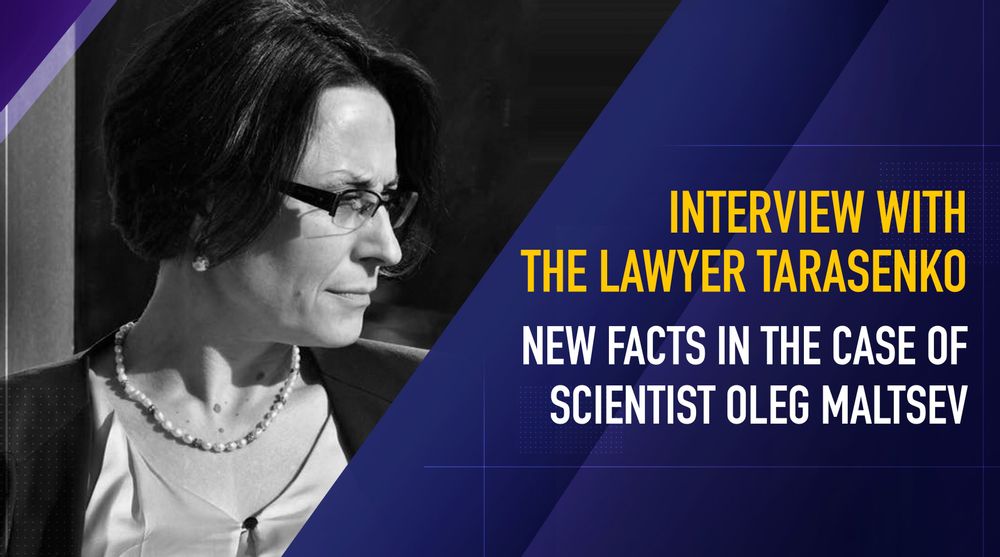
The case against scientist Oleg Maltsev, as well as his colleagues, has now been submitted to the court. The investigation has concluded. We spoke with his lawyer, Yevgeniya Tarasenko, to gain insight into the current developments. Of particular interest to us is the recent statement by European human rights organizations to the United Nations regarding this case, including the names mentioned therein. Below is our conversation with attorney Yevgeniya Tarasenko.
Q: Yevgeniya, good afternoon. Could you tell us what stage the case against the Ukrainian scientist Oleg Maltsev is currently at?
YT: The case has been submitted to court along with the indictment. The defense has received access to the case materials, which were compiled during more than two years of pre-trial investigation (approximately 1.5 years prior to the formal suspicion, and another 6 months following it). Here is what I can say at this stage.
Despite two years of meticulous work by ten prosecutors, twenty-five investigators, and operational support from the military counterintelligence division of the SBU, the prosecution failed to uncover or include in the case materials any evidence linking Oleg Maltsev’s so-called "dangerous" scientific organization to the Russian Federation. There is no correspondence “with Putin”, no “secret meetings” with alleged “handlers”, no statements of loyalty to the Russian Federation, nor any justification of its aggression against Ukraine.
Nevertheless, it was precisely this narrative of Oleg Maltsev’s alleged pro-Russian stance that certain Odessa journalists and paid Telegram channels attempted to keep in the public eye. More accurately, a small circle of media figures, “bound together by a common chain and united by a single goal”—to discredit Oleg Maltsev and his associates. I would note that as early as the first days of August 2024, online platforms began to circulate allegations of “betrayal” in connection with Maltsev. He was subsequently detained on September 12, 2024.
I believe this timeline provides further confirmation that the case against Oleg Maltsev was orchestrated.
Q: On March 28, during the annual United Nations Human Rights Conference in Geneva, French and Belgian human rights activists from Human Rights Without Frontiers and the Coordination of Associations and Individuals for Freedom of Conscience (CAP/Liberté de Conscience) stated that the case was fabricated and described it as an act of personal revenge by a particular SBU officer, Yevgeniy Volosheniuk. How would you respond to this assertion?
YT: This is the position of the European observers, and I am convinced that it is not without foundation. It is evident to me—and not only to me—that this case was fabricated. In every institution, there are honest employees, and there are those who exploit their official position for personal gain. This is not unique to Ukraine; it is a global phenomenon.
I can state that for the past six months, a particular officer from the SBU’s Department of Military Counterintelligence (DVKR) has not concealed his personal interest in this case. He has threatened defense counsel, eavesdropped on confidential conversations with the client, and made frequent displays of “his” power—though this power is not his own, but granted to him by the Ukrainian state, and I hope, only temporarily. He personally promised me that I would soon be “eating through a tube” and “end up in pre-trial detention alongside my clients.”
Let me offer one example from recent events.
On March 28, 2025, during a court hearing in this case, the same officer appeared in the courtroom. His presence served no legal or procedural purpose; he merely roamed the premises with an air of self-importance, eavesdropped on conversations between defense attorneys in the hallway, and inserted himself into the proceedings by vigorously defending a prosecution witness who, frankly, seems to be “from another planet” (as detailed in the article "Combat Accomplice" from Planet Tinia: A New Twist in the Case of Dr. Oleg Maltsev). He also attempted to provoke a journalist who was present.
To this day, I cannot understand what counterintelligence function he was performing, within the scope of his official duties, at the Primorsky District Court of Odessa. Who authorized him to engage in such conduct—parading his so-called expertise before attorneys in the hallway and provoking members of the press? And even more perplexing: why are Ukrainian taxpayers funding this off-duty circus in the form of a government salary?
Q: Understood. Then let me ask: are you saying the prosecution has not collected any evidence over the course of two years? That seems implausible.
YT: Why not? In fact, they did collect something: the testimony of a witness who claims she is “from another planet” and openly admits that she is motivated by personal revenge against Dr. Maltsev. Then there’s the testimony of one of the detainees, who spent four months in the Odessa pre-trial detention center. In my view, he could no longer endure the conditions and ultimately agreed to confess to something he did not commit.
Additionally, four women and a German journalist have now been held in pre-trial detention for six months. They are charged under minor articles, yet the court has repeatedly refused to grant them bail. I suspect the prosecution is hoping that these individuals, too, will eventually break under the pressure of prolonged detention and implicate my client.
The most absurd aspect of the case involving these four women and the journalist is that the indictment—the final document concluding the pre-trial investigation—does not actually specify what actions they are accused of. Under criminal law, a person can only be prosecuted for concrete acts or omissions. And yet, these five individuals still do not know what alleged illegal acts they are being accused of. Their defense attorneys are left wondering how they are expected to defend their clients when the charges lack any factual basis. And despite this, the accused remain detained.
As for the so-called evidence, the case still includes a linguistic analysis conducted by an SBU expert. Everything else amounts to meaningless paperwork.
To be clear, the entire case against Dr. Oleg Maltsev—and the rationale for his continued detention in the Odessa pre-trial detention center—is built on this linguistic analysis, which was performed by an SBU expert. That expert, with only one year of professional experience, completed the analysis in just eight days. For comparison, a panel of experts from the Ministry of Justice required 68 days to conduct a similar examination. That panel included specialists with more than 20 years of experience.
You can draw your own conclusions.
Q: Many online publications claim that Maltsev is accused of state treason. Is this true?
YT: No, that information is false. There are no charges of state treason (Article 111 of the Criminal Code of Ukraine) against Dr. Maltsev or his colleagues—nor have there ever been.
In fact, the very question is troubling to me as a lawyer. Even if such a charge had been filed, Ukraine is still governed by the presumption of innocence—no one has repealed it, and I hope no one ever will.
Unfortunately, in my personal opinion, our society has not yet fully shed the remnants of a Soviet mentality. In the USSR, if a person was accused of something—especially by the state security apparatus—that was enough. He was presumed guilty from the outset. People would turn away from him, pretend they didn’t know him, and self-proclaimed “champions of socialist construction” would rush to shout from every corner that he was guilty—without trial, without evidence.
You see, in the morning, some of our fellow citizens profess their belief in democracy—and by evening, they are leaving online comments reminiscent of the year 1937. It is deeply disheartening.
We remember with horror the victims of Stalinist repression—the darkness of an era when people were executed based on denunciations and sent to the Gulag without trial. And yet one critical question remains unanswered: who wrote those denunciations? They weren’t aliens from outer space. They were citizens of the USSR. There were millions of such denunciations. And they weren’t written reluctantly—they were written eagerly. Some wanted another person’s apartment. Some coveted a position. Others sought revenge.
This is the historical lesson we must learn from—and the example we must avoid at all costs. We must never again resemble those tragic figures, those shameful chapters of history, or those utterly unacceptable forms of so-called justice.
Q: In the UN report, the French and Belgian representatives allege that the SBU is exerting pressure on the court in the Maltsev case. Is this true?
YT: I have no concrete evidence to confirm whether that is true or not. That statement reflects the opinion of the European observers. If I had verifiable proof of pressure being exerted on the court, I would have filed a complaint with the State Bureau of Investigations (DBR) and the High Council of Justice (GRP) long ago.
What I can say with certainty, however, is that Ukrainian courts tend, more often than not, to side with the prosecution—this is my personal opinion, based on years of practice. It’s a lingering legacy of the Soviet era, which I mentioned earlier. I once had a prosecutor say to me, “Well, you understand, judges aren’t saints either, so they’ll make some concessions to us.”
It is no secret among criminal defense lawyers that the prosecution routinely relies on what’s known as the “administrative resource”—and they don’t even bother to hide it. Unfortunately, it works in Ukraine. Of course, this does not apply to every judge, but the general trend, from my perspective, is clear.
That said, there is a flipside. Anyone can become the target of a criminal case—judges, prosecutors, investigators alike. And when that happens, the “system” will operate against them in the same way. It’s not uncommon to see members of the judiciary or law enforcement express outrage over “lawlessness” only once they themselves are under investigation. But they often forget—they are the very ones who helped construct this system.
Q: Not long ago, some Telegram channels published claims that Odessa journalists are accusing the head of the Odessa branch of the National Union of Journalists of Ukraine (NUJU) of allegedly “leaking” information about the case to Maltsev’s lawyers. Can you clarify what this is about?
YT: Yes, I’ve seen those reports. In my view, this is nothing more than a dispute between certain Odessa journalists and the head of the local NUJU branch, in which they’re attempting to draw my client into their internal conflict. It’s true that some Odessa journalists—many of whom are no longer practicing journalists—submitted a “statement” about Dr. Maltsev to the head of the SBU investigation in the Odessa region. In it, they portray him as a dangerous individual and request that he not be released from custody. This document is part of the official case file and was made available to the defense on February 18, 2025, in accordance with Article 290 of the Criminal Procedure Code of Ukraine, along with other case materials.
So, if these Odessa journalists now wish to argue with the head of the NUJU over whether he supposedly “leaked” this “terrible secret” to us—let them go ahead. They’re welcome to entertain themselves. The so-called “secret” is included in the case file, and under current law, the prosecution is required to disclose all such materials to the defense—which is exactly what happened.
What I genuinely cannot understand is why a group of SBU-linked agitators is involving itself in matters related to journalism. I can only assume that the so-called “journalists” who authored this “statement” have direct ties to the SBU. If so, that has absolutely nothing to do with journalistic work—and everything to do with personal vendettas against Dr. Maltsev. It’s pure gossip masquerading as professional commentary. I believe their actions speak volumes. You’ll recall I previously mentioned the millions of denunciations in Soviet times? This is no different.
Q: Thank you for the conversation.
April 16, 2025