A Review of Oleg Maltsev’s ‘FRACTURE: Strategic Vision and Sales in the Age of Market Disintegration’
A Review of Oleg Maltsev’s ‘FRACTURE: Strategic Vision and Sales in the Age of Market Disintegration’
Vitalii Lunov
PhD, Cl. Academician of EUASU, Professor, Full Member of the Royal Society of St George (UK); member of the European Association of Science Editors (UK) and the Association of British Science Writers
Work under review: Maltsev, O. FRACTURE: Strategic Vision and Sales in the Age of Market Disintegration. European Academy of Sciences of Ukraine, 2026. 134 pp. ISBN 978-1-972646-78-6.
Abstract. This review considers Oleg Maltsev’s practical authorial manual devoted to strategic observation of the market, entrepreneurial positioning, and sales amid the disintegration of universal market models. It examines the concept of market ‘fracture’, the logic of specialisation, the system of heuristic matrices and diagnostic questions, the classification of client positions, and the chapters addressing artificial intelligence, product culture, and the attention economy. The book is shown to translate strategic ideas consistently into the language of entrepreneurial decisions, whilst at the same time opening a prospect for an interdisciplinary analysis of the market as a domain of technological, symbolic, and identificatory transformation. The review concludes that the work possesses educational, consultative, and conceptual value for entrepreneurs, executives, sales professionals, and scholars of contemporary consumer culture.
Market ‘Fracture’ as an Object of Entrepreneurial Thought
Contemporary business literature rather frequently resorts to the language of ruptures, disruption, and radical transition. Such rhetoric undoubtedly has a commercial allure of its own: it assures the reader that established rules are losing their authority at this very moment, and that delay will almost inevitably be paid for in lost opportunity. Yet beneath the outward categorical force of Academician Maltsev’s book lies a proposition of greater substance and, perhaps, greater composure. The market changes not merely because new technologies appear; it changes because the former universal solution ceases to satisfy increasingly heterogeneous groups of consumers with equal adequacy.
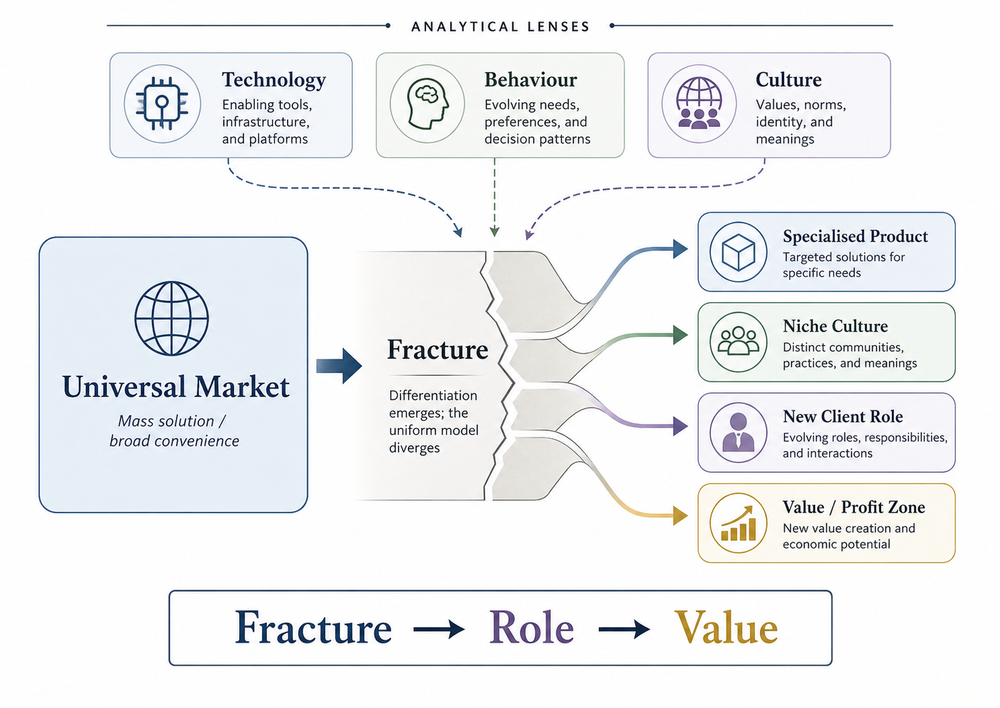
It is precisely this development that the author designates by the term fracture. What is at issue is neither a sudden catastrophe nor the literal disappearance of an industry, but the gradual disturbance of its former homogeneity. The universal product retains its scale, infrastructure, and recognisability; alongside it, however, emerge solutions that deliberately relinquish breadth of function in favour of precision, depth, and cultural definition. Viewed in this light, specialisation appears not as the defensive retreat of a small enterprise, but as an autonomous form of strategic advance.
This idea bears an affinity with several established traditions of strategic thought: competitive positioning, disruptive innovation theory, category marketing, the industry life-cycle concept, and research on the diffusion of innovations (Porter, 1980; Christensen, 1997; Ries & Trout, 1981; Rogers, 2003). The author makes no attempt to conceal this intellectual succession, drawing upon the work of M. Porter, C. Christensen, A. Ries, and J. Trout. At the same time, his purpose is less to reconstruct the academic genealogy of the proposed approach than to assemble dispersed ideas into a coherent practical system. The book’s novelty resides in this compositional achievement: familiar strategic categories are made to constitute an integrated language for discerning market transition, suitable not only for description but also for immediate action.
The work’s generic clarity is among its notable merits. It is conceived as an authorial practical manual for the entrepreneur, consultant, or executive who must reach a decision under conditions of incomplete information. The author offers the reader not a detached contemplation of the market, but a system of disciplining questions through which uncertainty may be converted into an orderly sequence of observations and decisions. Here, the well-posed question is not an adjunct to strategy; it is strategy’s original intellectual form.
From the Universal Product to a Specialised Culture
The book’s conceptual structure unfolds around the opposition between universality and specialisation. The universal product prevails by virtue of scale, convenience, and the capacity to combine numerous functions within a single system. As it reaches institutional maturity, however, a characteristic divergence arises between the ‘core’ of the original innovation and the ‘shell’ of accumulated infrastructure. The company continues to refine its services, ecosystem, and mechanisms of consumer retention, even though the once revolutionary core no longer creates a qualitatively new experience.
The author illustrates this logic chiefly through examples drawn from technology and premium brands: Apple, Nokia, Kodak, Leica, Kindle, reMarkable, and Astell&Kern. The selection of cases accords well with the book’s design. It demonstrates how the standardisation of the mass-market device releases space for the professional instrument, the ritualised experience, or the niche community. Thus, the universal smartphone does not necessarily extinguish the specialised camera or audio player; on the contrary, it may render more distinct the difference between everyday sufficiency and a depth that is professionally or culturally significant.
The most persuasive pages, to my mind, are those in which specialisation is treated as more than technical improvement. A product becomes resilient when a particular vocabulary, standards of competence, forms of recognition, and a sense of belonging develop around it. The consumer acquires more than a function; he or she affirms a particular conception of the self and of the quality of one’s own practice. Such a formulation carries the analysis beyond the conventional comparison of specifications and price.
At the same time, the author rightly cautions against romanticising narrowness as such. A niche product does not become strategic merely because it interests a small group of people. Genuine specialisation requires a growing problem, a cultural environment, a willingness to pay for depth of solution, and the possibility of forming an autonomous category. The introduction of the notion of ‘false specialisation’ appreciably strengthens the manual’s general logic: it prevents the idea of the niche from becoming a universal prescription capable of justifying every eccentric entrepreneurial design.
The Commodity as Sign: A Baudrillardian Perspective
The concept of the specialised product acquires further depth when considered within Jean Baudrillard’s coordinates. In The System of Objects and The Consumer Society, the French thinker had already shown that the modern object is never exhausted by its utilitarian function. The thing enters a system of differences in which its significance is determined not only by what it enables one to do, but also by the place it affords its possessor within the social and symbolic order (Baudrillard, 1968, 1970). From this perspective, consumption becomes a practice of reading and reproducing signs.
It is for this reason that, in Professor Maltsev’s work, Leica, the professional audio player, electronic paper, or the mechanical watch amount to something fundamentally more than bundles of technical specifications. They signify a refusal of universal sufficiency and an entry into another mode of relation to image, sound, time, or reading. Their elevated price thereby acquires not only a functional but also a signifying foundation: the consumer purchases distinction, cultural competence, and the right to be recognised within a particular community.
From a Baudrillardian standpoint, market ‘fracture’ may be understood as a disturbance of the dominant code of consumption. So long as the universal device successfully represents a coherent system of signs, the specialised object is perceived as superfluous or anachronistic. Yet when the mass form becomes too transparent, too ordinary, and devoid of differentiating force, demand arises for an object capable of producing a meaningful distinction anew. Specialisation thus responds not only to technical dissatisfaction, but also to the exhaustion of the universal product’s symbolic expressiveness.
This connection is particularly apparent in the author’s discussion of culture as the brand’s ‘invisible fortress’. Culture is not appended to a product once its development is complete; it constitutes the order of meanings within which the product becomes desirable in the first place. Baudrillard’s theory of sign value makes it possible to regard the manual’s cultural dimension not as an ornament to marketing strategy, but as one of the central conditions of economic value.
Under conditions of generative artificial intelligence, this conclusion becomes still more consequential. The mass production of texts, images, and stylistic imitations increases the autonomy of the sign from the history of its creation. Baudrillard’s problematic of simulation helps explain why provenance, school, authorial responsibility, and demonstrated practice are becoming independent sources of value (Baudrillard, 1981). The specialised product responds to the surfeit of reproducible images not by rejecting technology, but by restoring the relation between sign, mastery, and cultural genealogy.
Heuristic Instruments and the Discipline of Decision
The practical value of the book is determined above all by its system of matrices, scales, maps, and control questions. The author proposes that the market be analysed through three ‘lenses’—technology, behaviour, and culture; that the condition of a company’s core and shell be distinguished; that the stage of an industry’s specialisation be assessed; that the zone of possible profit be identified; and that a position be formulated through the sequence ‘fracture—role—value’. These schemes are not burdened by specialist terminology and may be employed both in individual work and during a strategic session.
Particular approval is due to the fact that the book repeatedly returns the reader from expansive forecasts to verifiable action. The author recommends beginning neither with costly production nor with an impressive presentation for investors, but with conversations with ten prospective clients. The requirement may appear almost studiedly modest; it is, however, precisely here that the practical maturity of the approach becomes evident. An entrepreneurial hypothesis should encounter the client’s language before it is converted into a product range, an organisational chart, and capital expenditure.
The proposed thirty-day cycle combines market diagnosis, refinement of positioning, a series of interviews, and an attempt at a first sale. As a form of preliminary validation, it is thoughtful and operationally lucid. The emphasis upon substantive refusal is equally significant: a position is defined not only by what the company intends to do, but also by the functions, audiences, and compromises it consciously declines. A strategy that entails neither choice nor exclusion does indeed risk remaining no more than an expression of preference.
The book’s diagnostic schemes constitute a distinctive language of managerial reflection. Their purpose is to render observation reproducible within an entrepreneurial team: to distinguish signal from noise, relate technological displacement to behavioural change, identify the stage of market transition, and select an appropriate course of action. In this capacity, Maltsev’s matrices perform not only an applied but also a communicative function. They establish a common frame of reference within which the founder’s intuition may be articulated, discussed, and transformed into a collective decision.
The Client, Desire, and the Language of Transition
The second substantive line of the book concerns sales within an emergent segment. The author proceeds from the premise that the client does not invariably possess a clear name for his or her own need. The client notices dissatisfaction with the universal solution, observes the conduct of early adopters, and hears a new professional vocabulary, yet remains unable to combine these elements into a coherent account. In such circumstances, the salesperson is more than an intermediary between commodity and purchaser. He or she must be able to name the change accurately and to indicate the client’s place within it.
This part of the manual lends itself to a productive reading through Jacques Lacan’s psychoanalytic theory. For Lacan, desire is not a simple internal need that already exists in finished form and merely awaits an appropriate object. It is structured by language, arises in relation to the Other, and becomes accessible to the subject through a system of signifiers (Lacan, 1966, 1973). Consequently, the change in client vocabulary to which Professor Maltsev attaches such importance is not an external accompaniment to the market, but one of the earliest indications that desire itself is being transformed.
The proposed distinction among the ‘seeker’, the ‘fugitive’, and the ‘observer’ is convenient in applied terms. The first pursues a new quality and is prepared to appreciate professional detail; the second wishes above all to be rid of the constraints of the former system; the third requires reassurance, examples, and a reduction of risk. The author acknowledges the mobility of pure types and recommends identifying the dominant motive in the particular situation. Client positions may therefore be understood as differing modes by which the subject enters a market discourse that has not yet reached completion.
In psychoanalytic coordinates, the seller of a specialised product occupies a noteworthy position. The seller does not merely communicate the object’s properties, but offers signifiers through which the client becomes able to name a previously indistinct dissatisfaction. The formula ‘to name the fracture’ thus becomes an act of symbolisation: particular inconveniences, dispersed impressions, and unformed preferences are gathered into a coherent statement of what the subject desires and what he or she intends to become.
The specialised product may, in turn, occupy within consumer discourse the place of the cause of desire, without coinciding with desire’s final satisfaction. The Lacanian objet petit a denotes not an object capable of abolishing lack once and for all, but that which sustains the movement of desire. The thing proves attractive insofar as it promises the subject a certain completeness of professional mastery, purity of experience, or recognition from a valued community. This is precisely why the language of technical specifications yields in the book to the language of role, transition, and new identity.
Professor Maltsev’s proposition that ‘one sells not a product, but a place in a new world’ may be interpreted as a description of symbolic identification. The purchaser relates not only to the thing but also to the figure of what he or she becomes within the field of the Other: a connoisseur, a master, a person of concentrated reading, attentive listening, or professional vision. The sale of a specialised solution thereby assumes the character of an offer of a new subjective position.
The four-phase sales scenario—establishing contact, diagnosis, presenting value, and agreeing the next action—deserves attention for its disciplined sequence. Its most consequential rule is that an account of the product must not precede an understanding of the client’s circumstances. In an age of automated promotional messages, such a discipline of listening acquires an almost moral dimension: it restores to selling the character of a professional conversation rather than an exercise in verbal pressure.
Artificial Intelligence, Attention, and the New Value of Depth
The concluding part of the book appreciably broadens its original problematic. In discussing artificial intelligence, the author describes a polarisation of the market between inexpensive automated production and profound specialisation. Everything standardised, averaged, and readily reproducible, in his account, rapidly loses value; by contrast, authorial choice, professional responsibility, cultural affiliation, and trust assume increasing importance.
The force of this thesis lies in its strategic clarity. It obliges the entrepreneur to ask a fundamental question: which part of the offering genuinely resists reduction to a template? Recent research on occupational exposure to generative AI confirms the scale of the transformation affecting tasks and professions (Gmyrek et al., 2025). Against this background, the author’s emphasis on depth acquires particular significance. The specialist of the future will be defined not by the simple preservation of established competences, but by an ability to unite machine productivity with responsible judgement, cultural competence, and a distinctive manner of formulating the problem.
The reflections upon the attention economy are still more original. Kindle, electronic paper, the specialised audio player, the mechanical watch, and the professional camera are interpreted as devices that limit the stream and restore to an activity its proper rhythm. The author treats quiet, concentration, and ritual as new premium categories. This proposition is distinctly fertile: in an environment where most services compete for duration of contact, a product that safeguards the user’s attention may indeed acquire a particular ethical and economic value.
Here the book approaches the cultural essay. The market is understood no longer simply as an aggregate of transactions, but as a domain in which habits, rhythms of perception, and forms of self-definition are produced. This expansion lends the original entrepreneurial model a pronounced perspective derived from cultural studies. The manual’s most conceptually abundant passages arise precisely where the author’s practical powers of observation encounter the question of what sort of user is produced by a given technological order.
The Prospect of the Concept: From Practical Manual to Research Programme
The concept of market ‘fracture’ possesses considerable potential for further development. The technological, behavioural, and cultural lines of analysis presented in the book may be elaborated into an interdisciplinary research programme uniting strategic management, consumer psychology, digital anthropology, semiotics, and the study of organisational change. Such a conjunction appears especially timely, since the contemporary market is increasingly resistant to description solely in terms of price, function, and scale.
The first promising direction concerns the mapping of early signals of fragmentation. The author’s three-lens model is capable of providing a basis for longitudinal observation of the manner in which new technical possibilities pass into changes in client vocabulary, subsequently become established practices, and finally acquire cultural institutionalisation. Within such a research design, the market would appear not as a static collection of offerings, but as the dynamic emergence of new distinctions.
A second direction opens at the intersection of Maltsev, Baudrillard, and Lacan. Baudrillard makes it possible to investigate how the specialised thing acquires sign value and enters a code of social distinction. Lacan, for his part, renders visible the role of language, lack, and symbolic identification in the formation of client desire. The conjunction of these perspectives allows the market segment to be considered as a discursive formation within which not only commodities but also new subjective positions are produced.
The third prospect concerns artificial intelligence. In the coming years, interest will attach not only to the automation of the mass product, but also to the emergence of new specialised cultures around the uses of AI. Professional communities will be differentiated by the quality with which they formulate tasks, by their standards for verifying results, by styles of human-machine co-authorship, and by ethical regimes of responsibility. In this context, the concept of ‘fracture’ may describe the transition from universal access to AI towards a plurality of mature practices for its professional appropriation.
Finally, the educational prospect possesses an importance of its own. The manual’s matrices and scenarios may serve as the foundation for entrepreneurial laboratories in which participants successively analyse their own market, conduct interviews, formulate a position, and test a minimal hypothesis. The book thus offers not only content for instruction, but also an organising principle: theory is mastered through observation, conversation, and action.
Composition, Language, and Readership
The book is written with energy, clarity, and deliberate rhythm. Brief paragraphs, dialogic interludes, diagrams, the recurrence of leading propositions, and concluding assignments establish an almost seminar-like mode of reading. The author does not permit the reader to remain for long in the position of an observer: every idea demands immediate relation to one’s own market, product, or client audience. For an entrepreneurial manual, this is an undoubted merit.
The volume’s visual organisation supports its methodological purpose. Tables and diagrams do not serve as mere embellishment; rather, they gather the logic of the chapters into readily comprehensible structures. The text lends itself to selective use: an individual matrix, chapter, or exercise may furnish the basis of a concise strategic session. The recurrence of the compositional formula establishes a methodological rhythm and enables the reader to move swiftly from recognising the problem to applying the instrument.
The book’s international prospect follows from the universality of the problem it addresses. The tension between mass convenience and specialised depth manifests itself across diverse technological and cultural settings, although its particular forms may differ. The author’s system may therefore be adapted to educational programmes, sectoral research, and consultative practice in differing national contexts.
The book’s principal reader is the proprietor of a small or medium-sized enterprise, the project founder, consultant, product specialist, or head of sales. For the academic researcher, the manual will be of interest chiefly as an instance of practical conceptualisation of market fragmentation. For the novice entrepreneur, it is valuable for the discipline of action it imposes; for the experienced practitioner, it offers an occasion to consider whether professional familiarity has become a form of attachment to a model whose relevance is declining.
Conclusion
Oleg Maltsev’s FRACTURE is a substantively organised and visually articulate authorial manual concerned with strategic conduct under conditions of market fragmentation. Its particular merit lies in the author’s translation of complex processes of technological, behavioural, and cultural change into a sequence of decisions that the entrepreneur can discuss, test, and revise.
The book persuades the reader to abandon two equally unproductive positions: the passive expectation that the former market will return, and the unqualified worship of every novelty. Between them lies the domain of disciplined observation. One must discern changes in the client’s language, determine whether a culture is forming around the solution, identify a minimal testable hypothesis, and enter into conversation with those already living within the new segment. For all its apparent simplicity, this conclusion carries considerable practical value.
‘Fracture’ affects more than the organisation of the market: it alters the code of things, the language of desire, and the symbolic positions available to the consumer. Maltsev’s practical model thereby opens towards a broader theory of the contemporary subject, who forms the self through the choice of instruments, communities, and regimes of attention.
In its present form, the work merits a positive assessment. It may be used to advantage in programmes of entrepreneurial education, business consultancy, the preparation of sales professionals, and the conduct of strategic sessions. Moreover, the book possesses a quality encountered rather less often than is commonly supposed: once it has been read, the reader is left not merely with an opinion about the future of markets, but with a sufficiently definite list of actions for the following Monday.
References
1. Maltsev, O. FRACTURE: Strategic Vision and Sales in the Age of Market Disintegration. European Academy of Sciences of Ukraine, 2026. 134 pp.
2. Baudrillard, J. Le système des objets. Paris: Gallimard, 1968.
3. Baudrillard, J. La société de consommation: ses mythes, ses structures. Paris: Denoël, 1970.
4. Baudrillard, J. Simulacres et simulation. Paris: Galilée, 1981.
5. Lacan, J. Écrits. Paris: Éditions du Seuil, 1966.
6. Lacan, J. Le Séminaire, Livre XI: Les quatre concepts fondamentaux de la psychanalyse. Paris: Éditions du Seuil, 1973.
7. Christensen, C. M. The Innovator’s Dilemma: When New Technologies Cause Great Firms to Fail. Boston: Harvard Business School Press, 1997.
8. Porter, M. E. Competitive Strategy: Techniques for Analyzing Industries and Competitors. New York: Free Press, 1980.
9. Ries, A., and Trout, J. Positioning: The Battle for Your Mind. New York: McGraw-Hill, 1981.
10. Rogers, E. M. Diffusion of Innovations. 5th ed. New York: Free Press, 2003.
11. Gmyrek, P., Berg, J., Kamiński, K., et al. Generative AI and Jobs: A Refined Global Index of Occupational Exposure. ILO Working Paper 140. Geneva: International Labour Organization, 2025.
LATEST NEWS
Twenty-four thinking skills: An Anatomy of a Critical Thinking Textbook for Adults and Children
The flame of critical thinking
Review of Professor O. V. Maltsev’s Book: "Fracture: Strategic Vision and Sales in the Age of Market Disintegration"
A Review of Oleg Maltsev’s ‘FRACTURE: Strategic Vision and Sales in the Age of Market Disintegration’
European Academy of Sciences of Ukraine Announces the Publication of FRACTURE
LATEST NEWS
Twenty-four thinking skills: An Anatomy of a Critical Thinking Textbook for Adults and Children
The flame of critical thinking
Review of Professor O. V. Maltsev’s Book: "Fracture: Strategic Vision and Sales in the Age of Market Disintegration"
A Review of Oleg Maltsev’s ‘FRACTURE: Strategic Vision and Sales in the Age of Market Disintegration’
European Academy of Sciences of Ukraine Announces the Publication of FRACTURE