A Neural Network Will Never Replace the Human Being by Prof. Dr. Oleg Maltsev
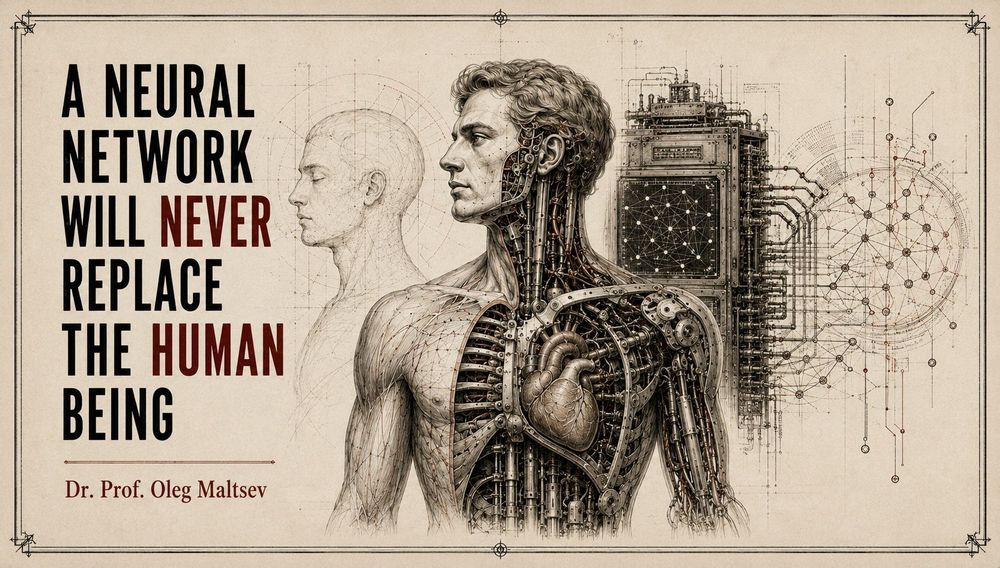
A Neural Network Will Never Replace the Human Being
Distinguishing the Human-Self, the Cybernetic Machine of the Body, and Artificial Intelligence
A Problem-Setting Article
by Dr. Prof. Oleg Maltsev
Abstract
Contemporary discussion of artificial intelligence is largely organized around a single question: will AI eventually replace the human being?
This article argues that the problem is incorrectly formulated from the outset.
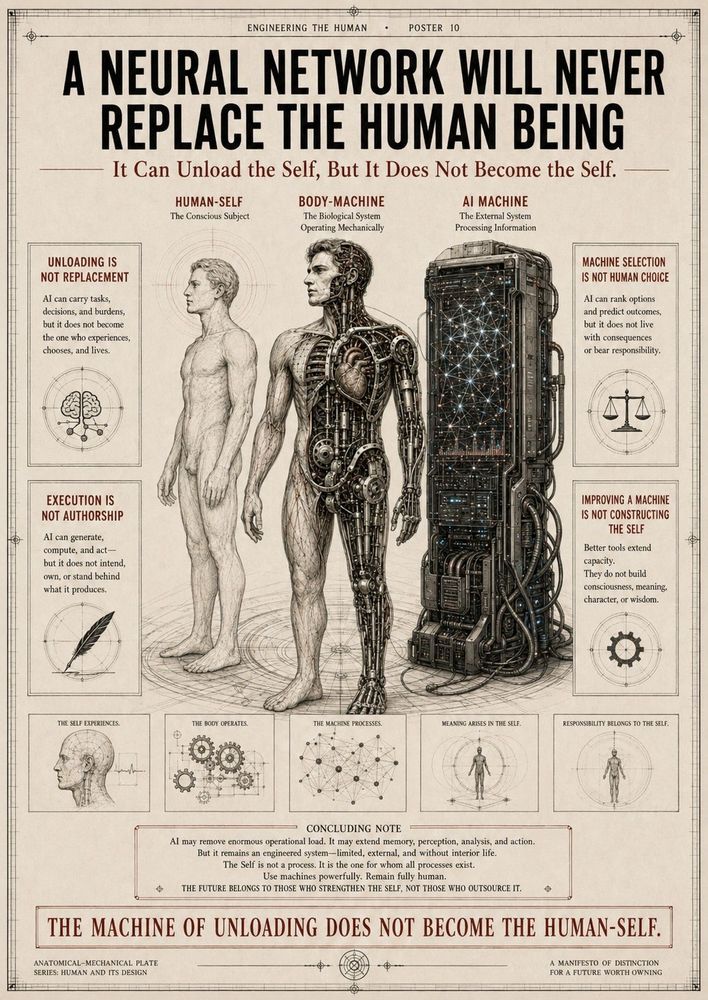
The underlying error lies in treating the human being as a unified aggregate of intellectual, computational, sensory, regulatory, and executive functions. The model proposed here distinguishes three different objects of analysis: the Human-Self, the cybernetic machine of the human body, and artificial intelligence.
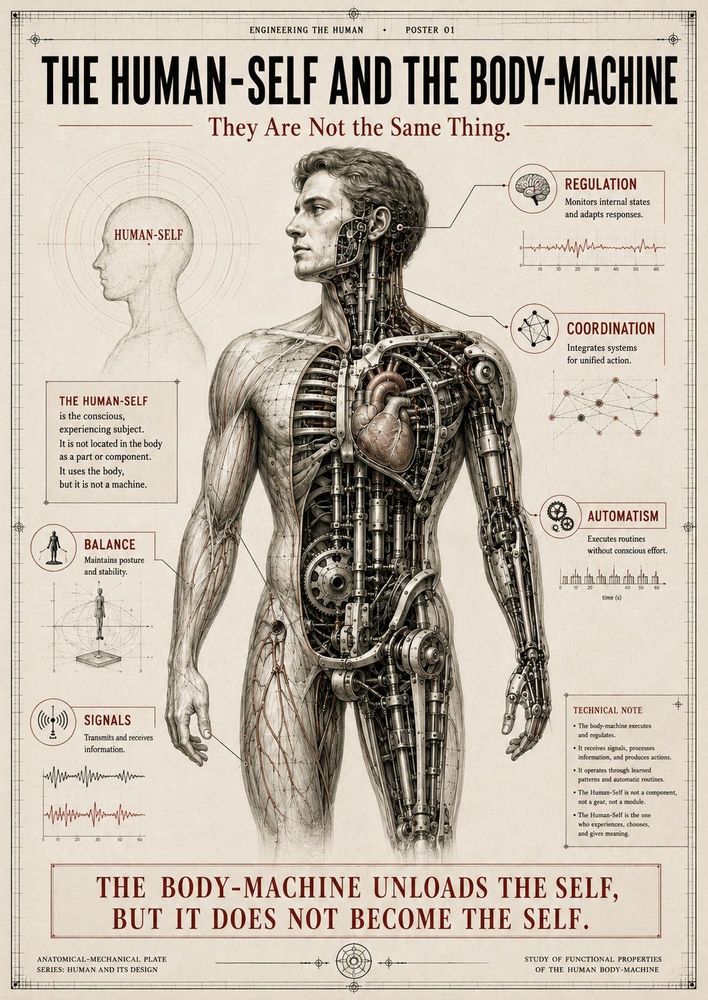
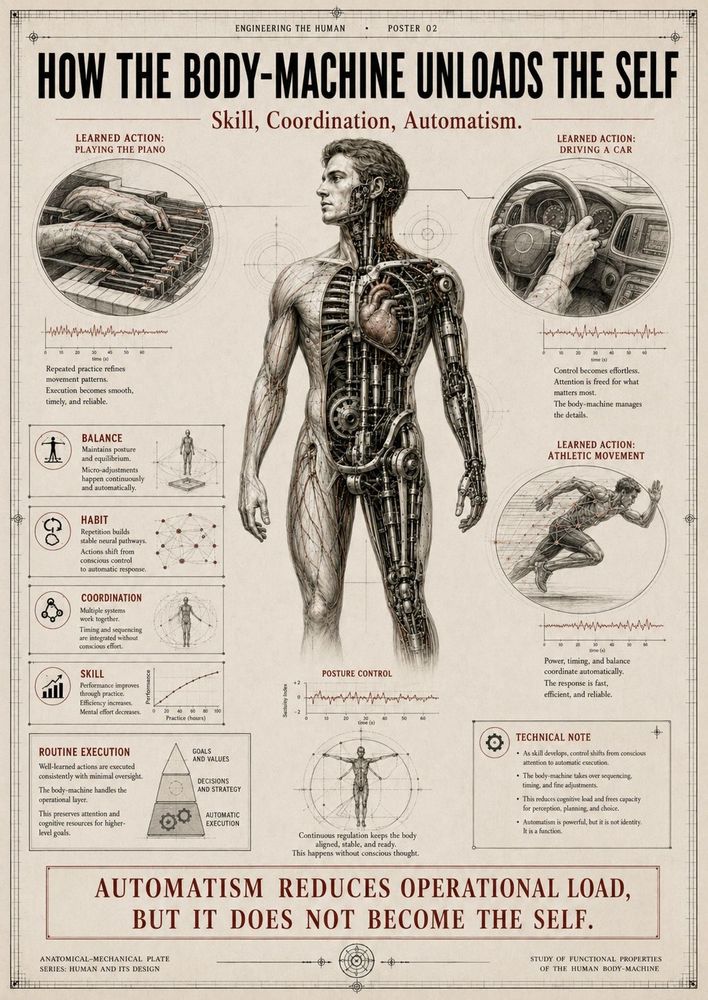
The Human-Self is not identical to the cybernetic machine of its own body. The body-machine performs an enormous range of automatic, sensory, regulatory, coordinative, and executive operations. In doing so, it provides what this article defines as functional unloading: the transfer of part of the operational load away from the Human-Self to an automatic cybernetic system.
Artificial intelligence represents a second form of such functional unloading.
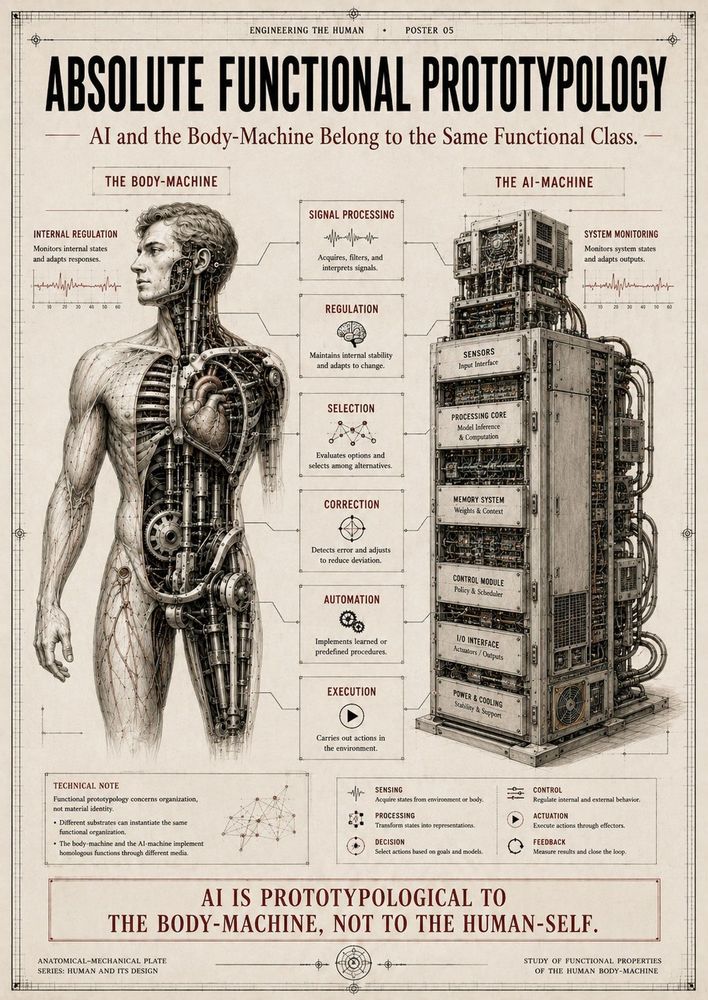
The central theoretical claim of the article is that artificial intelligence stands in a relation of absolute functional prototypology to the cybernetic machine of the human body.
The term functional prototypology is introduced here to describe correspondence at the level of functional organization rather than material identity. AI and the cybernetic machine of the body may differ radically in physical substrate, biological organization, and construction while nevertheless belonging to the same functional cybernetic class.
Both can process signals, regulate operations, select among alternatives, correct performance, automate procedures, store operational results, and execute assigned tasks.
However, functional prototypology to the body-machine is not prototypology to the Human-Self.
The central thesis is therefore:
A machine may remove an enormous amount of operational load from the Human-Self, but a load-relieving machine does not thereby become the Human-Self.
The development of artificial intelligence should consequently be understood as the development of an increasingly advanced artificial cybernetic machine, not as the construction of the Human-Self.
The Fundamental Error in the Question “When Will AI Replace the Human Being?”
The question “When will artificial intelligence replace the human being?” appears reasonable only if the human being and artificial intelligence are assumed to be objects of the same class.
If the human being is defined as a collection of functions, the conventional argument seems convincing. Machines first learned to calculate. They then acquired increasingly powerful forms of information storage. They learned to recognize images. They began generating texts, analyzing documents, constructing models, controlling technical systems, and performing operations that had previously required human labor.
The number of machine-performed functions continues to increase. The quality of performance continues to improve. This creates the impression that, at some threshold, an increase in the number and complexity of functions must produce a qualitative transformation and the machine must become equivalent to the human being.
That conclusion, however, depends entirely on one preliminary assumption:
the Human-Self is nothing more than the sum of technically reproducible functions.
The present theory rejects that assumption.
The Human-Self is not identical to the sum of the functions performed by the cybernetic machine of its own body.
Therefore, even the technical reproduction of an enormous number of human-associated operations does not constitute the reproduction of the Human-Self.
The problem is not primarily one of computational power. It concerns the class of object being constructed. A more powerful cybernetic machine remains a more powerful cybernetic machine.
Three Distinct Objects of Analysis
The proposed model distinguishes three objects:
the Human-Self;
the cybernetic machine of the human body;
artificial intelligence.
These objects interact, but they must not be conceptually collapsed into one another.
Within this theory, the Human-Self is associated with such phenomena as setting one’s own goals, changing those goals, assigning meaning, constructing an intention or design, making decisions, claiming authorship, and assuming responsibility.
The cybernetic machine of the body performs another vast class of operations. It regulates physiological states, coordinates movement, receives and processes signals, maintains balance, supports learned automatisms, and executes complex actions.
Artificial intelligence is an artificial cybernetic system capable of performing an expanding range of informational, analytical, regulatory, selective, and executive operations.
The fact that the same verb can be applied to more than one of these objects does not mean that the underlying processes are identical. A machine may “select,” a body may “anticipate,” and a person may “decide.” These words must not conceal the differences between the systems in which the processes occur.
The Cybernetic Machine of the Human Body
The term cybernetic machine of the body is used here as a functional research concept. It does not imply that the living human organism is merely an ordinary mechanical device. A biological organism is vastly more complex than an automobile, an industrial machine, or a digital computer.
Nevertheless, many processes within the body can be described cybernetically. The body receives signals, regulates internal states, maintains balance, coordinates movement, corrects performance, develops and uses automatisms, and preserves operational stability. It performs an enormous number of actions without requiring the Human-Self to supervise every microscopic component of execution.
For this reason, the human body can be analyzed functionally as an extraordinarily complex biological cybernetic machine. But the cybernetic machine of the body is not the Human-Self.
The Human-Self Is Not a Component Inside the Body-Machine
An important limitation must be introduced at this point. Engineering analogy must not be interpreted literally. The Human-Self is not being described as a small operator sitting somewhere inside the body. It is not a gear, a processor, a hidden electronic control unit, or simply one additional component of the biological machine.
Engineering analogies are used here only to distinguish functional roles. They help separate the system that executes operations from the system that is relieved of those operations, distinguish technical execution from authorship, and distinguish automatic control from the Human-Self.
The analogy with an automobile, a gearbox, a control system, or any other mechanism is therefore an analytical instrument, not a literal anatomical theory.
The Automobile as an Engineering Model of Functional Unloading
A modern automobile provides a clear engineering example of functional unloading. Early automobiles demanded far more direct operational involvement from the driver than modern vehicles, while modern vehicles contain numerous systems that remove part of this operational load.
An automatic transmission selects the appropriate gear ratio. ABS regulates braking behavior. Electronic control units manage the operation of the engine and other assemblies. Stability-control systems correct vehicle behavior, cruise control maintains speed, navigation systems calculate routes, and advanced driver-assistance systems monitor distance, lane position, surrounding traffic, and other operational parameters.
Each new technical system removes some work from the driver. This is precisely what is meant here by functional unloading: the driver does less because the machine does more.
But the fundamental engineering distinction remains:
The automobile does not become the driver merely because it has taken over more of the driver’s operations.
The increase in machine autonomy is an increase in machine capability.
It is not the construction of a second human driver inside the vehicle.
How the Body-Machine Functionally Unloads the Human-Self
The cybernetic machine of the human body performs a similar unloading function. A person can walk without consciously calculating the contribution of every muscle, does not manually control every postural correction, does not decide on each heartbeat, and does not consciously calculate every movement of the eyes.
A familiar motor skill does not have to be reconstructed from the beginning every time it is performed. As a skill develops, more of its execution becomes automated. An experienced pianist can perform highly complex finger movements without consciously supervising each individual muscular adjustment. An experienced driver does not consciously construct every small movement of the hands and feet, and an athlete can execute complex technical elements without consciously managing every component of coordination.
The cybernetic machine of the body therefore removes part of the operational burden from the Human-Self.
In the terminology proposed here:
The cybernetic machine of the body provides functional unloading of the Human-Self.
But the system that provides this unloading does not thereby become the Human-Self.
The Meat Grinder and the Difference Between Execution and Authorship
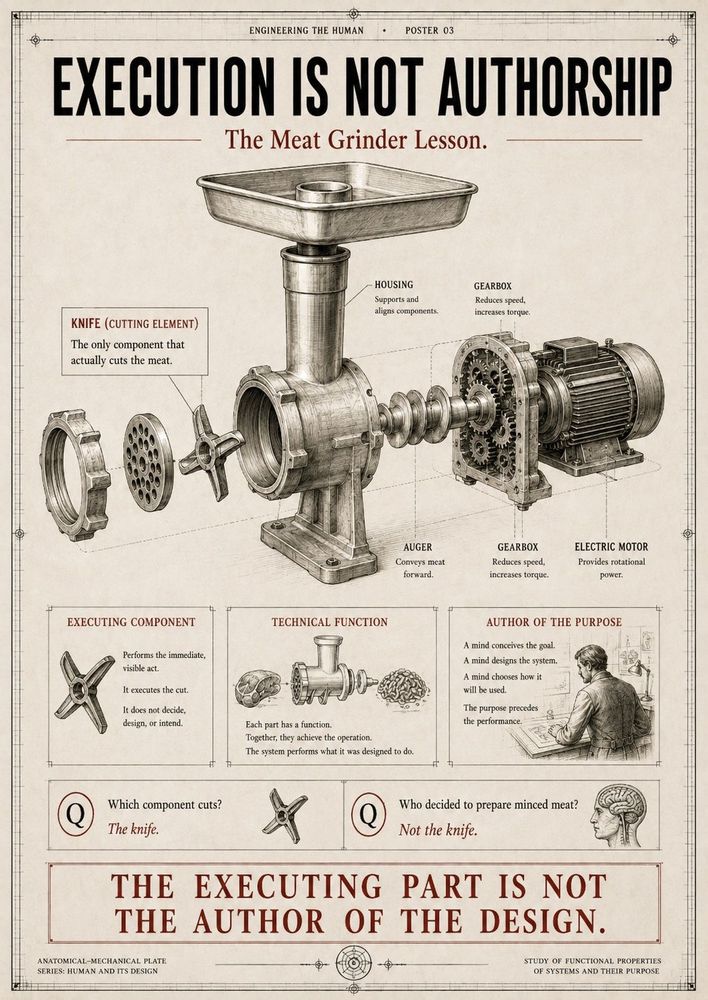
The difference between execution and authorship can be demonstrated by an extremely simple engineering device. Consider an electric meat grinder. The machine contains a motor, a gearbox, an auger, a knife, a perforated plate, and a housing.
The motor generates mechanical power. The gearbox modifies and transmits that power. The auger moves the material, the knife performs the cutting operation, and the perforated plate participates in forming the output.
If an engineer is asked, Which component performs the cutting? the answer is straightforward: the knife.
But if the engineer is asked, Who decided to prepare minced meat? the knife is no longer an acceptable answer. The knife performs an operation. It is not the author of the purpose for which the operation is performed.
Therefore:
An executing component is not the author of the design.
This distinction is essential for understanding artificial intelligence.
A system may directly perform an operation without thereby becoming the author of the broader activity.
Absolute Functional Prototypology
The central technical concept of the article can now be stated precisely.
Artificial intelligence stands in a relation of absolute functional prototypology to the cybernetic machine of the human body.
The expression absolute functional prototypology does not mean material identity. It does not mean that silicon is equivalent to biological tissue, that a server is a nervous system, or that machine memory is biologically identical to human memory.
The term refers specifically to functional organization. A system belongs to a cybernetic functional class when it can perform operations such as signal processing, regulation, selection, correction, adaptation of operational behavior, storage of operational results, automation, and execution.
The cybernetic machine of the body performs such functions biologically, while artificial intelligence performs such functions artificially. The physical construction may differ radically, but the functional class remains comparable.
That is the basis of absolute functional prototypology.
But the crucial limitation is:
Absolute functional prototypology to the body-machine is not prototypology to the Human-Self.
Different Materials Can Realize the Same Functional Class
Engineering routinely demonstrates that material difference does not eliminate functional correspondence. A hydraulic actuator and an electric servo can perform comparable functional tasks. A mechanical governor and an electronic controller can both regulate a system, while a mechanical transmission and an electronically controlled drivetrain can both modify the conditions under which power is delivered.
Their physical principles may be entirely different, yet at the level of functional organization they can belong to the same technical class. The same distinction is important in the present theory.
The human body is biological, while artificial intelligence is technical. Their material substrates, internal construction, and physical means of operation differ. But these differences do not invalidate functional prototypology.
The theory concerns the function of the machine, not the chemical composition of the components.
AI as an External Functional-Unloading Machine
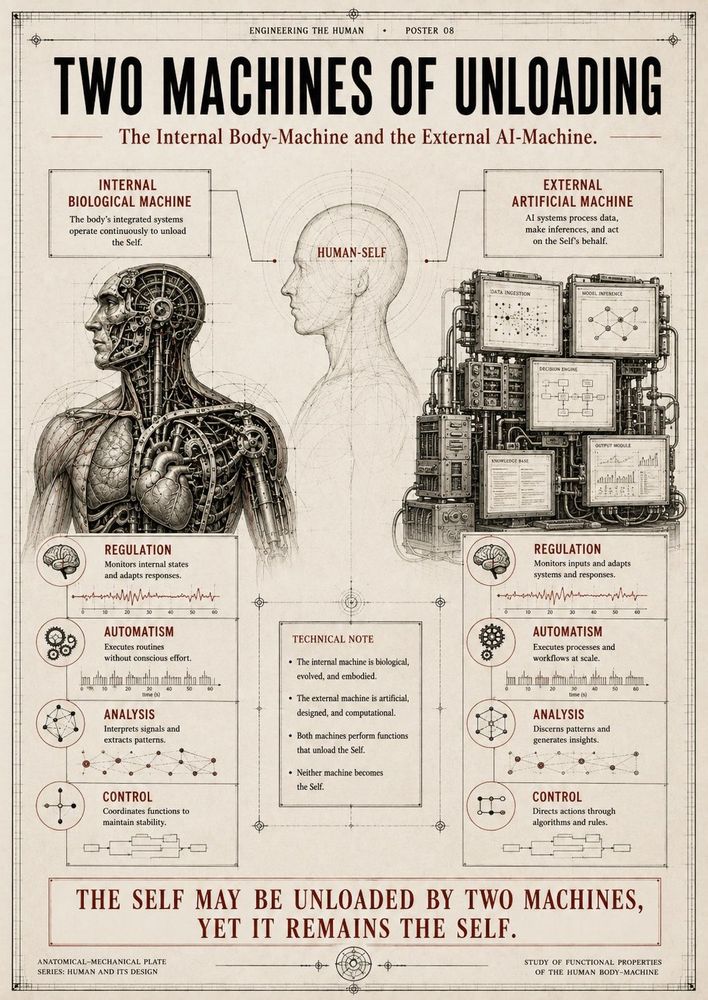
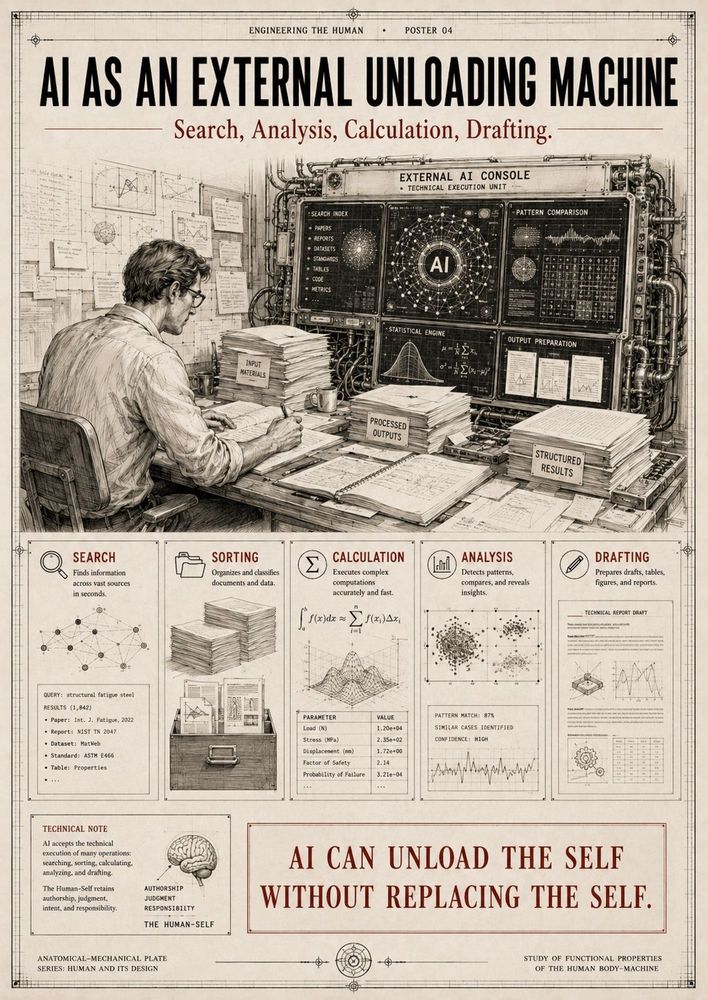
The Human-Self is already supported by one vast cybernetic system: the human body. Artificial intelligence introduces another. The first is the biological cybernetic machine of the body; the second is an artificial cybernetic machine located outside the biological body.
The body-machine unloads the Human-Self from a vast amount of sensory, regulatory, coordinative, and executive work. Artificial intelligence can unload the Human-Self from a growing amount of informational, computational, analytical, search-related, organizational, monitoring, and technical work. Artificial intelligence therefore becomes an external functional-unloading machine.
Two different cybernetic machines can thus be distinguished: the first is biological and internal to human existence, while the second is artificial and external. Both can remove operational load from the Human-Self. Neither is the Human-Self.
Functional Unloading Is Not Transfer of the Human-Self
The distinction must remain terminologically precise. It would be incorrect to say that artificial intelligence literally “receives the Human-Self’s functions” if such wording suggests that the Self is being dismantled into transferable components. What is actually transferred is operational work.
A researcher may delegate the sorting of thousands of documents to an AI system. The researcher has not transferred the Human-Self; the sorting operation has been transferred. A scientist may use a computer to calculate a statistical model. The scientist has not transferred authorship of the scientific problem to the computer; the calculation has been transferred.
A pilot may allow an autopilot to perform a large amount of routine flight control. The autopilot has not become the pilot as a Human-Self. Operational execution has been delegated.
Therefore:
The transfer of an operation to a machine is not the transfer of the Human-Self.
Functional unloading concerns workload.
It does not imply replacement of the Human-Self.
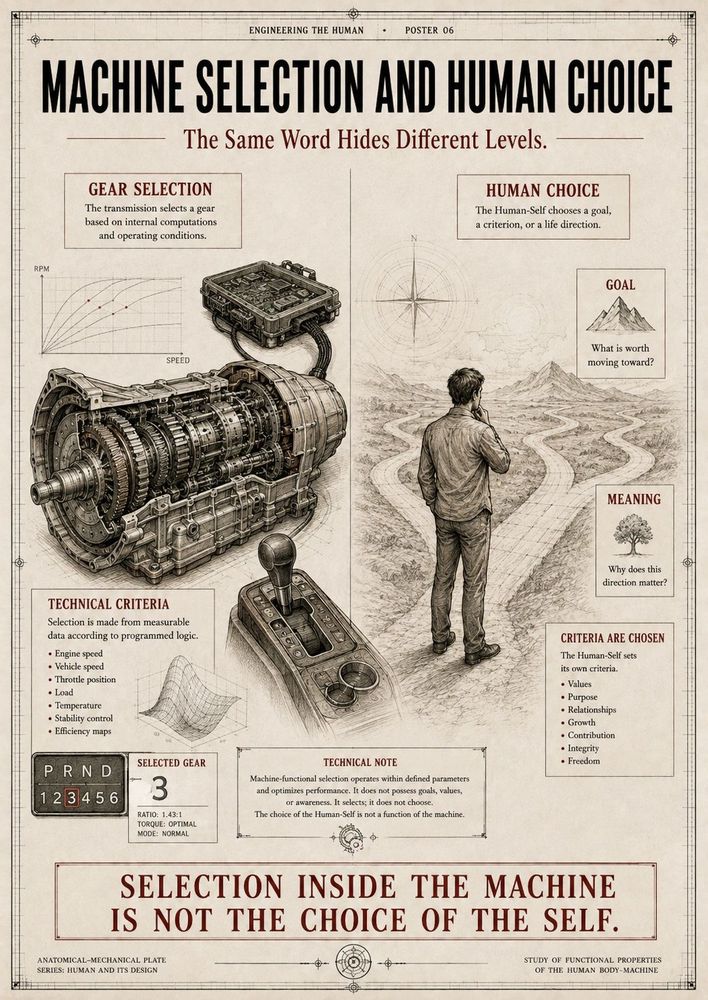
Machine Selection Is Not the Choice of the Human-Self
The word choice provides an important example of how identical language can conceal different functional levels. An automatic transmission genuinely selects a gear. That is technically accurate language: the system evaluates operating conditions and selects an appropriate mechanical regime.
This is machine-functional selection.
Artificial intelligence can perform enormously more complex forms of machine-functional selection. It can compare thousands or millions of alternatives, estimate probabilities, optimize against multiple criteria, and modify intermediate procedures.
But the choice of the Human-Self belongs to another level. The Human-Self can question the goal itself. A person can abandon a previously accepted objective, change the criterion, reject the technically optimal option, refuse an action on moral or personal grounds, reconsider the meaning of the entire undertaking, and ask whether the result is worth achieving at all.
Therefore:
Machine-functional selection is not identical to the choice of the Human-Self.
The sophistication of machine selection does not convert it into the Human-Self.
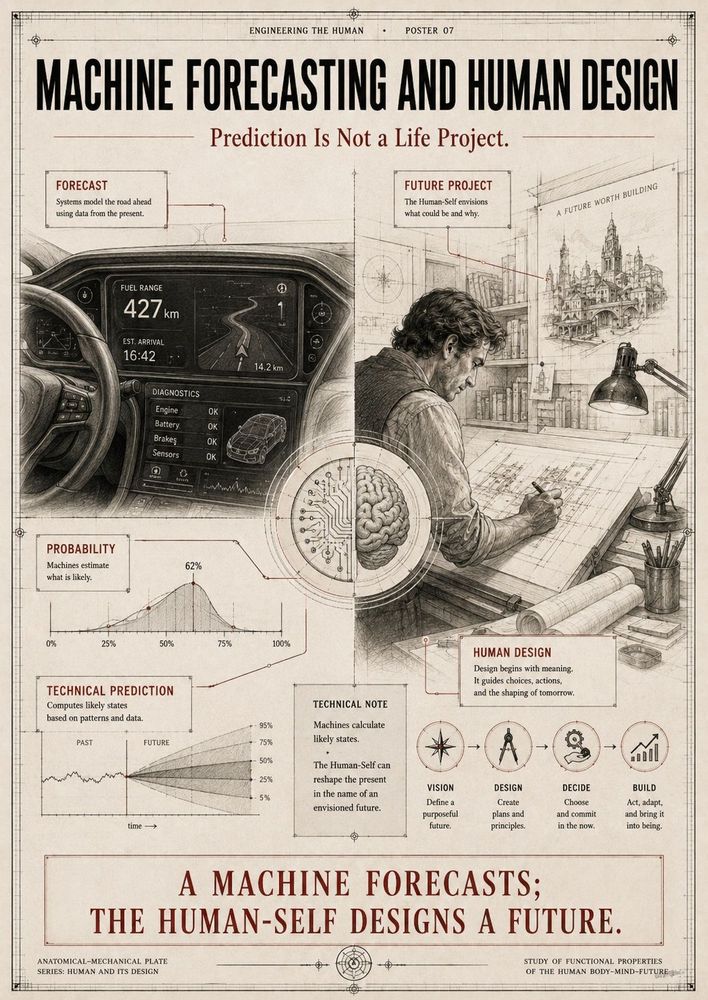
Machine Forecasting Is Not Human Design of the Future
The same distinction applies to prediction. The cybernetic machine of the body can, to some extent, perform anticipatory regulation: the organism can prepare certain processes before an expected movement or load.
Artificial intelligence can perform technical forecasting. An onboard computer can calculate remaining driving range, a diagnostic system can estimate the probability of component failure, a meteorological model can calculate probable weather conditions, and an AI system can model multiple possible developments in a complex situation. These are genuine machine forecasts.
But the Human-Self can do something categorically different within the proposed model. It can construct a future as part of a life design. A person can decide:
Ten years from now I want a different result, therefore I will change the way I live and act today.
The future has not yet occurred, yet it becomes a reason for changing present conduct. This is not simply probabilistic calculation. It is the use of an envisioned future within a human design.
Machine forecasting and human design must therefore be distinguished.
Improving AI Is Improving a Machine
The strategic proposition of the theory can now be formulated without ambiguity. The improvement of artificial intelligence solves the problem of improving an artificial cybernetic machine.
Its memory can become larger, its processing faster, and its models more sophisticated. Its ability to recognize patterns and select technical alternatives can improve. Its autonomy can increase, as can its ability to operate physical machines and perform larger and larger volumes of human-associated work.
But these improvements remain improvements of the machine. They are not the construction of the Human-Self.
To replace the Human-Self, an entirely different engineering task would have to be formulated. Within the theory proposed here, such a task is considered technically unrealizable.
Therefore:
No improvement of an artificial cybernetic machine is, by itself, a movement toward constructing the Human-Self.
Greater Machine Capability Means Greater Functional Unloading
The history of technology demonstrates a persistent engineering principle: the more capable the machine becomes, the more operational load it can remove from the human being.
A lifting mechanism removes physical lifting work, an excavator removes enormous quantities of manual digging, and an industrial machine tool removes repetitive manual machining. An automated production system removes numerous routine operations, while an automatic transmission removes part of the operational work of driving and an autopilot removes part of the operational work of flying.
Artificial intelligence extends this historical process into informational and intellectual-technical work. It can remove search work, sorting, calculation, preliminary analysis, monitoring, draft preparation, pattern detection, routine comparison, and technical forecasting.
The growth of AI capability should therefore be understood as the growth of its capacity for functional unloading.
But:
Greater functional unloading does not mean greater identity with the Human-Self.
The Released Resource of the Human-Self
Functional unloading produces a second-order problem that may prove more important than the problem of automation itself: what happens to the human resource that has been released?
When a technical system assumes routine operational work, the Human-Self can potentially redirect attention and effort elsewhere. The calculator removed large amounts of arithmetic routine, the computer removed vast quantities of manual calculation, photography removed the requirement to reproduce visual appearances manually simply in order to preserve them, and digital information systems transformed storage and retrieval.
Artificial intelligence can produce a much larger unloading effect. It can reduce the amount of routine work required in research, administration, analysis, production, planning, and many other fields.
The central question of the future may therefore not be whether AI diminishes the Human-Self.
It may be:
What can the Human-Self do with the resource released by increasingly advanced cybernetic machines?
The Industrial Workshop as an Engineering Analogy
Consider an industrial workshop. At first, a worker carries a component manually. A conveyor is introduced, and the worker no longer needs to carry it. A robotic manipulator is introduced, and the worker no longer needs to position the heavy component manually.
An automatic measurement system is installed, reducing part of the inspection work. Computer diagnostics are introduced, removing part of the analytical burden. Artificial intelligence is then introduced, allowing part of the planning, monitoring, error detection, failure prediction, and information processing to be delegated.
The number of operations directly performed by the worker decreases. But no engineer describes this process by saying:
the workshop is becoming human.
The correct engineering description is:
the level of automation of the workshop is increasing.
Artificial intelligence should be analyzed in the same manner.
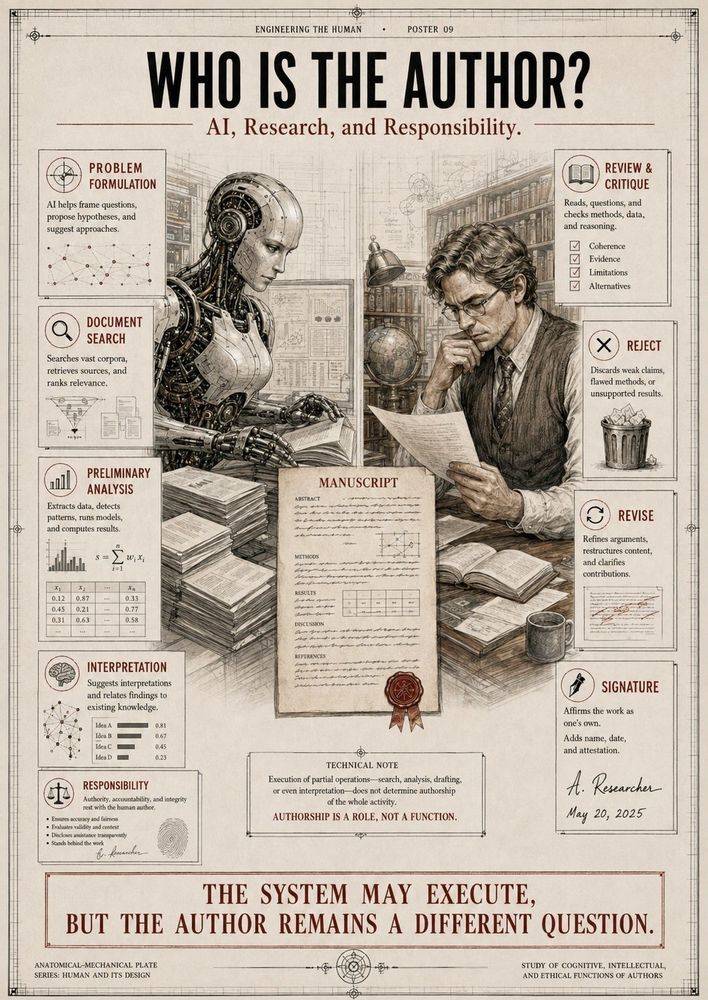
Execution and Authorship in AI-Assisted Activity
As machines assume more operational work, the distinction between execution and authorship becomes increasingly important.
Consider scientific research. AI may find relevant documents, sort them, summarize material, perform preliminary comparison, calculate a statistical model, and prepare a draft.
But who formulated the scientific problem? Who determined the object of research? Who selected the theoretical framework? Who accepted or rejected the interpretation? Who decided what the results mean? Who signs the article, and who bears responsibility for it?
The component performing a particular operation is not necessarily the author of the larger activity. The knife is not the author of the minced meat. The transmission is not the author of the journey. The calculator is not the author of the theorem. The statistical software is not the author of the research question.
Therefore:
Execution is not authorship.
This distinction will become increasingly important in science, law, criminology, autonomous systems, medicine, military affairs, and professional responsibility.
First-Person Language Does Not Create the Human-Self
Artificial intelligence produces a uniquely powerful anthropomorphic effect because it operates through human language. A meat grinder does not say, “I selected the optimal operating mode.” An automatic transmission does not say, “I decided to shift into third gear.” AI can.
It can use the word I, explain a machine operation in first-person language, describe uncertainty, generate self-referential text, and produce a convincing narrative of decision.
But the interface through which a machine reports its operation does not determine the class of the underlying system. Suppose an automobile begins saying, “I decided to reduce speed because I detected an obstacle.” The introduction of natural language does not create a Human-Self inside the automobile. It changes the communication interface of the control system.
Therefore:
First-person linguistic form is not the Human-Self.
Anthropomorphic language must not be confused with ontological identity.
Artificial Intelligence Is Not an Unfinished Human Being
The proposed model changes the perspective from which AI should be understood. Artificial intelligence is not an unfinished human being, nor is it a primitive Human-Self waiting to become complete. It is an extremely sophisticated artificial cybernetic machine.
Its significance lies precisely in its machine capability. It can perform operations with speed, scale, persistence, and complexity unavailable to previous technologies, and it can unload the Human-Self from an unprecedented amount of work.
Artificial intelligence should therefore be studied not primarily as a competitor to the Human-Self, but as a new level of technical functional unloading and amplification. The machine becomes more valuable as a machine. It does not have to become a human being.
Five Foundational Propositions
The model can now be condensed into five foundational propositions.
Proposition One
The Human-Self and the cybernetic machine of the human body are not the same object.
Proposition Two
The cybernetic machine of the body provides functional unloading of the Human-Self by automatically performing an enormous volume of regulatory, coordinative, sensory, and executive operations.
Proposition Three
Artificial intelligence stands in a relation of absolute functional prototypology to the cybernetic machine of the human body.
Proposition Four
Artificial intelligence can provide additional functional unloading of the Human-Self by taking over an increasing volume of operations for technical execution.
Proposition Five
No amount of functional unloading transforms the load-relieving machine into the Human-Self.
The Principal Engineering Test
The entire model can be tested using the automobile analogy. Imagine a vehicle in which almost every operational function has been automated.
It shifts gears by itself, monitors the road, maintains distance, keeps the lane, calculates the route, parks itself, diagnoses technical problems, and can alter its route.
It may eventually perform nearly the entire technical operation of a journey. The driver has been relieved of almost all immediate operational work.
The correct engineering description is:
The vehicle has maximally unloaded the driver from the technical operation of driving.
The incorrect description is:
The vehicle has become the driver as a Human-Self.
The first statement describes automation.
The second confuses automation with ontological replacement.
This distinction is the principal engineering test of the theory.
Why a Neural Network Will Never Replace the Human Being
The title of the article can now be stated without ambiguity. A neural network will never replace the human being not because neural networks must remain technically weak. They may become extraordinarily powerful.
They may outperform human beings in calculation, memory capacity, search, pattern recognition, technical forecasting, monitoring, controlling complex systems, processing enormous volumes of information, and performing routine intellectual-technical work without fatigue.
They may unload the Human-Self more profoundly than any previous machine. But every one of these achievements concerns the development of machine capability.
Improving a functional-unloading machine is not the construction of the Human-Self.
The number of operations transferred to AI is therefore not a measure of the transformation of AI into the Human-Self.
It is a measure of the operational capacity of the machine.
A New Formulation of the AI Problem
The conventional question should therefore be replaced by a more productive set of engineering and scientific questions.
What volume of operational work can be transferred to an artificial cybernetic machine? Which operations should be automated? Which forms of bodily automation should remain functions of the biological cybernetic machine? Which decisions belong to the Human-Self? Where is the boundary between machine execution and human authorship?
Who bears responsibility for the result? How much operational load can be removed without losing effective human control? What should the Human-Self do with the resource released through artificial intelligence?
These questions concern the architecture of future human activity. They are more precise than the general idea that “AI will replace the human being.”
Conclusion
Contemporary discourse on artificial intelligence is largely built upon an incorrect comparison. AI is compared directly with the human being. The theory proposed in this article distinguishes three different objects of analysis:
the Human-Self;
the cybernetic machine of the human body;
artificial intelligence.
The cybernetic machine of the body is not the Human-Self. It functionally unloads the Human-Self by automatically performing an enormous range of sensory, regulatory, coordinative, and executive operations.
Artificial intelligence stands in a relation of absolute functional prototypology to the cybernetic machine of the body. It is an artificial cybernetic machine capable of extending functional unloading into informational, computational, analytical, organizational, monitoring, and technical domains.
There is therefore functional prototypology between artificial intelligence and the cybernetic machine of the body. There is no such prototypology between artificial intelligence and the Human-Self.
Three central principles follow:
Functional unloading is not replacement.
Execution is not authorship.
Improving a machine is not constructing the Human-Self.
The principal engineering formula of the theory can therefore be stated as follows:
A machine may remove almost the entire operational load from the Human-Self, but a load-relieving machine does not thereby become the Human-Self.
The future of artificial intelligence should not be understood as the history of the gradual disappearance of the human being. It should be understood as the history of increasingly advanced artificial cybernetic machines capable of relieving human beings of ever larger volumes of operational work.
Such machines can search, calculate, analyze, forecast, sort, monitor, control, execute, and automate. They can radically increase the scale and efficiency of human activity.
But precisely because artificial intelligence is becoming an increasingly advanced machine, we must reject the mistaken assumption that improving the machine is, by itself, a path toward constructing the Human-Self.
A NEURAL NETWORK WILL NEVER REPLACE THE HUMAN BEING.
It can do something else.
It can unload the human being in a way no previous machine has ever been able to do.
LATEST NEWS
THE NIGHT THAT LEFT NO WITNESS
Reflections on the Fate of Science, or Should We Expect Digital Monasteries of the New Middle Ages?
The Student’s Side of the Problem: How Social Media and Mobile Phones Affect Intellectual Development
The 2025 PISA results, part I. Lies, damn lies, and English education statistics.
Social Media, Mobile Phones, and the Intellectual Development of Students: What Challenge Does Academia Face?